A HERE CITY site

USDA Shrinks the 2026 Sorghum Crop to 273.7 Million Bushels, Down 37%, as Kansas Yields Fall to 59 Bushels
USDA cut the 2026 sorghum crop 6% more to 273.7 million bushels as Kansas yields fell to 59 bu. Exports were cut too, and the PLC math is shifting.
Key takeaways
- USDA now pegs the 2026 U.S. grain sorghum crop at 273.7 million bushels, down 37% from 2025 and 6% below its October estimate.
- The national yield forecast fell to 52.4 bushels an acre, versus 72.6 last year; Kansas dropped to 59 bushels from 90.
- USDA cut projected sorghum exports by 35 million bushels to 125 million, so ending stocks actually rose to 34 million.
- The projected season-average price of $4.45 sits below sorghum’s $4.67 reference price, which matters for the Dec. 11 ARC/PLC decision.
The Plains sorghum crop kept shrinking into November. USDA’s National Agricultural Statistics Service (NASS) on Tuesday forecast 2026 grain sorghum production at 273.7 million bushels, a 6% drop from a month earlier and 37% less than the 436.8 million bushels harvested in 2025.
Two things drove the decline, according to NASS and Brownfield Ag News: fewer acres and much lower yields. Growers are expected to harvest 5.225 million acres, down from 6.02 million last year, and the national yield estimate slid another 3.3 bushels from October to 52.4 bushels per acre. Brownfield attributed the acreage drop to weak demand going into spring and the yield losses to drought across key growing states.
Why it matters for your bottom line
A smaller crop usually means firmer prices, but this year’s balance sheet is more complicated. In its November World Agricultural Supply and Demand Estimates (WASDE), USDA reduced projected 2026-27 sorghum exports to 125 million bushels from 160 million in October. That is well under the 206 million bushels shipped in 2025-26. USDA added 10 million bushels to feed and residual use, but because exports fell more than production, ending stocks rose to 34 million bushels from 26 million in the October report.
USDA lowered its season-average farm price forecast by a nickel to $4.45 a bushel. That is still well above the $3.67 average for 2025-26, but growers with poor yields will have fewer bushels to sell at that price.
State by state: Kansas takes the biggest hit
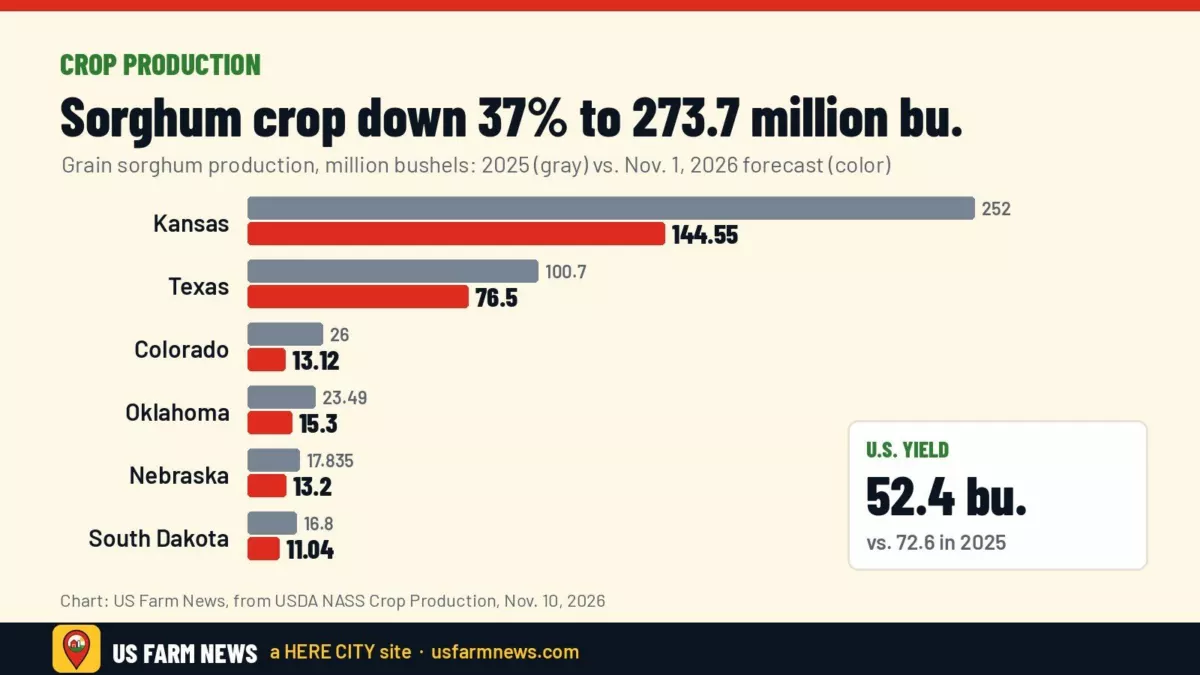
Kansas, the largest sorghum state, accounts for most of the national decline. NASS cut its Kansas yield forecast to 59 bushels from 65 in October; Kansas growers averaged 90 last year. With harvested area also down to 2.45 million acres from 2.8 million, the state’s crop is now estimated at 144.55 million bushels, compared with 252 million in 2025. Arable Wire calculated that as a 42.6% decline.
- Texas: 76.5 million bushels, down from 100.7 million; yield cut to 45 bushels from 47 in October.
- Oklahoma: 15.3 million bushels, down from 23.49 million; the yield estimate actually improved to 45 bushels from 39 a month ago.
- Colorado: 13.12 million bushels, about half of last year’s 26 million, on a 32-bushel yield.
- Nebraska: 13.2 million bushels, down from 17.835 million; yield 80 bushels, down from 85 in October.
- South Dakota: 11.04 million bushels, down from 16.8 million; yield 69 bushels versus 72 in October.
Harvest is also running late. NASS said 64% of U.S. sorghum acres were harvested by Nov. 1, which is 14 percentage points behind the five-year average, and 96% of the crop had reached maturity.
The farm program angle: PLC and the Dec. 11 deadline
For farms with sorghum base acres, the price forecast is relevant to the 2026 program election. The Kiowa County, Colo., USDA Service Center lists the 2026 reference price for grain sorghum at $4.67 a bushel. Price Loss Coverage pays when the national marketing-year average price falls below the reference price. The payment is the price gap times the farm’s PLC payment yield times 85% of base acres, the office explained in its Nov. 11 update.
If USDA’s $4.45 forecast holds, the gap would be about 22 cents a bushel. That is a projection, though, and the final price will not be known until after the marketing year ends. The 2026 ARC/PLC election and enrollment deadline is Dec. 11, 2026. Our ARC-CO vs. PLC explainer walks through how to compare the options.
Context: drought and demand
The sorghum cuts were part of a broader USDA report that also trimmed the corn crop. Our November WASDE breakdown has the corn and soybean details. Abroad, the WASDE said larger sorghum shipments from Brazil helped lift world coarse grain trade. That leaves U.S. sellers facing more competition at the same time USDA is lowering its export outlook.
What to watch
- Dec. 10: USDA’s next WASDE and Crop Production reports, with updated yields as the late harvest finishes.
- Dec. 11: deadline to elect and enroll in ARC or PLC for 2026.
- January: NASS’s annual crop production summary, which replaces these condition-based forecasts with end-of-season estimates.
- Export sales: weekly sorghum sales will show whether USDA’s lower 125-million-bushel export forecast holds.
Frequently asked questions
How big is the 2026 U.S. sorghum crop?
USDA’s November forecast is 273.7 million bushels on 5.225 million harvested acres and a 52.4-bushel yield, down 37% from 2025.
Why did sorghum ending stocks rise if the crop got smaller?
USDA cut projected exports by 35 million bushels to 125 million, more than the production cut, so 2026-27 ending stocks rose to 34 million bushels.
Could sorghum PLC pay for 2026?
It could if the final season-average price stays below the $4.67 reference price. USDA projects $4.45, but the final figure is not known until the marketing year ends.
Get the Daily Ag Business Briefing
Markets, policy and farm business in one free email each weekday.