A HERE CITY site

Drought-Hit Ranchers: How to Claim 2026 Livestock Forage Disaster Payments Under the New 4-Week Trigger Before March 1
LFP now pays after 4 weeks of D2 drought instead of 8. Who qualifies for 2026 grazing losses, how many payment months, the forms and the March 1 deadline.
Key takeaways
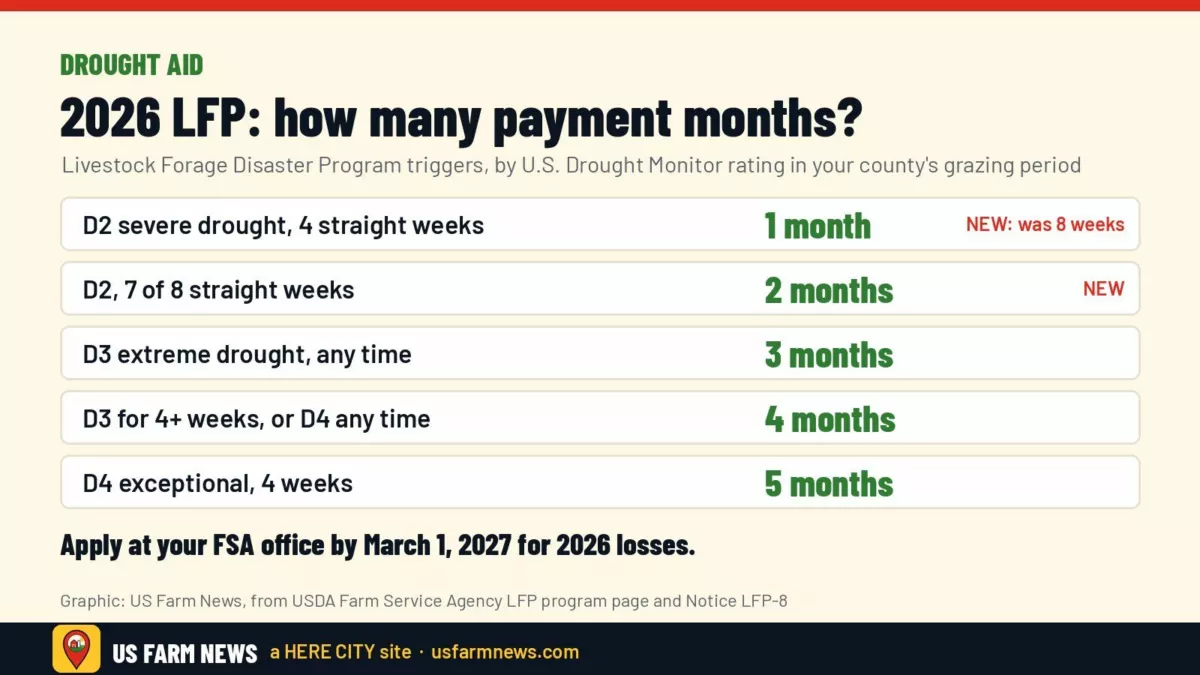
- For 2026 grazing losses, USDA’s Livestock Forage Disaster Program (LFP) now pays one month after four straight weeks of D2 severe drought, half the old eight-week trigger.
- Seven of eight weeks at D2 earns two months; D3 and D4 drought can earn three to five monthly payments.
- The deadline to apply for 2026 losses is March 1, 2027, at your local FSA office.
- If you already applied under the old rules, FSA says your qualifying date and payment factor update automatically, and you can revise your application if the earlier date helps you.
This year’s drought on the Plains and in the Missouri River basin means more ranchers will be counting on LFP payments this winter. A 2026 rule change also makes counties qualify sooner than they used to. If you run cattle, sheep, goats or other grazing livestock on drought-hit pasture, here is how the program works for 2026 losses and what to bring to the Farm Service Agency (FSA).
What changed for 2026
The Working Families Tax Cuts Act, the 2025 law also known as the One Big Beautiful Bill Act, lowered LFP’s severe-drought threshold. A county now qualifies for a one-month payment after D2 drought on the U.S. Drought Monitor lasts four consecutive weeks during the normal grazing period. The old requirement was eight weeks. FSA said in its Notice LFP-8 that the final rule was published July 9, 2026, and covers the whole 2026 program year.
FSA’s payment schedule now works like this:
- D2 for 4 consecutive weeks: 1 monthly payment
- D2 for 7 of 8 consecutive weeks: 2 monthly payments
- D3 at any time: 3 monthly payments
- D3 for at least 4 weeks, or D4 at any time: 4 monthly payments
- D4 for 4 weeks (they need not be consecutive): 5 monthly payments
Payments depend on drought severity and how many livestock units you graze. The drought rating is for the county where your pasture is physically located, for that pasture type, during its normal grazing period. Severe counties can reach the maximum: the Kiowa County, Colo., USDA Service Center said in its Nov. 11 update that the county is eligible for a five-month payment.
Already applied? Check your qualifying date
Because the shorter trigger arrived partway through the year, many counties now have an earlier “date of qualifying drought.” According to FSA’s notice, applications approved before July 9 stay approved, and dates and payment factors are updated automatically in FSA’s software. Producers who had only qualified for one month under the old D2 rule get an extra month of payment automatically.
The earlier date can also help you. Livestock and pasture eligibility are measured on the qualifying date, so if you had more animals or controlled more grazing acres on the new, earlier date, FSA says you may revise your application before the March 1, 2027 deadline. In FSA’s example, a Mississippi rancher who had 50 more stockers on the earlier date qualified for an additional payment. If your application was signed but not yet approved, FSA says you will be notified and must review it and sign a revised form within 60 days of that notice.
Who is eligible
- Land: grazing land you own or cash-lease in a qualifying county. Fire losses are covered only on federally managed rangeland where you hold a grazing permit.
- Livestock: FSA lists beef and dairy cattle, bison and buffalo, water buffalo, horses, sheep, goats, alpacas, llamas, deer, elk, reindeer, ostriches and emus, as long as they are raised commercially within a farming operation.
- Proof: you need documentation of the grazing loss and must meet FSA’s payment eligibility rules, including the adjusted gross income (AGI) certification.
Your application checklist
FSA lists these forms for an LFP application:
- CCC-853, the LFP application
- FSA-578, report of acreage
- AD-2047, customer data worksheet
- CCC-902 farm operating plan (individual or entity version) and CCC-901 for entity members, if they apply
- CCC-941, the AGI certification
- AD-1026, conservation compliance certification
- SF-3881, direct deposit enrollment
Also bring copies of your pasture leases or grazing permits, deeds or other ownership proof, and herd records showing what you had on the qualifying drought date. It is easier to gather sale barn receipts, vet records and lease copies now than in late February.
Other drought help to check
- ELAP: the Rural Advancement Foundation International (RAFI) notes that USDA’s ELAP emergency livestock assistance program can cover drought costs LFP does not, such as hauling water or livestock beyond normal. Its 2026 deadline is also March 1, 2027.
- NAP for 2027 forage: the Kiowa County office says Dec. 1, 2026 is the last day to buy Noninsured Crop Disaster Assistance Program coverage on alfalfa and native grass, at $325 per crop per producer.
- Your county’s status: the Drought Monitor’s FSA LFP eligibility tool shows which counties have triggered and how many payment months they qualify for.
For the bigger drought picture, see our report on the early end to Missouri River barge season and our Drought Monitor coverage.
This article is general information, not legal, tax or financial advice. Program details and eligibility are decided by your county FSA committee, so confirm with your local FSA office.
Frequently asked questions
What is the LFP deadline for 2026 drought losses?
Applications for 2026 grazing losses must be filed with your local FSA office by March 1, 2027.
How many weeks of drought trigger an LFP payment in 2026?
Four consecutive weeks of D2 severe drought during the normal grazing period triggers one monthly payment, down from eight weeks under the old rules.
I applied before July. Do I need to do anything?
Approved applications stay approved and are updated automatically, but you may revise yours before March 1, 2027 if the earlier qualifying date would help. Applications that were signed but not yet approved must be reviewed and re-signed within 60 days after FSA notifies you.
Get the Daily Ag Business Briefing
Markets, policy and farm business in one free email each weekday.