A HERE CITY site

2027 Crop Insurance: SCO Now Starts at 90%, ECO Shrinks and Endorsements Can Stack. What to Ask Your Agent
For 2027, SCO covers county losses from 90%, ECO narrows to 95-90%, and USDA will allow multiple endorsements, with details due Nov. 30. A farmer's guide.
Key takeaways
- For the 2027 crop year, the Supplemental Coverage Option (SCO) covers county-level losses from 90% of expected revenue down to your policy’s coverage level, up from 86%.
- The Enhanced Coverage Option (ECO) narrows to a 95%-to-90% band, so its premium and maximum payment both shrink; both carry an 80% premium subsidy.
- SCO no longer depends on your ARC or PLC choice, and USDA says it will let farmers buy multiple endorsements on one policy in 2027, with details due to agents by Nov. 30.
- For spring crops, extension economists list March 15 as the ECO decision deadline; talk to your agent this winter.
The add-on crop insurance coverage that sits on top of a farmer’s base policy is changing shape for 2027, and the changes are big enough that many operations should rethink which endorsements they carry. Federal crop insurance managers have widened the Supplemental Coverage Option, shrunk the Enhanced Coverage Option to fit around it, and USDA has promised more freedom to stack products on the same policy.
This explainer pulls together what the Risk Management Agency (RMA) has published, what USDA announced in October, and how extension economists at Kansas State University and the University of Minnesota are framing the choice. It is general information, not insurance, legal or financial advice; your crop insurance agent has the final word on what is available for your crops and county.
What changed, in plain terms
SCO and ECO are endorsements, or add-ons, to an individual revenue or yield policy such as Revenue Protection. They pay based on county results rather than your own farm’s, which is why they are called area-based. They are meant to cover the “shallow” losses that fall inside your base policy’s deductible.
The 2025 tax and spending law, the One Big Beautiful Bill Act, made two changes to SCO that RMA’s June 30 managers bulletin (PM-26-036) writes into the 2027 endorsement:
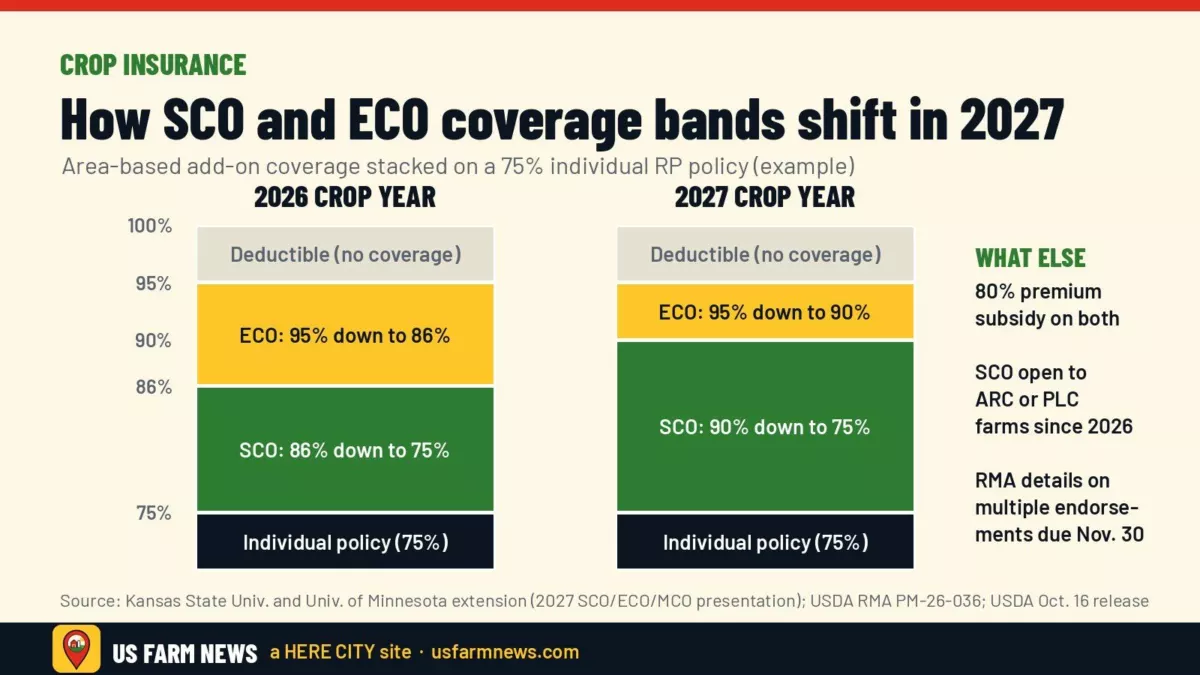
- Higher ceiling: SCO’s top coverage level rises from 86% to 90% of expected county revenue.
- No ARC restriction: SCO can be bought no matter whether the farm is enrolled in Agriculture Risk Coverage (ARC) at the Farm Service Agency. Before the law, ARC farms could not buy it.
Because ECO sits directly above SCO, the Federal Crop Insurance Corporation board also adjusted ECO’s band. Per the Kansas State and Minnesota presentation, ECO covered from 95% (or 90%) down to 86% in 2026; in 2027 it covers only from 95% down to 90%. The premium subsidy is 80% for both products, the same rate as in 2026, up from 65% in 2025 for ECO.
According to RMA, crops whose contract change date fell on June 30, 2026, get the new rules starting in 2027; crops with an earlier contract change date pick them up a year later, in 2028. Insurance companies must notify policyholders at least 30 days before the cancellation date, the bulletin says.
What it means for your premium and your odds of a payment
Kansas State’s Jenny Ifft and Minnesota’s Henrique Monaco summed up the trade-off this way in their presentation:
- ECO in 2027: lower premium and a lower maximum payment, while the trigger stays the same, at a 5% drop in county revenue.
- SCO in 2027: higher premium, but it triggers sooner, at a 10% county revenue loss instead of 14%, and it can pay more.
- Effectively, the 90%-to-86% slice that ECO used to cover now belongs to SCO.
Some farms, for budget reasons, may pick one product rather than both, the economists noted. Their rule of thumb: ECO pays smaller amounts more often, while SCO pays more in genuinely bad years. Farms that already carry an 80% base policy will see less difference between the two choices than farms at 75% or lower, where the SCO band is wider.
Their back-test for dryland winter wheat in Sumner County, Kan., using 2027 rules on a 70% Revenue Protection policy, shows the pattern. In 2023, a year with a big yield drop, SCO would have paid $70 versus $18 for ECO. In milder years such as 2022 and 2025, the example showed ECO payments of $5 and $4 and no SCO payment. Results vary widely by county and year, they cautioned, and payments still arrive around June of the following year.
Stacking endorsements: the October announcement
On Oct. 16, Agriculture Secretary Brooke Rollins announced that farmers will be able to buy more than one endorsement on the same crop insurance policy starting in 2027. USDA framed it as part of its Great American Cotton Plan, but said it applies to other eligible crops as well. RMA plans to send final details to approved insurance providers and agents by Nov. 30, 2026, USDA and the Texas Farm Bureau said.
Texas Farm Bureau’s Brant Wilbourn called expanded insurance options and new cotton demand “positive steps,” while warning that cotton growers still face serious financial strain.
Until RMA publishes those details, it is not yet clear which combinations will be allowed. One existing limit to know: the Margin Coverage Option (MCO), a county-level margin product, can be paired with SCO but not with ECO, according to the extension presentation.
Your 2027 checklist
- Watch for your insurer’s notice. Companies must tell you about endorsement changes at least 30 days before your crop’s cancellation date.
- Ask your agent after Nov. 30 which endorsement combinations RMA will allow on your policy.
- Price SCO and ECO side by side at your base coverage level. The changes shift premium from ECO to SCO, so last year’s quote is not a guide.
- Revisit your base coverage level. With SCO starting at 90%, the gap between a 75% and an 80% base policy affects how much the add-on covers.
- Keep ARC and PLC in the picture. SCO no longer limits your farm program choice; see our ARC vs. PLC breakdown and sign-up checklist.
- Mark March 15 for spring-planted crops, the ECO decision deadline listed in the extension presentation, and confirm the date for your crop with your agent.
For how this year’s harvest prices are shaping 2026 claims, see our harvest price story.
Frequently asked questions
Can I buy SCO if my farm is enrolled in ARC?
Yes. Under the 2025 law, SCO can be purchased regardless of an ARC election, and RMA wrote that into the 2027 SCO endorsement.
Does ECO still exist in 2027?
Yes, but it covers a narrower band, from 95% down to 90% of expected county revenue, so both its premium and maximum payment are smaller.
When will the multiple-endorsement rules be final?
USDA said RMA will send final details to insurance companies and agents by Nov. 30, 2026.
This article is general information, not insurance, legal, tax or financial advice. Coverage rules, deadlines and availability vary by crop and county; confirm details with a licensed crop insurance agent.
Get the Daily Ag Business Briefing
Markets, policy and farm business in one free email each weekday.