A HERE CITY site

Holding Grain Costs 3 to 14 Cents a Bushel a Month: How to Set a Storage Break-Even This Winter
Storing unpriced corn can cost 11-13 cents a bushel a month in commercial space and about 10 cents on-farm. Here's how to set a break-even and use options.
Key takeaways
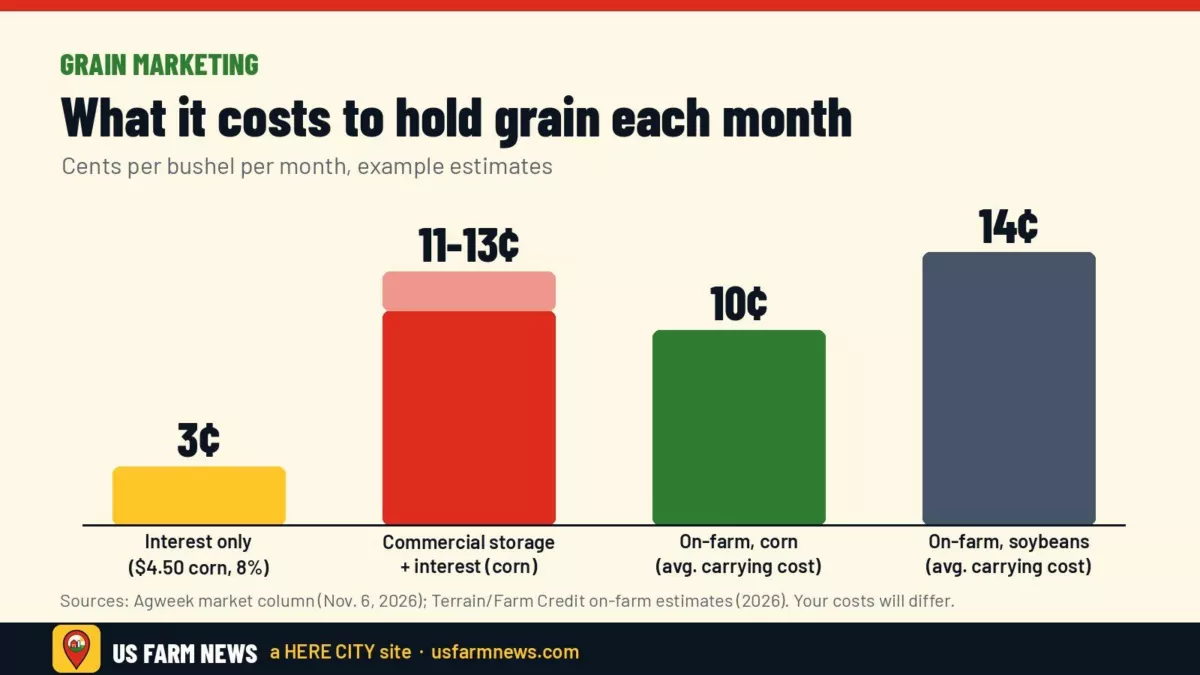
- At $4.50 corn and an 8% interest rate, interest alone costs about 3 cents a bushel per month to hold grain, according to an Agweek market column.
- Add commercial storage of 8 to 10 cents a month and the total runs 11 to 13 cents a month, or 33 to 39 cents over three months, in that example.
- Farm Credit’s Terrain team estimated average on-farm carrying costs at about 10 cents a month for corn and 14 cents for soybeans.
- Options can replace bin space: sell cash grain and buy a call, or keep the grain and buy a put to protect a floor.
With harvest in the home stretch and grain and soybean futures sliding to another round of lows this past week, according to Pro Farmer, plenty of farmers are shutting the bin door and planning to wait for a better price. That can work, but holding unpriced grain is not free, and the bill adds up month by month.
An Agweek market column published Nov. 6 laid out the math, and it lines up with earlier estimates from Terrain, the research team for several Farm Credit associations. The bottom line from both: before you store, know how much the cash price has to climb just to break even.
What it costs to wait
Interest is the cost most people overlook, because no one sends a bill for it. Using corn worth $4.50 a bushel and an 8% annual rate, the Agweek column put the interest cost near 3 cents per bushel each month. Over three months that is 9 cents, or $4,500 on 50,000 bushels. If you carry an operating loan, that is money a grain sale could save by paying the balance down. Even debt-free farms tie up cash that could be working elsewhere.
Commercial storage stacks on top. In the column’s example:
- Storage charge: 8 to 10 cents per bushel per month (actual elevator terms vary, and some have minimums).
- Interest: about 3 cents per bushel per month.
- Total: 11 to 13 cents per month, or 33 to 39 cents over three months.
That means a 30-cent cash rally after three months in commercial storage could still leave you behind, the column noted. Stretch the same example to six months and the hurdle roughly doubles to 66 to 78 cents.
On-farm bins are cheaper, but not free
Grain in your own bins avoids elevator charges, but you still carry interest, aeration, handling, shrink and the work of keeping grain in condition. Terrain estimated average on-farm carrying costs, spread over a nine-month storage period, at roughly:
- Corn: about 10 cents per bushel per month, with interest about 2.5 cents of that.
- Soybeans: about 14 cents per bushel per month, with interest about 6.6 cents.
Terrain said those figures rely in part on a storage-cost calculator built by Iowa State University and fold in drying, handling in and out, transportation and a return on invested capital averaged across the storage period. It added that marginal costs are likely about 1 cent a month higher once labor and quality risk are counted. Your own numbers will differ, so run them for your operation.
Decide what storage is supposed to earn
Storing grain is a bet on futures, basis or both, and those do not always move together. A futures rally can be partly wiped out if your local basis weakens at the same time, while a stronger basis can lift your cash bid even when futures sit still. The Agweek column suggested comparing nearby and deferred bids, then subtracting the carrying cost to see how much of a higher deferred price you actually keep.
Market timing is a factor this year. Pro Farmer’s Nov. 7 newsletter said harvest hedge pressure on corn and soybeans should ease soon as harvest reaches the home stretch, that corn demand has picked up, and that Chinese soybean purchases have cooled with the country close to its 2026 goal of 25 million metric tons.
Two ways to stay in the market without the bin
- Sell cash, buy a call. The sale brings in cash, stops storage charges and can pay down an operating loan, while the call option keeps upside if futures rally before it expires. The trade-offs: you give up any later basis gain, a small rally may not cover the premium, and the call can expire worthless. Your maximum loss is the premium plus fees.
- Keep the grain, buy a put. A put gives you the right to sell futures at a set price, so it gains value if futures fall and helps offset losses on stored bushels. You keep upside from a rally (minus the premium) and from basis improvement, but storage, interest and basis risk remain. It is not a guaranteed cash price.
Give every stored bushel a job
The column’s most practical advice: decide before the next rally what it must accomplish. Tie a target price and a quantity to a specific need, such as an upcoming loan payment, moving bushels out of paid storage or pricing more of the crop at a profit. Then set a deadline: if the target has not hit before your next cash need, what is the fallback? Writing it down makes it harder to keep waiting for one more dime.
Terrain also urged farmers to map expected income and expense dates with their lender so grain sales, loan payments and input purchases line up.
If you are weighing new bins or drying equipment, see our guide to November FSA loan rates, including farm storage facility loans. For the price outlook heading into USDA’s Nov. 10 reports, read our week-ahead markets preview.
This article is general information, not financial, tax or marketing advice. Options involve risk; talk with your lender, broker or marketing adviser about your own situation.
Frequently asked questions
How much does it cost to store corn per month?
In an Agweek example, interest on $4.50 corn at 8% runs about 3 cents a month, and commercial storage adds 8 to 10 cents, for 11 to 13 cents total. Terrain estimated average on-farm costs near 10 cents a month for corn.
How do I find my storage break-even?
Add your monthly storage, interest, shrink and handling costs, multiply by the months you plan to hold, and compare that with the gain between today’s cash bid and the deferred bid.
Can I sell grain and still benefit if prices rise?
Yes. Selling cash grain and buying a call option keeps exposure to a futures rally, though you give up basis gains and can lose the premium if prices do not rise.
Get the Daily Ag Business Briefing
Markets, policy and farm business in one free email each weekday.