A HERE CITY site

Soybeans Lose 40 Cents, Feeders Fall $13.40 in a Bruising Week Before Tuesday’s WASDE
January soybeans fell 40½ cents and feeder cattle $13.40 on the week. Here's where markets closed and what the trade expects from USDA's Nov. 10 report.
Key takeaways
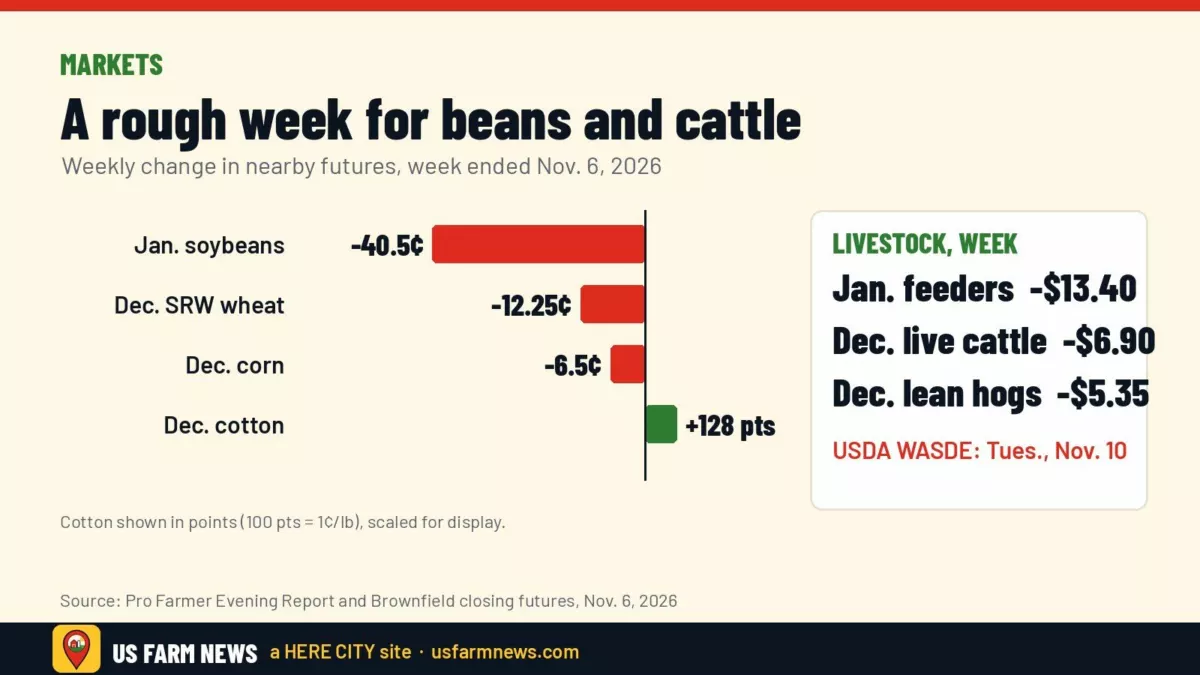
- January soybeans lost 40½ cents on the week to settle at $11.93¾ Friday, after touching an 11-week low, Pro Farmer reported.
- December corn ended at $4.41½, down 6½ cents for the week; December SRW wheat hit a four-month low at $5.91¼.
- Cattle took the hardest hit: January feeders fell $13.40 and December live cattle $6.90 for the week.
- Next up: USDA’s crop production and WASDE reports on Tuesday, Nov. 10, with the average trade guess near 180.3 bu./acre for corn and 53.5 for soybeans, per AgWeb.
Grain and livestock futures limped into the weekend after a bruising week. Corn and soybeans managed a small short-covering bounce on Friday, Nov. 6, but that only trimmed losses that piled up after Tuesday’s midterm elections, talk of Russia-Ukraine peace negotiations and a sharp break in cash cattle. Now the trade turns to USDA’s Nov. 10 crop production and supply-and-demand reports, which could set the tone for the rest of the marketing year.
Why it matters for your marketing plan
For growers who still have unpriced bushels in the bin, the week moved the goalposts. Soybeans slipped back under $12 on the January contract, and corn is hovering in the low $4.40s for December. A Tuesday report that confirms bigger soybean yields could add pressure; a smaller corn number could offer a selling opportunity. Either way, having price targets and orders in place before the report comes out keeps the decision on your terms rather than the market’s.
Where the markets closed
According to Pro Farmer’s Friday evening report and Brownfield’s closing futures table:
- Corn: December rose 1½ cents Friday to $4.41½, a weekly loss of 6½ cents.
- Soybeans: January gained 5½ cents to $11.93¾ but was down 40½ cents on the week. December meal rose $2 to $319.20 and December soyoil gained 2 points to 62.26 cents.
- Wheat: December soft red winter fell 8 cents to $5.91¼, a four-month low and a weekly drop of 12¼ cents. December hard red winter lost 3¼ cents to $6.32½ and December spring wheat 4 cents to $6.16.
- Cotton: December rose 40 points to 79.11 cents, up 128 points on the week.
- Livestock: December live cattle slipped 35 cents to $214.05, an 11-week low for the contract. January feeders dropped $1.95 to $318.375, and December lean hogs lost $1.575 to $53.525, another contract low.
Settlements above are as reported by those outlets; check CME Group for official prices.
What moved grain this week
Politics did much of the work. Randy Martinson of Martinson Ag Risk Management said on the Agweek Market Wrap that reports of possible Russia-Ukraine-U.S. talks, expected around Nov. 10-11, put wheat and corn “under the defense,” along with unconfirmed rumors of a deal involving Iran. Dave Chatterton of Strategic Farm Marketing told AgWeb that Friday’s bounce looked more like a pause ahead of the USDA data and that meeting than a confirmed bottom.
Demand news was mixed. Brownfield said China bought 136,000 tons of U.S. soybeans before Friday’s open, the fifth announced sale in six business days, and unknown destinations booked 101,000 tons of U.S. corn. On the other side, Brownfield noted that Argentina and Ukraine currently hold a price edge on corn exports, while Argentina’s planting is moving ahead. Pro Farmer also flagged a stronger-than-expected October jobs report, which lifted Treasury yields and the dollar, a potential headwind for farm commodities.
Trade with China remains the wild card. Pro Farmer reported that U.S. officials pressed Beijing this week for “concrete actions” on farm purchases, and that China’s commerce ministry tied further buying to a reciprocal tariff-cut deal. For background on the $17 billion non-soybean pledge, see our earlier look at China’s farm purchase commitments.
Cattle: cash weakness spills into futures
AgWeb said sharply lower cash trade weighed on cattle futures all week, and fund selling followed the chart damage. Live cattle closed below the September chart gap, leaving the August lows as the next support area, according to AgWeb. Martinson said cattle took “a pretty good beating this week,” pointing to the cash market and broader stock-market uncertainty. Feeder cattle buyers and cow-calf sellers alike should watch whether cash trade stabilizes next week before reading too much into one Friday.
What the trade expects Tuesday
AgWeb reported the average trade guess for the national corn yield at 180.3 bushels per acre, down nearly a bushel from USDA’s October number, while StoneX came in higher at 183.1. For soybeans, the average guess is 53.5 bushels per acre and StoneX is at 55. Martinson framed the two big questions plainly: will USDA trim corn yield a little, and will it push soybeans to a record crop?
There’s an extra layer of scrutiny this month. USDA corrected its September corn estimates in October after a processing error, and officials say an internally built AI tool will screen the Nov. 10 report for anomalies. We cover that in USDA’s new AI check on the crop report.
What to watch next week
- Tuesday, Nov. 10: USDA Crop Production and WASDE reports.
- Nov. 10-11: Expected talks involving Russia, Ukraine and the U.S., per Agweek and AgWeb.
- Nov. 13: CONAB’s updated Brazil crop estimates, according to Brownfield.
- Thursday: USDA weekly export sales, to see whether China’s soybean buying continues. Our last export sales recap showed shipments at a marketing-year high.
Get the Daily Ag Business Briefing
Markets, policy and farm business in one free email each weekday.