A HERE CITY site

China bought just $7.2 billion of non-soybean U.S. farm goods in 9 months, far short of its $17 billion pledge
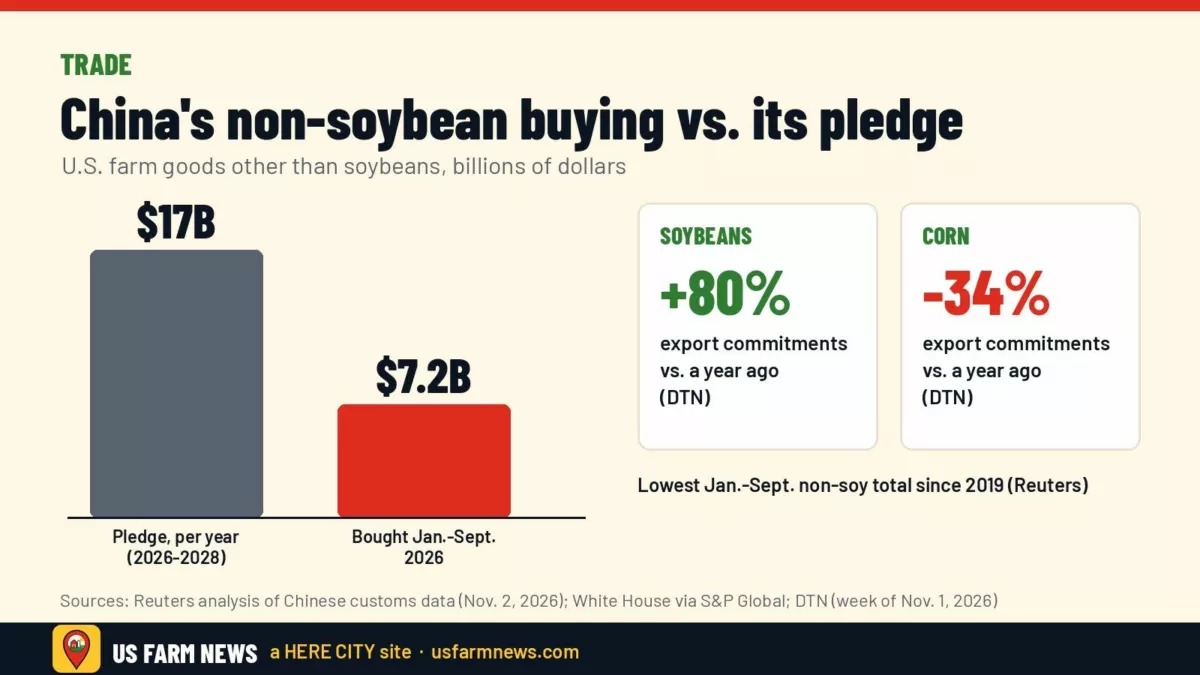
China's purchases of U.S. farm goods other than soybeans hit $7.2 billion through September, a 7-year low, Reuters found. Corn, sorghum and beef lag most.
Key takeaways
- China bought only $7.2 billion of U.S. farm products other than soybeans from January through September, a Reuters review of customs data found, the weakest pace for that stretch since 2019.
- Beijing’s pledge, announced by the White House in May, calls for $17 billion a year in non-soybean U.S. farm purchases from 2026 through 2028, with 2026 prorated.
- Soybeans are on track. Corn, sorghum, wheat and beef are where the gap is, and analysts told Reuters state-directed buying may be needed to close it.
- No U.S. corn or wheat had been sold to China this marketing year as of last week, DTN said, though Chinese buyers have asked about U.S. soft red winter wheat.
China is buying U.S. soybeans again, but most of the rest of the farm trade it promised has not shown up. Purchases of U.S. agricultural products other than soybeans totaled $7.2 billion in the first nine months of 2026, according to a Reuters analysis of Chinese customs data published Monday. That is the lowest January-September total since 2019, during the first trade war.
For corn, sorghum and cattle producers, the gap matters. Those are the commodities the non-soybean pledge was supposed to help, and full bins plus falling futures leave little room for a demand shortfall this winter.
What China promised
According to a May 17 White House fact sheet, as summarized by S&P Global, China committed to buy $17 billion of non-soybean U.S. farm goods annually for three years, 2026 to 2028, with this year’s amount prorated. That was on top of a separate soybean commitment made in October 2025.
It is not clear whether China is behind schedule. Reuters noted that the White House has never said when the prorated clock started: at the May announcement, or once China finalizes its proposed tariff cuts, which has not happened yet. USDA referred questions about the schedule to the U.S. Trade Representative’s office, and neither USTR, the White House nor China’s Commerce Ministry responded to Reuters.
China’s Commerce Ministry said Sept. 28 that it would consider lowering tariffs on U.S. beef, pork, corn, wheat and other products but left soybeans off the list, S&P Global reported. U.S. soybeans still face a 13% Chinese duty, compared with 3% on Brazilian beans.
Commodity by commodity
- Corn: China imported about $5.6 billion of U.S. corn at the 2021 peak. In October, COFCO Futures, a broker tied to China’s state grain trader, forecast only about 900,000 metric tons of U.S. corn imports for 2026-27 and said U.S. corn is not competitive, partly because China has plenty of its own, Reuters reported.
- Sorghum: U.S. sorghum exports to China reached roughly 3.7 million tons by the end of August, well ahead of last year, but new sales have stalled for four months, according to Reuters. Brazil gained access to the Chinese market in September 2025 and has shipped 1.7 million tons this year, Eduardo Vanin of Marex told the news agency.
- Beef: China renewed export licenses for more than 400 U.S. beef plants in May, yet about half of U.S. fed-cattle slaughter capacity still cannot ship there, the U.S. Meat Export Federation told Reuters. S&P Global, citing USDA data, put marketing-year U.S. beef sales to China at 7,800 metric tons, down 77.8% from the year before.
- Pork: A brighter spot. China has committed to 135,900 metric tons of U.S. pork for marketing year 2026, up 18.9% from a year earlier, S&P Global said, citing USDA.
- Wheat: S&P Global said China bought just $66 million of U.S. wheat from January through July. DTN reported this week that Chinese buyers have asked about new-crop U.S. soft red winter wheat.
“Our growers are patriots, but there’s a lot of bins of grain full and certainly a desire to see grain trade,” Tim Lust, CEO of National Sorghum Producers, told Reuters.
Soybeans are the exception
U.S. soybean export commitments have reached 1.057 billion bushels for 2026-27, 80% above a year ago and ahead of USDA’s projection, DTN said in its weekly outlook. Corn commitments stand at 925 million bushels, 34% behind last year and short of USDA’s forecast. DTN cautioned that commitments are sales on the books, not shipments.
That split echoes how the trade has worked so far. U.S. traders told S&P Global that recent soybean purchases came from Chinese state buyers COFCO and Sinograin, while private crushers have favored cheaper Brazilian supplies.
Why state buying is the swing factor
Analysts quoted by Reuters said China will probably have to direct state-owned companies to buy if it wants to reach $17 billion, as it has done with soybeans. Darin Friedrichs of Sitonia Consulting put it bluntly: “It’s difficult to get to $17 billion in non-soybeans without directed, non-market, purchases.”
S&P Global noted that China’s non-soybean purchases topped $17 billion only in 2021 and 2022, according to Census Bureau data.
What to watch
- Thursday’s USDA export sales: look for China in the corn, sorghum and wheat lines, not just soybeans.
- Tariff cuts: any final Chinese decision on lowering duties for beef, pork, corn and wheat.
- Beef plant eligibility: whether more U.S. plants are cleared to ship.
- Nov. 10 WASDE: USDA’s export estimates for corn and sorghum.
For this week’s market drivers, see our corn and cattle week-ahead outlook, and follow trade developments in our Policy & Trade section.
Get the Daily Ag Business Briefing
Markets, policy and farm business in one free email each weekday.