A HERE CITY site

Election Day: 62% of farm respondents say ag is on the wrong track as Congress loses 14 ag committee members
An Agri-Pulse survey finds 62% of farm respondents see ag on the wrong track as at least 14 ag committee members exit Congress. What it means.
Key takeaways
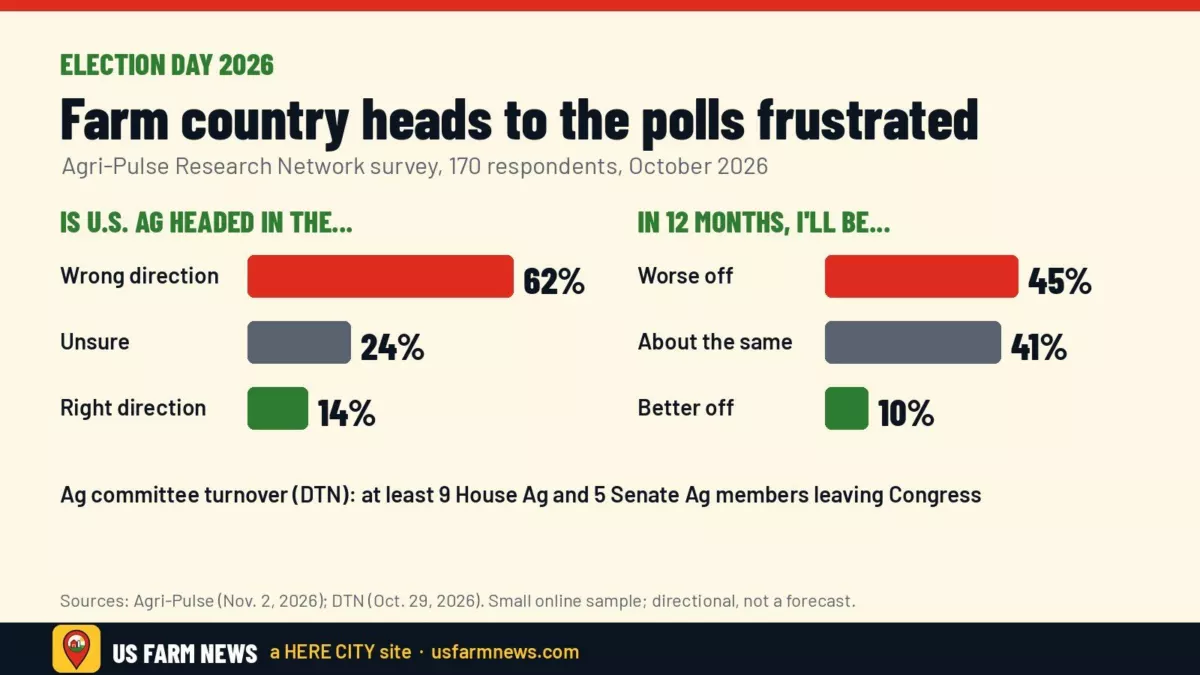
- In an Agri-Pulse survey of 170 farm and agribusiness respondents, 62% said U.S. agriculture is on the wrong track and only 14% said it is headed the right way.
- 45% expect to be worse off financially over the next 12 months; just 10% expect to be better off.
- DTN counted at least nine House Agriculture and five Senate Agriculture Committee members who won’t be back next year, including the top Democrat on each panel.
- The 120th Congress starts Jan. 3. Before then, the lame-duck session still has the farm bill and fiscal 2027 farm spending to deal with.
Farm country votes today in a sour mood, and whatever the results, the committees that write farm policy will look very different in January.
A new Agri-Pulse Research Network survey, released on the eve of the midterms, found most farm and agribusiness respondents think agriculture is moving the wrong way. Separately, DTN tallied at least 14 members of the House and Senate agriculture committees who will not return. Taken together, they suggest the next farm bill will be written by a reshuffled group of lawmakers for a frustrated set of producers.
What the survey found
Agri-Pulse said 170 people answered its online survey during October, run with the Stratovation Group. Roughly two-thirds (64%) described themselves as farmers or ranchers. The rest were ag retailers, agribusiness staff and about a dozen policy experts. Nearly half (48%) were from the Midwest.
- Direction of agriculture: 62% wrong direction, 24% unsure, 14% right direction.
- Next 12 months: 45% expect to be worse off financially, 41% about the same, 10% better off.
- Trade policy’s effect on their operation: 41% somewhat negative and about a third very negative. Only 12% called it positive, and 16% were neutral.
- Ratings on a 1-to-10 scale: President Trump averaged 3.7 for his handling of agriculture. Agriculture Secretary Brooke Rollins averaged 4.7.
- South American beef imports: Just over half rated the administration’s move to bring in more beef from South America “very negative,” and another 24% somewhat negative. Only 5% saw it as positive.
No single issue dominated the wish list for Washington. Improving the farm economy and commodity prices and removing tariffs and trade barriers each drew 18%. A new farm bill drew 15%, lowering input costs 14% and industry concentration 13%. Asked for their single biggest concern, respondents most often pointed to costly inputs, weak crop prices and steep interest rates, Agri-Pulse said.
Agri-Pulse founder Sara Wyant cautioned that the sample is small and was collected during harvest. She said it still shows, “directionally,” how frustrated farm country is heading into the vote. Read it as a snapshot of mood, not a forecast of results.
Why it matters for your operation
Those worries line up with what farm budgets show this fall. Our recent coverage of farm bankruptcies rising 19% in 2026 and of the $8 billion Harvest Fuel Relief program points to the same squeeze from costs and prices. The people who take over the agriculture committees will decide what the safety net, trade aid and conservation programs look like for the 2027 crop and beyond.
Turnover on the agriculture committees
DTN’s Jake Zajkowski counted the departures. On the House Agriculture Committee, six members are confirmed to leave after retiring or losing primaries, two are running for other offices, and six more are in competitive races. In the Senate, four Agriculture Committee members are retiring and two are seeking other offices.
The departures include leaders on both sides:
- House: Ranking Democrat Angie Craig of Minnesota lost her Senate primary. Two Republicans, Iowa’s Randy Feenstra and South Dakota’s Dusty Johnson, came up short in GOP primaries for governor. Nebraska’s Don Bacon and Washington’s Dan Newhouse, also Republicans, chose to retire.
- Senate: Four are stepping down: Iowa’s Joni Ernst and Kentucky’s Mitch McConnell on the Republican side, and Illinois’ Dick Durbin and Minnesota’s Tina Smith for the Democrats. Ranking Democrat Amy Klobuchar of Minnesota and Republican Tommy Tuberville of Alabama are running for governor.
So each panel will seat a new lead Democrat next year. The American Soybean Association noted that if Democrats win a chamber, that lawmaker would be in line to chair its agriculture committee. If Republicans keep control, the top Democrat would be ranking member. On the House side, Reps. Jim Costa of California and Shontel Brown of Ohio have both announced bids for the post, Farm Policy News reported.
Races farm groups are watching
Every House seat (435 in all) and 35 Senate seats are up today, ASA said. Some contests with direct agriculture ties:
- Iowa Senate (open, Ernst): Rep. Ashley Hinson (R) vs. state Rep. Josh Turek (D).
- Minnesota Senate (open, Smith): Lt. Gov. Peggy Flanagan (D) vs. Michele Tafoya (R).
- Kansas Senate: Sen. Roger Marshall, an Agriculture Committee Republican, is in a race DTN listed as a tossup. Rollins planned to join Marshall in El Dorado, Kan., on Monday to discuss farm and ranch issues, Agri-Pulse reported, a day after President Trump campaigned in Iowa and Kansas.
- House Agriculture members in close races: DTN’s list includes North Carolina Democrat Don Davis, Pennsylvania Republican Rob Bresnahan, Texas Republican Monica De La Cruz and California Republican David Valadao, a dairy farmer. ASA highlighted Zach Nunn (R-Iowa) against state Sen. Sarah Trone Garriott and Derrick Van Orden (R-Wis.) in a rematch with Rebecca Cooke.
What to watch after the votes are counted
- Lame-duck session: DTN noted that lawmakers still face weeks of work before the new Congress, including the farm bill and the fiscal 2027 agriculture appropriations bill.
- Nov. 10: House Republicans plan to choose their leaders, DTN said, citing Politico. Democrats’ leadership picks are expected in the new year.
- Jan. 3, 2027: The 120th Congress begins. DTN said retirements alone will turn over about 20% of both chambers, before counting election losses.
We will track what the results mean for farm programs, trade and the farm bill in our Policy & Trade section.
Frequently asked questions
Who leads the agriculture committees next year?
It depends on which party wins each chamber. Each committee gets a new lead Democrat because Rep. Angie Craig and Sen. Amy Klobuchar are leaving Congress. Republican leadership could also change based on the results and party decisions.
Can Congress still pass a farm bill this year?
Lawmakers return for a lame-duck session before the new Congress starts Jan. 3. The farm bill and fiscal 2027 agriculture spending are among the unfinished items, DTN reported.
How big was the Agri-Pulse farm survey?
It drew 170 responses during October. Agri-Pulse’s publisher called it a small sample that shows direction rather than a precise measure.
Get the Daily Ag Business Briefing
Markets, policy and farm business in one free email each weekday.