A HERE CITY site

How to set up a variable cash lease for 2027: Formulas, rent factors and government payments
A variable cash lease ties rent to actual crop revenue. Step-by-step formulas, Illinois rent factors and how to treat ARC/PLC payments for 2027.
Key takeaways
- A variable (flex) cash lease ties rent to the year’s actual crop revenue, so rent rises in good years and falls in bad ones.
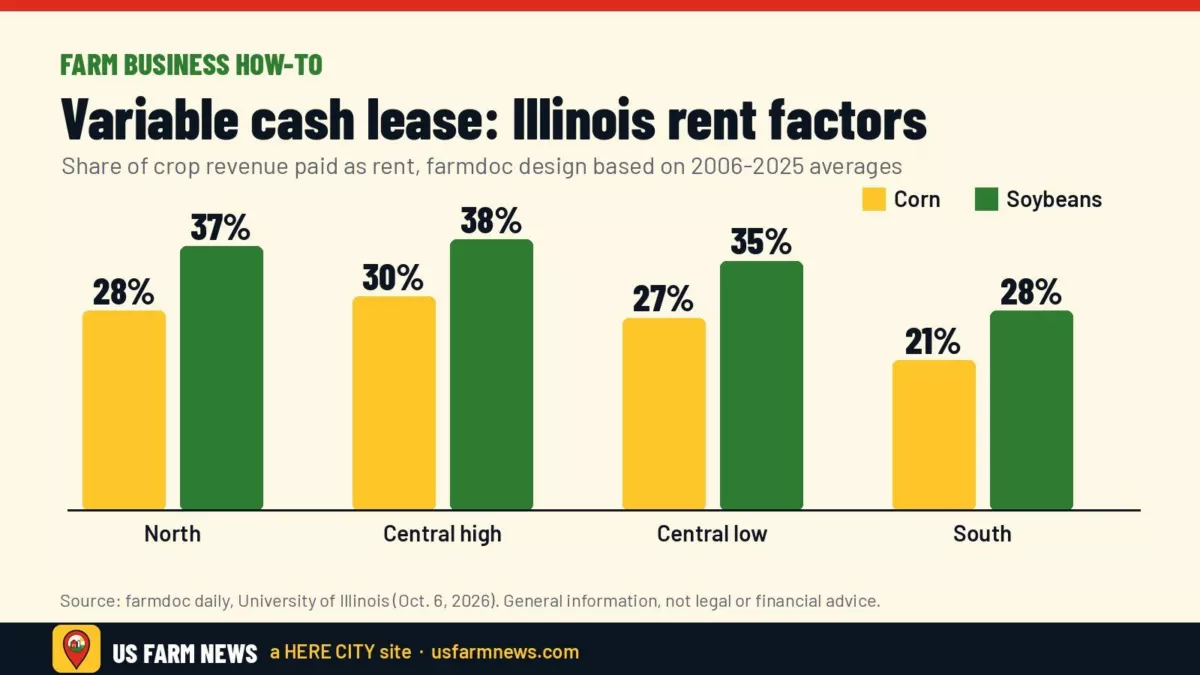
- farmdoc’s simple design multiplies crop revenue by a rent factor: 21% to 30% for corn and 28% to 38% for soybeans, depending on the Illinois region.
- For central Illinois high-productivity land, that formula would have set 2025 rent at about $294 an acre, $32 below the area’s $326 average cash rent.
- With corn around $5 and soybeans at $12 or more projected for 2026 and 2027, farmdoc said the flex formula would pay landlords more than $30 an acre above projected cash rents.
Fall is lease season. With margins still thin and crop prices bouncing, more landlords and tenants are trading a fixed cash rent for one that moves with the crop. In Illinois, 35% of rental agreements are now some form of variable lease, up from 21% in 2020, according to farm manager surveys cited by farmdoc daily.
Here is how a basic variable cash lease works, how to run the numbers, and the choices you will need to settle before both sides sign for 2027.
Step 1: Pick a structure
“Flex rent” can mean several things. Purdue University’s flex rent tool guide describes leases that adjust for yield alone, for gross revenue, or that pay a fixed base plus a bonus tied to price, yield or both. Two common designs:
- Percent of revenue (farmdoc design): Rent equals actual yield times actual price times a rent factor, with an agreed minimum and maximum.
- Base plus bonus (Purdue tool): The landlord gets a guaranteed base rent. If gross revenue tops an agreed trigger, the landlord also gets a set share of the revenue above that trigger.
Step 2: Run the math
farmdoc’s example for central Illinois high-productivity farmland uses 2025 averages:
- Corn: 242 bushels an acre at $4.09 a bushel is about $990 of revenue. At a 30% rent factor, rent comes to about $297 an acre.
- Soybeans: 75 bushels at $10.24 is about $768. At 38%, rent is about $292 an acre.
- Half corn, half soybeans: about $294 an acre, which is $32 less than the $326 average cash rent on that class of land.
The Purdue guide works a base-plus-bonus case the same way. With a $140 base and 40% of revenue above a $450 trigger, a 135-bushel county yield at $3.50 corn produces $472.50 of revenue. The bonus is 40% of the $22.50 overage, or $9, for a total rent of $153.50 an acre. Those are illustration numbers from the tool guide, not current market rents.
Step 3: Choose the rent factor or bonus share
This is the number that matters most, and published ranges differ. farmdoc set its Illinois factors so that, over 2006 to 2025, the variable rent averaged out to the cash rents actually paid on Illinois grain farms:
- Corn: 28% north, 30% central high-productivity, 27% central low-productivity, 21% south.
- Soybeans: 37% north, 38% central high, 35% central low, 28% south.
University of Illinois Extension’s Kevin Brooks, writing about common practice, put typical corn percentages at 30% to 38% and soybeans at 36% to 44%. Soybean shares run higher because the crop costs less to grow. The spread is a reminder to test any percentage against your own farm’s yields, costs and local rents rather than borrowing a number.
Step 4: Set the guardrails
- Minimum and maximum. In farmdoc’s central Illinois example, a floor near $225 an acre and a cap near $425, about $100 on either side of the average cash rent.
- Which yield. Farm yield, county yield or crop insurance records. Brooks suggests trend-adjusted yields from federal crop insurance records when they are available. Purdue’s tool bases its bonus on county yield.
- Which price. Brooks describes averaging the local elevator’s closing price on a set day each month from January through October, so one high or low day does not decide the rent.
- Payment timing. Decide what is paid up front and what is settled after harvest once yields and prices are known.
Step 5: Decide on government payments
farmdoc said more farmers and landowners are asking whether ARC, PLC and ad hoc aid should count as revenue in the formula. Its factors use crop revenue only. The researchers noted that program payments are often not known when rent is due. They also said recent ad hoc aid was meant to offset high costs, which most variable leases do not account for. If you include government payments, farmdoc suggested trimming the factors by 1 to 2 points for corn and 2 to 3 points for soybeans.
Purdue’s guide recommends having the county FSA office review a flex agreement so that program payments are split according to the rules. For the 2026 and 2027 program decisions, see our ARC/PLC sign-up checklist.
What it means for 2027
A flex lease is not a cure for poor margins. farmdoc found that average farmer returns on cash-rented Illinois land were negative in 2023, 2024 and 2025. In 2023 and 2024 they would have stayed negative even under the variable lease, though by less. Because the formula does not adjust for costs, higher projected prices for 2026 and 2027 would push flex rents above expected cash rents and leave tenants’ projected returns slightly lower than with a fixed rent.
Purdue’s guide offers a simple starting point if the parties are unsure: set the base rent at last year’s cash rent, see how it plays out under different yields and prices, and then adjust.
This is general information, not legal, tax or financial advice. Lease rules vary by state; have a written lease reviewed by an attorney and talk with your FSA office about program payment shares. More guides are in our Farm Management section.
Frequently asked questions
What is a variable cash lease?
It is a cash rent that adjusts with the year’s actual crop revenue, often with a minimum and maximum, so the landlord shares some of the upside and the tenant gets some protection in poor years.
What percentage of revenue is typical?
It varies. farmdoc’s Illinois factors run 21% to 30% for corn and 28% to 38% for soybeans by region, while Illinois Extension’s Kevin Brooks cited 30% to 38% for corn and 36% to 44% for soybeans as common.
Should government payments be included?
farmdoc’s formula leaves them out. If they are included, it suggests lowering rent factors by 1 to 2 points for corn and 2 to 3 points for soybeans.
Get the Daily Ag Business Briefing
Markets, policy and farm business in one free email each weekday.