A HERE CITY site

AI-priced crop insurance: SAGE and Aon plan field-by-field coverage for 2027 corn and soybeans in 15 states
A private crop policy priced field by field with AI will sit atop federal coverage in 2027. Aon modeling hints at $10-$15/acre savings on low-risk ground.
Key takeaways
- Aon, AI risk firm SAGE and insurer AgriCap plan private crop insurance priced field by field for corn and soybeans in 15 states starting with the 2027 crop year.
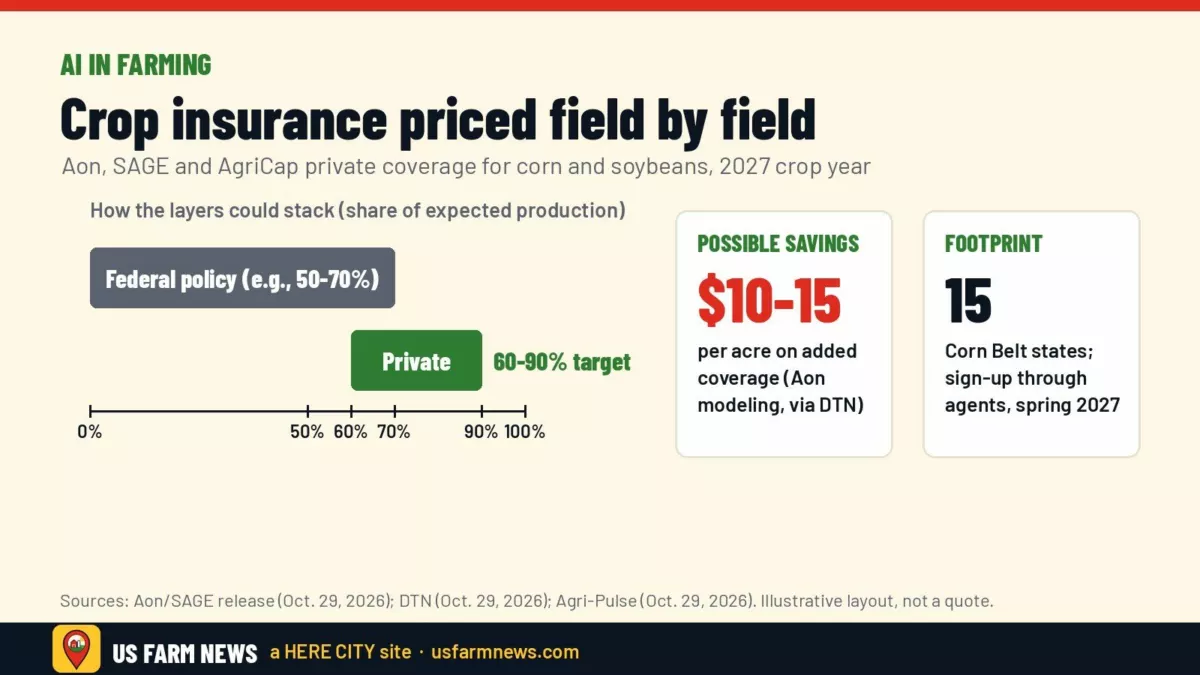
- It’s designed to sit on top of federal crop insurance, not replace it. SAGE’s founders say it would usually cover 60% to 90% of expected production.
- Some growers could pay $10 to $15 an acre less for the added coverage, based on Aon’s modeling, DTN reported. Real savings will depend on each field’s risk.
- Sign-up will run through insurance agents during the normal spring 2027 enrollment window.
Federal crop insurance rates are built mostly on county-level risk, so a well-drained, steady-yielding farm can pay about what the neighbor with the flood-prone bottom ground pays. A new private program announced Oct. 29 uses artificial intelligence to price that risk one field at a time. If it works as pitched, farmers with lower-risk acres could buy higher coverage for less.
Who’s behind it and how it works
Insurance brokerage Aon and SAGE, a California-based agricultural risk intelligence company, announced the program with AgriCap, a specialty agricultural insurer that will sell it through its agency network. SAGE was co-founded by Robert Bonnie, who led USDA’s farm production and conservation mission area as under secretary, and CEO Bill Veghte, a former Microsoft and Hewlett-Packard executive, according to DTN.
SAGE’s models combine soil, water, weather and management data, and the company says it can now analyze those data sets together at scale. Agri-Pulse reported that the inputs include data from farm equipment and USDA, satellite observations, scientific papers and university process models. In each case the result is a risk estimate for an individual field. Aon then turns that estimate into a price and lines up the capital behind the policies.
Aon’s release says federal crop insurance covers nearly 90% of U.S. corn and soybean acres. Because it is priced on county averages, many growers pay premiums that may not match their own fields, the companies argue.
“Farmers have understood that every field is different,” Veghte said in the release. The barrier, he said, has been the ability of USDA and the insurance industry to measure those differences at scale.
How it would fit with your federal policy
The private policy is meant to be added to federal coverage, not swapped for it. Bonnie told DTN a grower could buy a federal policy at 50%, 60% or 70% of expected production, then use the new product for higher coverage. The companies see the biggest opening in those upper coverage levels, where federal premium subsidies shrink.
Bonnie and Veghte said the private layer would generally target coverage of 60% to 90%, depending on the field and the farmer’s federal policy. Enrollment would follow the usual crop insurance calendar, including spring sign-up, and farmers would keep working with their own agents. The product carries “No taxpayer subsidy,” Bonnie told DTN.
Eligibility is set field by field, not by farmer or county. Veghte said even counties with high average risk contain low-risk fields that could qualify.
A soil-health angle
The two companies are also working in Michigan. There, the Resilience in Agricultural Lending and Insurance Coalition (RALIC) built a four-county pilot with partial funding from the state’s agriculture department. Aon said the pilot spans more than 1 million acres, roughly 12% of Michigan’s farmland. Corn and soybean growers in those counties who adopt practices such as cover crops and no-till are slated to get cheaper premiums beginning in 2027, Agri-Pulse reported.
Bonnie also told DTN the approach could let a policy reflect a higher price for crops grown under low-carbon programs like the 45Z clean fuel tax credit. Growers who buy the coverage will get SAGE’s AI agronomy report, the SAGE Almanac, which the company plans to offer more widely as well.
Practical takeaways before spring sign-up
- Know your numbers first. Pull your APH yields and recent premium bills by unit so you can compare a federal-only plan with a federal-plus-private plan side by side.
- Ask what data you hand over. Field-level pricing runs on field-level data. Ask your agent which records, equipment data and imagery SAGE uses, who owns the data and how it’s protected.
- Check how claims work. Ask how a loss is adjusted on the private layer, when it pays and how that lines up with your federal claim.
- Treat savings estimates as a range. The $10 to $15 an acre figure comes from Aon’s modeling, DTN reported. Your fields could land higher or lower.
- Coordinate with your lender. If your operating loan requires a minimum coverage level, confirm the lender accepts the combined policy.
Veghte said agencies in the Corn Belt that want to offer the product should contact AgriCap, Agri-Pulse reported. Aon said growers and agents can find details at sage.ag before enrollment opens in spring 2027.
This is general information, not insurance, legal or financial advice. Talk with a licensed crop insurance agent about your own operation. For more on this year’s program decisions, see our 2026 ARC-CO vs. PLC explainer and the Machinery & Tech section.
Frequently asked questions
Does the SAGE/Aon policy replace federal crop insurance?
No. It is designed to complement federal coverage. A grower could keep a federal policy at 50% to 70% and add private coverage on top.
Which farmers can buy it?
Corn and soybean farmers in 15 states, beginning with 2027 crops. Eligibility is decided field by field based on SAGE’s risk analysis.
When can I sign up?
During the spring 2027 sign-up period, through insurance agents. AgriCap is the insurance partner.
Get the Daily Ag Business Briefing
Markets, policy and farm business in one free email each weekday.