A HERE CITY site

ARC or PLC for 2026? The Dec. 11 decision, explained with the trigger prices
University of Illinois economists say ARC-CO looks like the better bet for most corn and soybean base acres, while wheat is closer. Here are the numbers, plus when ARC-IC makes sense.
Key takeaways
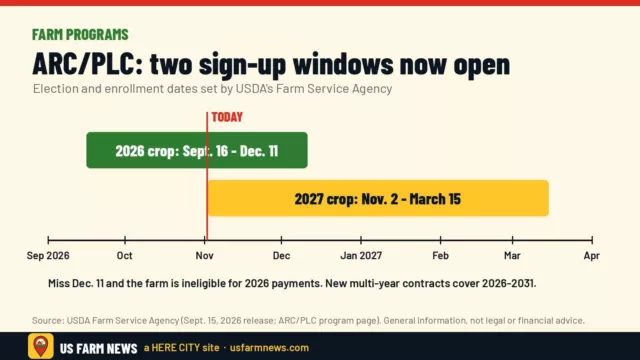
- The 2026 ARC/PLC election deadline is Dec. 11, 2026, after harvest instead of the usual March 15.
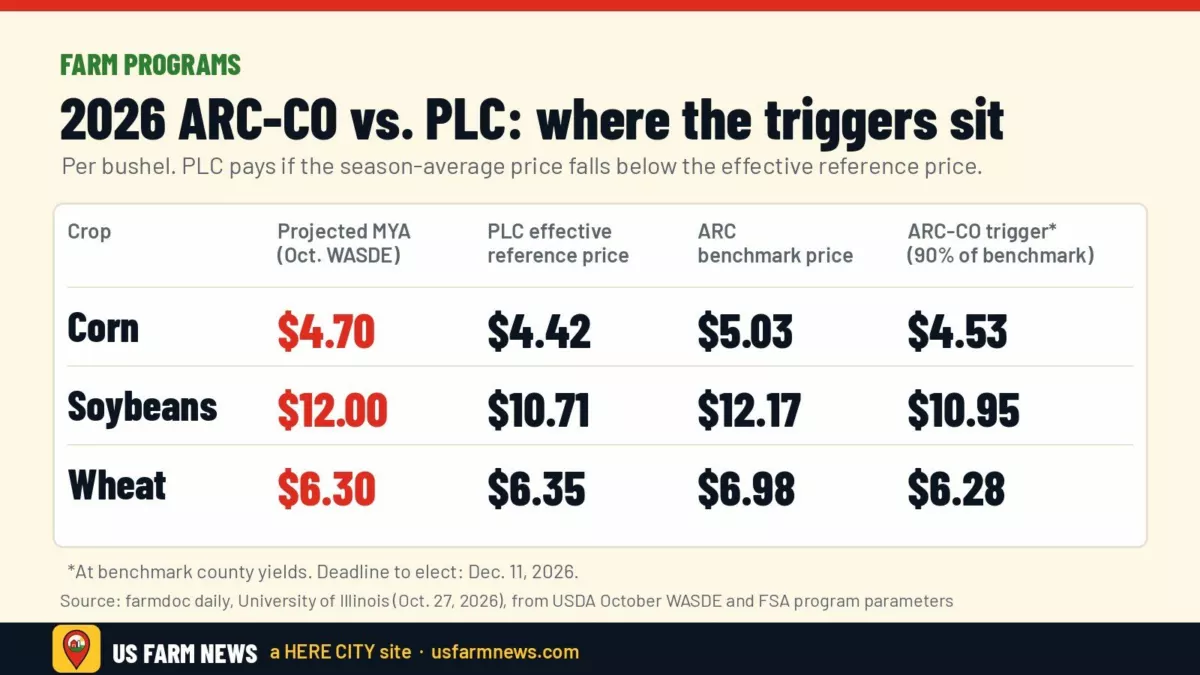
- At October WASDE projections, PLC would not pay on corn ($4.70 projected vs. $4.42 reference) or soybeans ($12.00 vs. $10.71).
- farmdoc daily finds ARC-CO tends to pay more for most corn and soybean base acres; wheat is closer and often favors PLC.
- Growers with localized hail or wind losses should also look at ARC-IC.
This year, farmers are choosing between ARC and PLC after harvest instead of before planting. The 2026 enrollment deadline is Dec. 11, and the late date means you can decide with yields mostly known and USDA’s latest price projections in hand. University of Illinois economists say the numbers point one direction for most corn and soybean acres, and closer to a coin flip for wheat.
Why the decision is back
The One Big Beautiful Bill Act (OBBBA) rewrote both programs starting with 2025, raising the odds and size of payments. For 2025, producers automatically got the higher of the ARC-County or PLC payment. For 2026 the choice returns, delayed from the usual March 15 deadline while FSA finalized the OBBBA base-acre updates. One thing hasn’t changed: any 2026 payments won’t arrive until October 2027.
The trigger prices
A farmdoc daily analysis by the University of Illinois’ Hongxia Jiao and colleagues lays out where each program would start paying, using October WASDE projections:
- Corn: PLC pays if the 2026/27 marketing-year average (MYA) price falls below the $4.42 effective reference price. USDA projects $4.70, so no PLC payment at current projections. ARC-CO’s benchmark is $5.03, which means a county at benchmark yield triggers ARC at $4.53 or lower (90% of benchmark revenue).
- Soybeans: The projected MYA of $12.00 is well above the $10.71 PLC trigger. ARC-CO would pay at $10.95 or lower for counties at benchmark yields.
- Wheat: The projected $6.30 MYA sits a nickel below the $6.35 reference price, enough for a 5-cent PLC payment rate if projections hold. ARC-CO would trigger at $6.28 for benchmark-yield counties.
County yields complicate ARC. Counties with yields below benchmark can trigger ARC payments at higher prices, while counties with strong yields need lower prices.
The verdict: ARC-CO for most corn and soybean acres
Across the most plausible price-and-yield scenarios, farmdoc found that ARC-CO “would tend to trigger larger payments than PLC” for corn and soybean base acres. In its example, non-irrigated corn in Champaign County, Ill., the farmdoc ARC/PLC Calculator shows an expected ARC-CO payment around $45 per base acre, against just under $16 for PLC. Its odds of paying anything are 54% versus 29%. PLC wins mainly in low-price scenarios, roughly below $3.70 corn, where ARC-CO hits its payment cap.
Wheat is closer. For counties with yields near or above benchmark, PLC carries the larger expected payment on most farms, while counties with poor wheat yields may do better with ARC-CO.
Don’t overlook ARC-IC if hail or wind hit you
Illinois economist Nick Paulson used a recent farmdoc webinar to point some growers toward ARC-Individual Coverage, which works off your farm’s own revenue rather than the county’s. “There are some growers looking at ARC-IC due to some severe wind and hail damage that occurred in a narrow band,” Paulson said, as reported by Brownfield Ag News. Because the deadline falls after harvest, “you’re going to have some pretty good information.” He made a similar point about 2019, when flooding made ARC-IC make sense “in more situations than it normally would.” Paulson still expects most producers to find ARC-CO the best fit for 2026.
How to decide
- Pull your FSA base acres and PLC yields by farm number. The OBBBA updated base acres for 2026.
- Run your county in the online farmdoc ARC/PLC Calculator, or download the 2026 Farm Bill What-If Tool to test price and yield scenarios.
- Ask which risk worries you most. A deep price drop favors PLC. A county-wide revenue shortfall at moderate prices favors ARC-CO.
- Get your election into the FSA office before Dec. 11.
Payments depend on final marketing-year prices (May 31 for wheat, Aug. 31 for corn and soybeans) and on final county yields, which FSA typically releases in mid- to late June.
Frequently asked questions
When is the 2026 ARC/PLC deadline?
Producers must make their 2026 ARC or PLC election at their FSA office by Dec. 11, 2026. The deadline was moved from the usual March 15 while FSA finalized the One Big Beautiful Bill Act base-acre updates.
Will PLC pay on corn or soybeans for 2026?
Not at October WASDE projections. USDA projects a $4.70 marketing-year average for corn against a $4.42 effective reference price, and $12.00 for soybeans against $10.71. A deep price drop would change that.
Is ARC-CO or PLC better for 2026?
For most corn and soybean base acres, farmdoc daily’s analysis finds ARC-CO tends to trigger larger payments than PLC. Wheat is closer: in counties with yields near or above benchmark, PLC often carries the larger expected payment.
What is ARC-IC and who should consider it?
ARC-Individual Coverage pays on a farm’s own revenue rather than the county’s. Illinois economist Nick Paulson said growers hit by localized wind or hail damage are looking at it.
Get the Daily Ag Business Briefing
Markets, policy and farm business in one free email each weekday.