A HERE CITY site

AI data centers face at least 49 local ballot votes: What farmland owners should check before signing an option
Voters in 13 states weigh at least 49 local data center measures. Here is what the votes mean for farmland and what to check before you sign an option.
Key takeaways
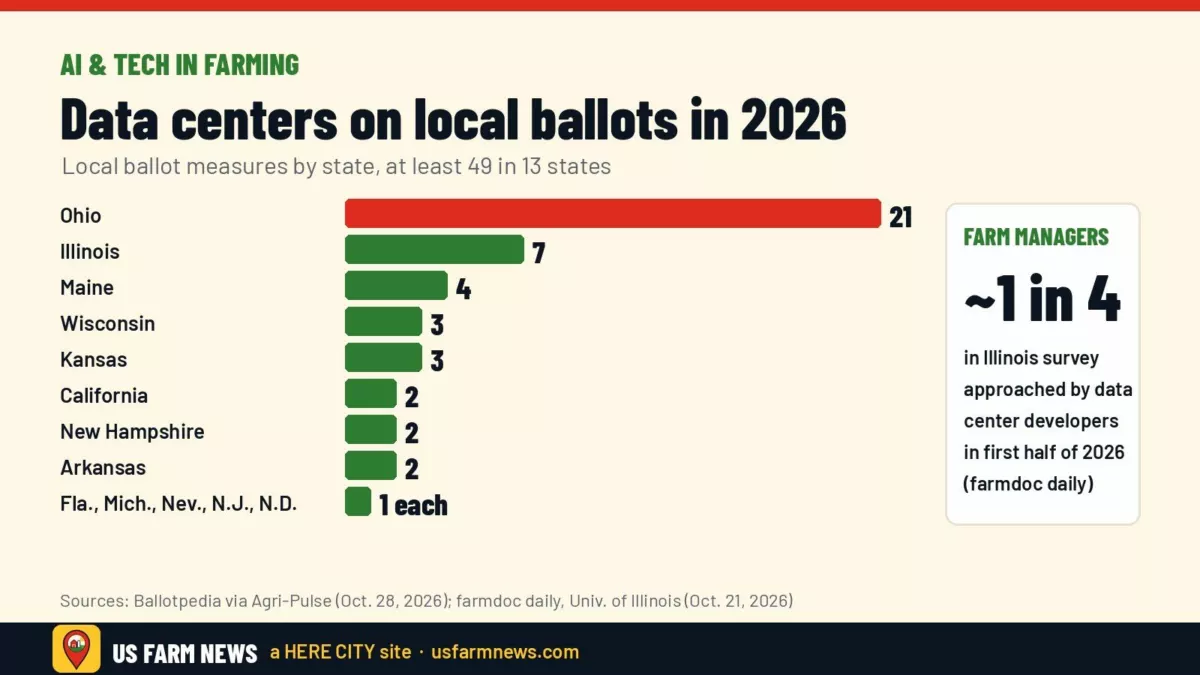
- Voters in 13 states face at least 49 local data center ballot measures this year, from outright bans to zoning limits, Agri-Pulse reported, citing Ballotpedia. Ohio has 21.
- About a quarter of Illinois farm managers surveyed said data center developers approached them in the first half of 2026, farmdoc daily reported.
- In a University of Illinois national survey, the share of adults very worried about farmland being converted to data centers rose by 15 to 20 percentage points between February and August.
- A Kansas State extension paper urges landowners to treat a developer’s option like a final contract: firm end dates, rising non-refundable payments, limits on assignment and the right to keep farming.
The artificial intelligence boom is showing up on farm country ballots today. Communities across the Midwest and beyond are voting on whether, and how, to allow the large data centers that power AI and cloud computing. Many of the proposed sites are farmland.
For landowners, that makes AI less of a software question and more of a land, water and contract question. Here is what the votes are about, what the public thinks, and what an agricultural law expert says to check before signing anything.
What’s on the ballot
At least 49 data center measures are going before local voters in 2026, according to Ballotpedia figures cited by Agri-Pulse. Ohio leads with 21. Illinois has seven, Maine four, and Wisconsin and Kansas three each. California, New Hampshire and Arkansas have two apiece, and five more states (Florida, Michigan, Nevada, New Jersey and North Dakota) have one each.
The measures take different forms. Some would ban construction, some would impose temporary moratoriums, and others change zoning, add approval steps or simply poll voters. A few examples Agri-Pulse described:
- Emporia, Kan.: A proposal would bar “high-impact” data centers in every zoning district. It defines those as sites with peak power demand above 10 megawatts or water withdrawals above 100,000 gallons a day.
- Madison County, Ill.: Four townships are asking nonbinding questions to gauge whether local officials should allow new facilities.
- Bloomington, Ill.: Voters will weigh a moratorium even though the city council already approved a six-month pause.
Most of these measures started with residents, not local governments. Ballotpedia counted 31 of 38 measures as citizen-initiated petitions, Agri-Pulse said.
Why farmland is in the middle of it
Data centers need big parcels with access to high-voltage power and water. In a June extension paper for Kansas State University’s AgManager.info, Roger McEowen of the Washburn University School of Law wrote that relatively cheap land, transmission access and water have drawn developers to farm states including Kansas, Iowa, Nebraska, Missouri, Texas and Indiana.
Bowling Green State University political scientist Dominic Wells told Agri-Pulse that a center going up near Bowling Green, Ohio, sits on farmland near Interstate 75. University of Illinois researchers, writing in farmdoc daily, cited a Dallas Fed report that farm output in West Texas is slowing as acreage shifts to data centers and alternative energy.
Water is a big part of the debate. Agri-Pulse cited a 2026 U.S. Geological Survey synthesis estimating that a single 100-megawatt data center may use 2 million gallons of water a day. Actual use depends heavily on cooling design. McEowen noted that air-cooled systems generally need far less water than evaporative ones.
What the public thinks
The University of Illinois Gardner Food and Agricultural Policy Survey asks about 1,000 U.S. adults each quarter about AI and data centers. Between February and August 2026, the share who said they were very worried about agricultural land being converted to data centers jumped 20.0 points among Democrats, 17.3 points among Republicans and 15.4 points among independents and others, the researchers reported. By August, close to half or more of every political group said they were very worried about electricity costs, water use and farmland conversion.
Agri-Pulse pointed to similar findings elsewhere. In a September Bowling Green State poll of Ohio voters, 75% expressed some level of opposition to data centers in their own communities, and 78% backed a temporary ban until more is known.
Supporters point to tax revenue and jobs. A U.S. Chamber of Commerce analysis cited by Agri-Pulse put the local job count for a typical 50-megawatt center at about 740 across a 20-year run. The farmdoc researchers found Republicans were more optimistic than other groups about those benefits, especially tax revenue.
If a developer calls: practical takeaways
McEowen’s paper opens with a scenario many landowners now recognize: a site consultant for an unnamed company offers several times farm value and wants a confidentiality agreement and a three-year purchase option signed fast. His guidance, in short:
- Read the option as if it were the final deal. Options usually come first and are often written to give the developer flexibility. Push for a firm expiration date, option payments that rise over time and are not refundable, and limits on who the developer can assign the deal to.
- Protect the farming operation. The contract should expressly allow planting, harvest, grazing, drainage upkeep, conservation work and USDA program participation until closing. Spell out who pays for crop damage, tile repair, fences and gates if the developer does soil borings or testing, even if the sale never closes.
- Check the water rights. In many states, converting an irrigation right to industrial use needs separate state approval and can be protested by neighbors. Do not assume the buyer simply takes over your right.
- Plan taxes before you sign. McEowen wrote that installment sales, how the price is allocated, like-kind exchanges and entity changes should be weighed early, because many options disappear once a binding contract is signed.
- Ask the basic questions. Who is really buying? Is this an option or a binding contract? What happens if zoning is denied or the project is abandoned? Who pays for environmental cleanup?
Neighbors who are not selling still have a stake. McEowen noted that rezoning hearings are often the best chance to shape conditions on noise, roads or groundwater monitoring, and that transmission and fiber easements should address drainage repairs, compaction and crop losses.
For more on how AI is reaching the farm, see our story on USDA’s satellite and AI crop-report plan and our Farm Management section.
This is general information, not legal, tax or financial advice. Data center deals are governed mainly by state law; talk with a qualified attorney and tax adviser in your state before signing.
Frequently asked questions
How many data center measures are on ballots in 2026?
At least 49 local measures in 13 states, according to Ballotpedia figures cited by Agri-Pulse. Ohio has the most, with 21.
What should a landowner negotiate in a data center option?
A Kansas State extension paper recommends a firm expiration date, rising non-refundable option payments, limits on assignment, and the right to keep farming and stay in USDA programs until closing.
Does a buyer automatically get my irrigation water right?
Not necessarily. In many states, changing an agricultural water right to industrial use requires separate approval and can be challenged by neighboring users.
Get the Daily Ag Business Briefing
Markets, policy and farm business in one free email each weekday.