A HERE CITY site

Farm bankruptcies are up 19% in 2026, and court filings don’t show the whole picture
Chapter 12 filings hit 292 through September, with Arkansas leading the nation in the third quarter. Here's what the data show, what they miss, and what farmers can do before renewal season.
Key takeaways
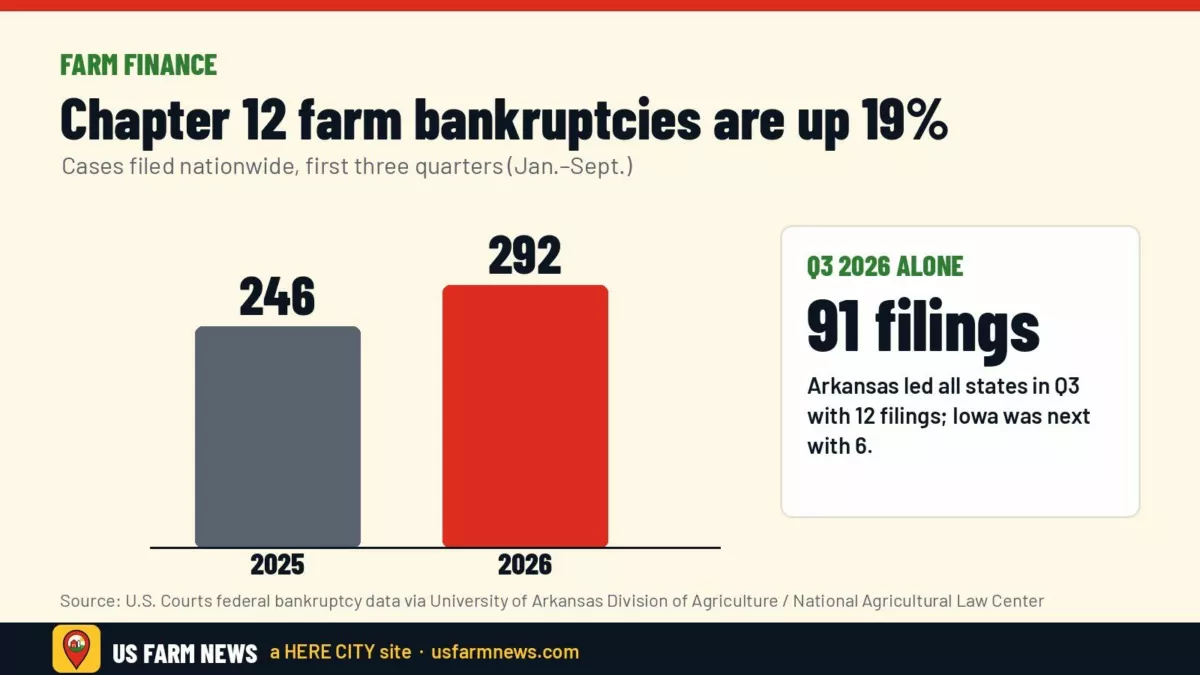
- Farmers filed 292 Chapter 12 bankruptcy cases in January–September 2026, up nearly 19% from 246 a year earlier.
- Arkansas led the third quarter with 12 filings, double Iowa’s six.
- Court filings understate stress: some farmers with equity simply quit farming, and larger operations may file under Chapter 11.
- Low row-crop prices against high input and fuel costs are the main driver. Filings are still far below 1980s levels.
Farm financial stress is showing up in bankruptcy court. Federal court data show 292 Chapter 12 farm bankruptcy cases filed nationwide from January through September 2026, nearly 19% more than the 246 filed over the same months of 2025. Of those, 91 came in the July–September quarter alone.
The numbers were compiled by the University of Arkansas System Division of Agriculture and the National Agricultural Law Center (NALC) from U.S. Courts data. Arkansas stands out. Its 12 third-quarter Chapter 12 cases were more than any other state and double Iowa’s six, the next-highest. Arkansas operations have filed 32 Chapter 12 cases so far this year.
Why Chapter 12 matters
Congress created Chapter 12 for family farmers and fishermen in 1986, when the farm debt crisis of that decade was at its worst. Instead of liquidating under Chapter 7, a farm can restructure its debts under a court-approved repayment plan and keep operating. Because it’s built for farms, economists treat it as a barometer of stress in agriculture.
It’s an incomplete barometer, though. NALC director Harrison Pittman said the filings “tell only part of the story.” The center’s DEBT Project also tracks agricultural operations that file under Chapter 11, typically larger businesses. Nationally, Chapter 11 filings of all kinds rose 11.5% over the same nine months, to 7,623, according to the Arkansas report summarized by the University of Illinois’ Farm Policy News.
Some exits never reach a courtroom. “I would love to know how many farm operators have simply ceased farming, but didn’t declare bankruptcy,” Pittman told Brownfield Ag News. “They had enough equity and they didn’t need to restructure debt, they just got out of farming.”
Why now
Margins are the short answer. Row-crop prices have been low against high input costs, and diesel and other fuel costs have climbed this year. At Thursday’s close, December corn was about $4.51 and December crude oil was above $100 a barrel. Rice, a cornerstone of Arkansas agriculture, is a case in point: the USA Rice Federation told Brownfield that this year’s price rebound hasn’t caught up with growers’ production costs. The pressure isn’t confined to farms, either. Bloomberg data cited by Farm Policy News count 221 trucking-company bankruptcies this year, and many small carriers haul grain and fertilizer.
What farmers and lenders can do
- Get ahead of renewal season. Lenders are reviewing 2026 results and 2027 plans now. A cash-flow projection with realistic prices does more for you than optimism.
- Watch working capital. Sliding working capital is usually the first warning sign, long before a missed payment.
- Use the safety net. The 2026 ARC/PLC election deadline is Dec. 11. See our guide to the decision.
- Know the options early. Farm financial counselors, state farm-mediation programs and ag-law clinics can lay out alternatives, including Chapter 12, before choices narrow.
Even at a 19% increase, today’s filings are far below 1980s levels. Still, the trend line is moving the wrong way, and the quarterly court data will be worth watching into 2027.
Get the Daily Ag Business Briefing
Markets, policy and farm business in one free email each weekday.