A HERE CITY site

Daily Ag Business Briefing, Oct. 29: Wheat exports jump, USDA unveils $472.5M food buy, farm bill math
Wheat export sales post their best week of the marketing year, USDA plans a $472.5 million Section 32 purchase, CBO scores the Senate farm bill's SNAP delay, and farm bankruptcies keep rising. Here's what moved farm business Thursday.
The briefing in 30 seconds
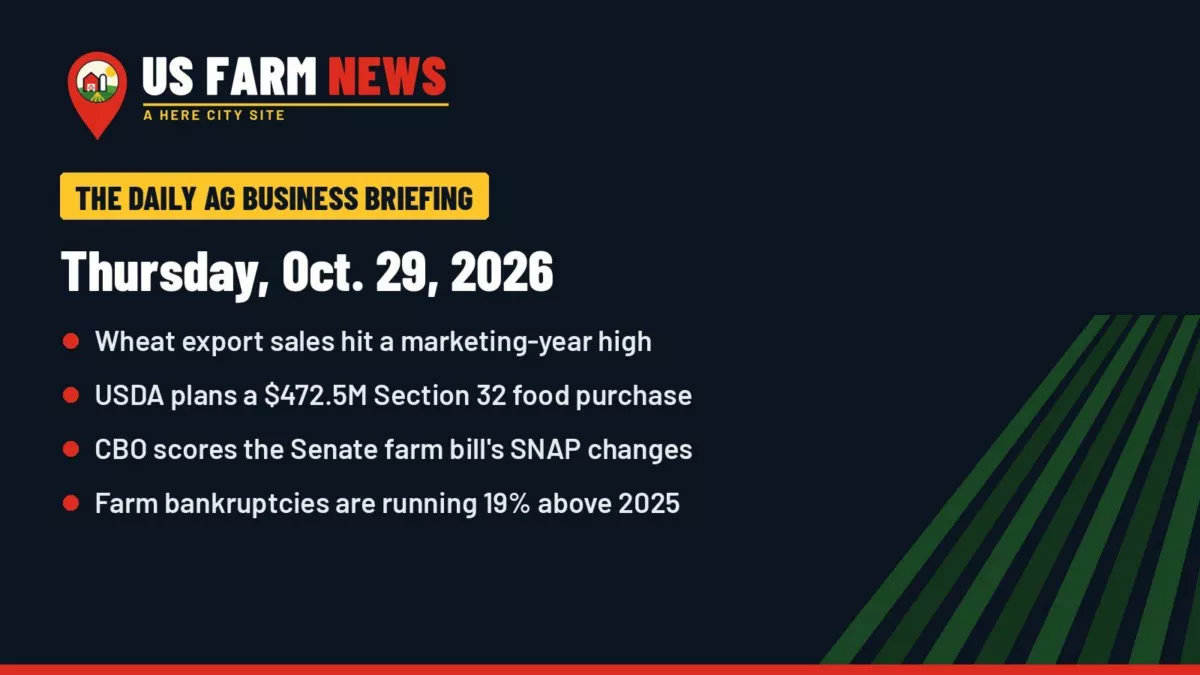
- Wheat export sales climbed to their best week of the marketing year as buyers stepped in after the recent price drop, and December Chicago wheat closed up 4¾ cents.
- USDA plans to buy up to $472.5 million in U.S. food under Section 32. Dairy gets $165.5 million of that.
- CBO puts a $1.1 billion-a-year price tag on the SNAP state cost-share mandate the Senate farm bill would delay.
- Chapter 12 farm bankruptcies are running nearly 19% ahead of 2025.
Markets: wheat bounces, cattle slip, hogs firm
Thursday’s grain trade was mixed. Brownfield Ag News’ closing tally had December corn at $4.51¼, down ½ cent, and November soybeans at $12.19¾, down 4¾ cents. December Chicago wheat gained 4¾ cents to $6.03¾ on short covering and technical buying. Brownfield described the market as “very oversold,” but traders were wary of rallying far enough to cool new demand.
Harvest pressure is still part of the story. Brownfield noted that U.S. harvest is moving quickly for soybeans, with rain expected to slow fieldwork in some areas starting this weekend. South American planting conditions look mostly favorable, though traders are watching El Niño. First notice day for November soybean futures is Friday.
Livestock futures split. December live cattle fell $1.02 to $226.30 and November feeders slipped 27 cents to $346.47 while the cash cattle trade waited for direct business to develop. December lean hogs rose $1.22 to $59.82, and Brownfield reported cash hogs “sharply higher” as packers bid up to fill needs. November Class III milk lost 38 cents to settle at $17.93. December cotton gained 35 points to 78.50 cents. December crude oil held above $100 a barrel at $102.00, an input-cost number every farm budget is watching.
Exports: a big week for wheat buyers
USDA’s weekly export sales report, covering the week ended Oct. 22, showed 31.2 million bushels of wheat sold, a high for the marketing year. The Philippines and South Korea led, according to Brownfield’s summary of the USDA data. Soybean sales of 94.7 million bushels were lower than the prior week but still above average, mostly to China and Spain. Corn sales of 51.3 million bushels were also above average, headed by unknown destinations and Mexico. Pork sales rose 13% from the previous week.
The next big test for prices is USDA’s November supply-and-demand update on Nov. 10.
USDA opens its wallet: $472.5 million in Section 32 buys
USDA said Thursday it intends to buy up to $472.5 million in American-grown commodities for food banks and nutrition programs, using its Section 32 authority. Dairy is the biggest line at $165.5 million, followed by pork ($41 million), split peas ($37 million), almonds ($30 million) and lentils ($29 million). Smaller amounts go to rice, chicken, catfish, citrus, raisins and hazelnuts. Our full breakdown has the details.
The rice piece, $21 million, came at the industry’s request. USA Rice’s Jake Westlin told Brownfield that the price rebound of recent months still falls short of growers’ production costs, and that imported rice keeps weighing on domestic prices.
Washington: farm bill math and an E15 fight
The Congressional Budget Office released its estimate of the Senate farm bill’s budget effects, Agri-Pulse reported. The state cost-share requirement for SNAP created by the One Big Beautiful Bill Act would cost states about $1.1 billion a year. The Senate bill would push that mandate back a year, to Oct. 1, 2028, which CBO estimates would save states roughly $5.2 billion.
Separately, 22 House Republicans led by Republican Study Committee Chairman August Pfluger of Texas warned Speaker Mike Johnson about the Senate bill’s year-round E15 language and its overhaul of small refinery exemptions. Our E15 story explains what’s at stake for corn demand. Lawmakers return Nov. 9, and House and Senate ag leaders want a final farm bill before the session ends Jan. 3.
Farm finance: bankruptcies keep climbing
Farmers filed 292 Chapter 12 bankruptcy cases from January through September, compared with 246 in the same stretch of 2025, and 91 of them came in the July–September quarter, according to a University of Arkansas analysis of federal court records. Read our analysis.
What to watch
- Friday: first notice day for November soybeans.
- Monday: USDA Crop Progress (4 p.m. ET). As of Oct. 25, corn was 60% harvested and soybeans 79%. Our harvest story.
- Nov. 9: Congress returns from recess.
- Nov. 10: USDA WASDE report.
- Dec. 11: ARC/PLC election deadline. Here’s how to think about it.
Market figures are as reported by Brownfield Ag News (data: Barchart, delayed) and are for information only.
Get the Daily Ag Business Briefing
Markets, policy and farm business in one free email each weekday.