A HERE CITY site

Harvest check: soybeans pull ahead, but Iowa corn is 20 points behind
USDA says 79% of U.S. soybeans and 60% of corn were harvested as of Oct. 25. Iowa corn is lagging badly. Here's the state of the harvest and the weather ahead.
Key takeaways
- As of Oct. 25, U.S. corn was 60% harvested vs. a 66% average; Iowa was far behind at 47% vs. 67%.
- Soybeans were 79% harvested, 2 points ahead of average after a very late September start.
- Winter wheat was 76% planted and 53% emerged, both close to normal.
- Faster soybean harvest feeds exports; slow corn harvest can support local basis. Next report: Monday, Nov. 2, 4 p.m. ET.
The 2026 harvest is running in two directions. USDA’s latest Crop Progress report puts the soybean harvest slightly ahead of normal after a slow September start, while corn is still behind, especially in Iowa.
The numbers (as of Oct. 25)
| Crop / stage | 2026 | 5-year average |
|---|---|---|
| Corn harvested | 60% | 66% |
| Iowa corn harvested | 47% | 67% |
| Soybeans harvested | 79% | 77% |
| Winter wheat planted | 76% | 77% |
| Winter wheat emerged | 53% | 54% |
Source: USDA National Agricultural Statistics Service, Crop Progress, released Oct. 26, 2026, as reported by DTN.
Corn: Iowa is the drag
Nationally, 60% of the corn crop was out of the field by Sunday, 6 points behind the five-year pace. Iowa explains most of the gap. DTN Lead Analyst Rhett Montgomery pointed out that just 47% of Iowa’s crop had been harvested, compared with a 67% state average for late October. Twenty points is a lot of acres in the country’s top corn state.
Of the corn still standing, NASS rated 56% good-to-excellent, unchanged from the week before. The very poor-to-poor share edged up a point to 18%. Those ratings matter less this late in the season than standability. The longer mature corn stands, the more exposure it has to stalk lodging and wind damage.
Soybeans: a comeback
Soybeans are the better story. At 79% harvested, the crop is 2 points ahead of average. “The 2026 U.S. soybean harvest has staged an impressive comeback after a very late start in September and is now ahead of the usual pace for late October,” Montgomery told DTN. He noted that Iowa and Nebraska, where delays were worst, “made up considerable ground as weather conditions improved in October.”
Winter wheat: rain helped and hurt
Winter wheat seeding reached 76%, a point behind normal. Recent rain slowed planting, but Kansas, the top producer, was 80% planted, and emergence was running close to average at 53%. In the Plains, moisture now helps a crop that needs to establish before dormancy.
Weather and the week ahead
DTN Ag Meteorologist John Baranick expected only minor fieldwork disruptions this week, with scattered showers along a system crossing the Plains into the Upper Midwest and mostly above-normal temperatures. By Thursday, the Brownfield Ag News grain wrap was flagging probable near-term delays in some areas starting this weekend, which traders said could push corn harvest back further in key states.
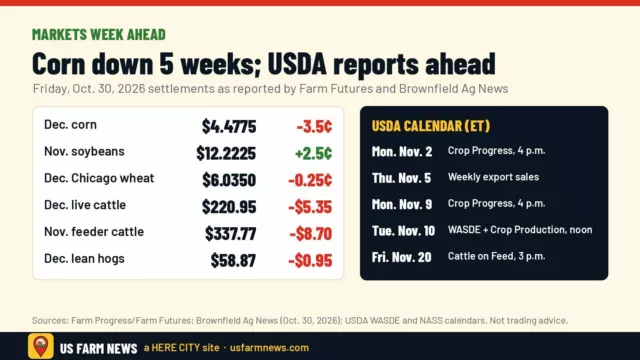
For markets, the pace matters in two ways. Faster soybean harvest means more beans available to move into a busy export program. Brownfield reported 94.7 million bushels of soybean sales in the latest weekly USDA data, mostly to China and Spain. Slower corn harvest can support basis in areas where farmers are behind. December corn closed at $4.51¼ on Thursday.
The next Crop Progress report comes out Monday, Nov. 2, at 4 p.m. ET. State-level detail is on each NASS state office’s “Crop Progress & Condition” page.
Get the Daily Ag Business Briefing
Markets, policy and farm business in one free email each weekday.