A HERE CITY site

Corn slips a fifth straight week and cattle tumble: What to watch before USDA’s Nov. 10 WASDE
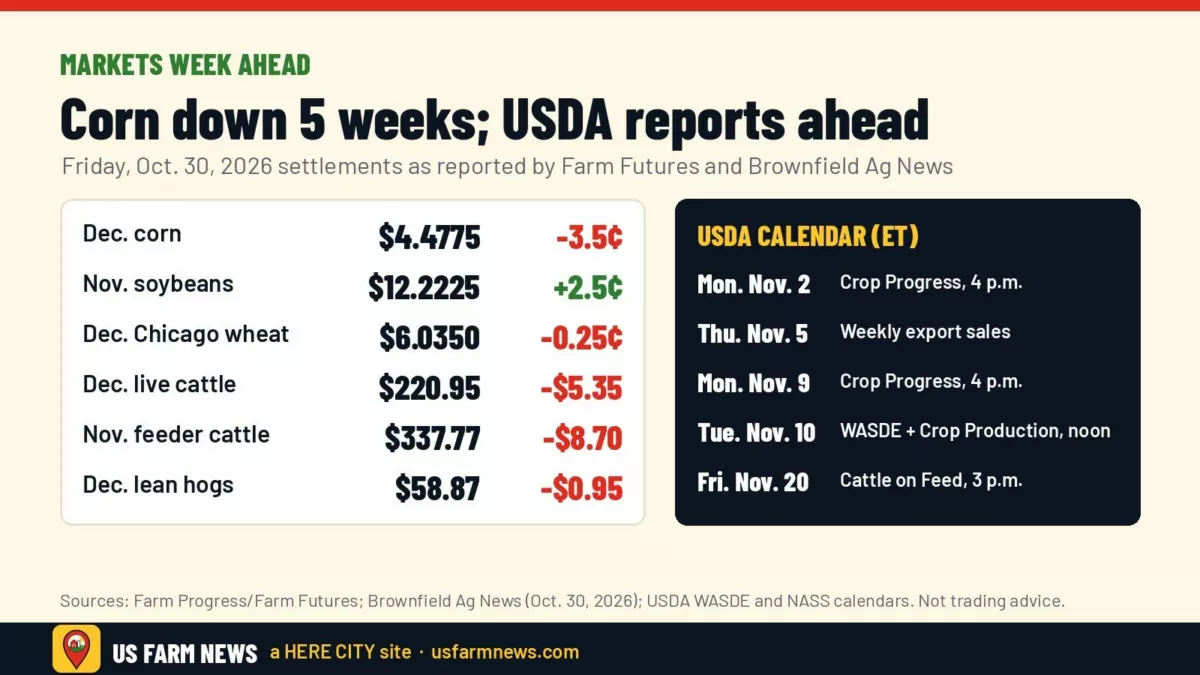
December corn ended Oct. 30 at $4.4775, a fifth weekly loss, and feeder cattle fell $8.70. Crop Progress comes Monday and WASDE on Tuesday, Nov. 10.
Key takeaways
- December corn fell for a fifth straight week and settled Friday, Oct. 30, at $4.4775, according to Farm Futures. Traders are still focused on USDA’s 181.2 bushel-per-acre yield estimate.
- Cattle futures dropped sharply Friday. December live cattle lost $5.35 and November feeders $8.70, which Brownfield blamed on technical selling and demand worries.
- Soybeans held near $12.22 for November on two flash export sales. Wheat export sales hit a marketing-year high.
- Ahead: Crop Progress on Monday, Nov. 2, then USDA’s WASDE and Crop Production on Tuesday, Nov. 10.
Grain markets ended October without the post-harvest bounce many farmers were waiting for. Cattle, which had held up through most of the fall, took a hard hit to close the week. Here’s where prices stood at Friday’s close, what drove them, and the USDA reports that could move them next. Plan this week’s marketing and cash-flow decisions around those dates.
Corn: harvest pressure and a big yield number
December corn lost 3.5 cents Friday to settle at $4.4775 a bushel, and March fell 3.75 cents to $4.61, Farm Futures senior editor Ben Potter reported for Farm Progress. That was the fifth weekly decline in a row. Traders are still weighing USDA’s 181.2-bushel national yield estimate and whether the department will lower it in later reports.
Jon Scheve of Scheve Grain said the market is down about $1 a bushel from its highs, mostly because of heavy fund selling. “Until at least 80% of the corn crop has been harvested, it will be difficult for prices to rally much,” he told Farm Futures. Scheve added that ARC, PLC and diesel relief payments should give farmers enough cash flow to wait for a possible post-harvest rally.
The latest USDA count put corn harvest at 60% complete as of Oct. 25; see our Crop Progress breakdown. Monday’s report will show how much ground was covered last week.
Soybeans and wheat: export demand shows up
November soybeans gained 2.5 cents to $12.2225, Brownfield’s closing table showed. January slipped half a cent to $12.3425, according to Farm Futures. Private exporters reported two flash sales to unknown destinations, one for 6.1 million bushels and one for 4.9 million, both for the 2026-27 marketing year. JJ Keske of Advance Trading told Farm Futures that the firm’s ending stocks estimate of 316 million bushels is close to USDA’s 315 million. He called the balance sheet balanced rather than burdensome and pegged the average harvest price for crop insurance on November soybeans near $12.50.
In wheat, December Chicago soft red winter eased a quarter cent to $6.0350, and Kansas City hard red winter lost a penny to $6.4425. USDA’s weekly report showed wheat export sales of 32 million bushels for the week through Oct. 22, a marketing-year high and far above the trade range of 7.3 million to 18.4 million bushels, Farm Futures reported.
Cattle and hogs: a sharp Friday selloff
December live cattle gave up $5.35 to settle at $220.95, while November feeder cattle dropped $8.70 to $337.77, Brownfield Ag News reported. Brownfield attributed the slide to technical selling and worries about softer demand. Cash trade was light: live cattle in Kansas traded at $225, and dressed sales in Nebraska ran $350 to $352. Both were below the prior week’s weighted average. Choice boxed beef slipped $2.62 to $364.66.
December lean hogs fell 95 cents to $58.87 on fund and technical selling. Brownfield said the cash hog market is still struggling to find steady support.
Cattle producers in the Southwest also have a disease issue to watch: New World screwworm was just confirmed in Arizona for the first time. See our livestock coverage.
Weather and outside markets
NOAA’s 72-hour outlook called for 1.5 inches of rain or more over big portions of Iowa, Kansas, Minnesota, Nebraska and South Dakota from Saturday through Tuesday, which could slow harvest. For Nov. 6-12, NOAA’s 8-to-14-day outlook points to a return to seasonally dry conditions in the eastern Corn Belt, Upper Midwest and Northern Plains, and warmer-than-normal readings are likely across the central U.S., Farm Futures reported. In energy, Brent crude rose more than 2% Friday to about $113 a barrel, and Brownfield listed December crude oil up $2.12 at $104.12. That matters for diesel and drying costs.
What to watch this week
- Monday, Nov. 2, 4 p.m. ET: NASS Crop Progress, with the latest corn and soybean harvest pace.
- Thursday morning: USDA’s weekly export sales, to see whether last week’s strong wheat number holds.
- Monday, Nov. 9, 4 p.m. ET: the next Crop Progress report.
- Tuesday, Nov. 10, noon ET: WASDE and NASS Crop Production. This is the next chance for USDA to revise the 181.2-bushel corn yield.
- Friday, Nov. 20, 3 p.m. ET: NASS Cattle on Feed.
Futures prices in this story are as reported by the named sources. For official settlements, see CME Group. Nothing here is trading advice. Find more market coverage in our Markets section.
Get the Daily Ag Business Briefing
Markets, policy and farm business in one free email each weekday.