A HERE CITY site

Year-end farm tax planning for 2026: Section 179 at $2.56 million, 100% bonus and prepaid inputs explained
Section 179 tops out at $2.56 million for 2026 and 100% bonus depreciation is back. Here's how farms can use them, plus prepaid inputs, before Dec. 31.
Key takeaways
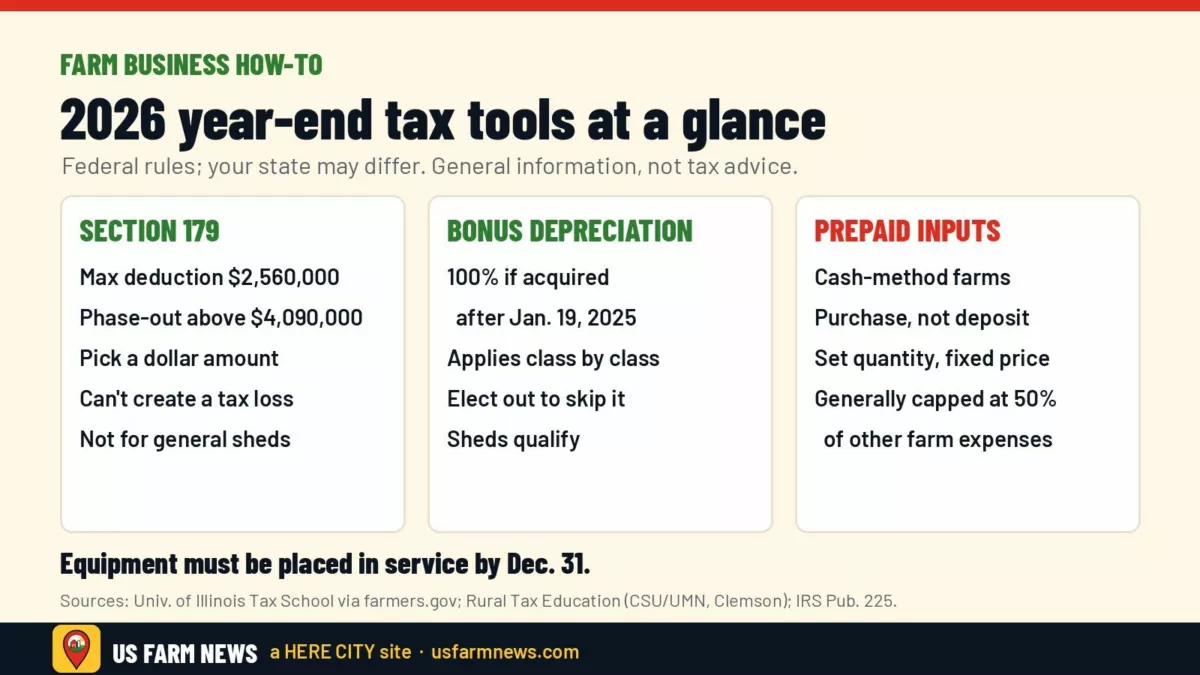
- For 2026, the Section 179 expensing limit is $2,560,000, and it starts to phase out once qualifying purchases top $4,090,000, according to University of Illinois Tax School material published on farmers.gov.
- 100% bonus depreciation applies to qualifying property acquired after Jan. 19, 2025. Either way, a machine must be placed in service by Dec. 31 to count for 2026.
- Cash-method farmers can deduct prepaid seed, feed and fertilizer in the year paid if it is a true purchase, not a deposit. The deduction is generally capped at 50% of other deductible farm expenses.
- Some levers still work after Dec. 31, including income averaging and electing out of installment reporting on deferred grain contracts.
With harvest winding down, most farms have a rough idea of what 2026 income will look like. Now is the time to sit down with your tax preparer, because several of the biggest tax-management tools only work if you act before Dec. 31. This guide covers the main year-end options, drawn from IRS Publication 225 (the Farmer’s Tax Guide) and Rural Tax Education fact sheets written by land-grant university extension specialists.
One caution first. Pushing your taxable income as low as possible is not always the best plan. A Clemson University extension fact sheet published by Rural Tax Education in October notes that cutting this year’s tax to the bone can hurt in later years, and that comparing this year’s tax rates with past and expected future rates is often smarter.
1. Equipment: Section 179 vs. bonus depreciation
The 2025 tax law restored 100% bonus depreciation for property acquired after Jan. 19, 2025, and raised the Section 179 limits. Bob Rhea of the University of Illinois Tax School laid out the 2026 figures in a February webinar for Rural Tax Education, which farmers.gov posted:
- Section 179 maximum deduction: $2,560,000 for tax years beginning in 2026.
- Phase-out threshold: $4,090,000 of qualifying purchases. Above that, the deduction shrinks dollar for dollar.
- Bonus depreciation: 100% for qualifying assets acquired after Jan. 19, 2025; 40% for assets acquired before Jan. 20, 2025.
The two tools work differently, and the difference matters when you have more deductions than you need:
- Section 179 can be taken in a specific dollar amount, is claimed first, can’t push the return into a loss and can be changed on an amended return, according to the webinar.
- Bonus depreciation applies automatically to every asset in a class life. To skip it, you must elect out for the whole class on your return.
- Buildings: a general farm building such as a machine shed is 20-year property. Section 179 is not available for it, but bonus depreciation is. Single-purpose livestock and horticultural structures do qualify for Section 179.
- Used vs. new: new farm machinery has a five-year recovery period and used machinery seven years, the webinar said, and both can qualify for Section 179 and bonus.
The Dec. 31 test: ordering a tractor is not enough. To deduct it for 2026, the machine must be placed in service, which the webinar describes as being “in a state of readiness” for its intended use, by year-end. A Clemson fact sheet adds that equipment bought after year-end can’t be depreciated on the current return.
Trade-ins: since the 2017 tax law, trading in machinery no longer defers gain. The Illinois webinar’s example shows the gain on a fully depreciated trade-in reported on Form 4797, while the full price of the new machine is eligible for depreciation.
State rules: your state may not follow federal depreciation. The webinar uses Illinois as an example where state depreciation differs.
If you are shopping for iron to beat the deadline, our sourced tractor comparison may help, but buy because the farm needs the machine, not just for the deduction.
2. Prepaying 2027 inputs
Farmers on the cash method can deduct seed, feed, fertilizer and similar supplies paid for this year but used next year. A Rural Tax Education fact sheet by Colorado State and University of Minnesota extension specialists lists three tests:
- It must be a purchase, not a deposit. In general, you must be locked in to accept a set amount of product at a set price, with no right to a refund. Signs of a deposit include no set quantity, a right to get unused money back, a seller that books the payment as a deposit, or the right to swap in different products.
- It needs a business reason beyond cutting taxes, such as locking in a price or making sure supply is available.
- It can’t materially distort income. The IRS looks at your usual practice, the size of the expense compared with income, when in the year you bought, and how it compares with past purchases.
The deduction for prepaid supplies is generally limited to 50% of your other deductible Schedule F expenses. A farm-related taxpayer can get around that limit in some cases, for example when prepaid expenses over the prior three years were less than 50% of other expenses, the fact sheet says. IRS Publication 225 has the full rules.
Fertilizer prices make this decision bigger than usual. DTN’s latest retail survey put anhydrous ammonia at an average of $1,007 a ton. If your plans change and you return prepaid inputs, document the deal carefully so the original payment isn’t treated as a deposit, the fact sheet advises.
3. Tools that still work after Dec. 31
The Clemson fact sheet lists several options you and your preparer can use while filling out the return:
- Choose how fast to depreciate assets bought in 2026. You can take Section 179 or bonus, or slow it down with straight-line or the Alternative Depreciation System. This changes timing, not the total.
- Farm income averaging on Schedule J lets you apply the lower tax brackets from the prior three years to some of this year’s farm income. It doesn’t amend old returns.
- Deferred-payment grain contracts: income on a contract signed this year but paid in 2027 is normally taxed in 2027. You can elect to report it in 2026 instead. Several smaller contracts give more flexibility than one big one, because each stands alone. You cannot set up a deferral after year-end.
- CCC loans: you can elect to treat Commodity Credit Corporation loans as income in the year received.
- Retirement and health accounts: IRA and SEP contributions, and HSA contributions if you have a qualifying plan, can be made up to the filing deadline.
- Raising income on purpose: if 2026 was a low year, you can amortize fertilizer instead of expensing it or capitalize repairs, both by annual election.
Crop insurance proceeds may also be deferred to the next year in some cases if you can show you normally sell the crop in the following year. See our guide to 2026 harvest prices and crop insurance claims.
Your year-end to-do list
- Book a meeting with your tax preparer in November or early December, with year-to-date income and expenses.
- List machines and buildings bought or planned this year, with delivery and in-service dates.
- Get input prepay contracts in writing with quantity and fixed price.
- Count grain sold on deferred contracts and decide what to report this year.
- Check your state’s depreciation rules.
This is general information, not legal, tax or financial advice. Tax rules depend on your facts; confirm everything with a qualified tax professional.
Frequently asked questions
What is the Section 179 limit for 2026?
The maximum deduction is $2,560,000 for tax years beginning in 2026, and it phases out once qualifying purchases exceed $4,090,000, according to University of Illinois Tax School material posted on farmers.gov.
Can I deduct a tractor I order in December but receive in January?
Generally no. Equipment must be placed in service, meaning ready for its intended use, by Dec. 31 to be depreciated on the 2026 return.
How much can I deduct for prepaid fertilizer and seed?
Generally no more than half of your other deductible farm expenses that year, if it is a true purchase with a business purpose. Some farm-related taxpayers can exceed that limit.
More guides are in our Farm Management section.
Get the Daily Ag Business Briefing
Markets, policy and farm business in one free email each weekday.