A HERE CITY site

2026 crop insurance harvest prices are $4.75 corn, $12.63 soybeans: How to tell if you still have a claim
Harvest prices beat spring levels at $4.75 corn and $12.63 soybeans. With RP, a claim now turns on bushels. Worked examples and a to-do list for farms.
Key takeaways
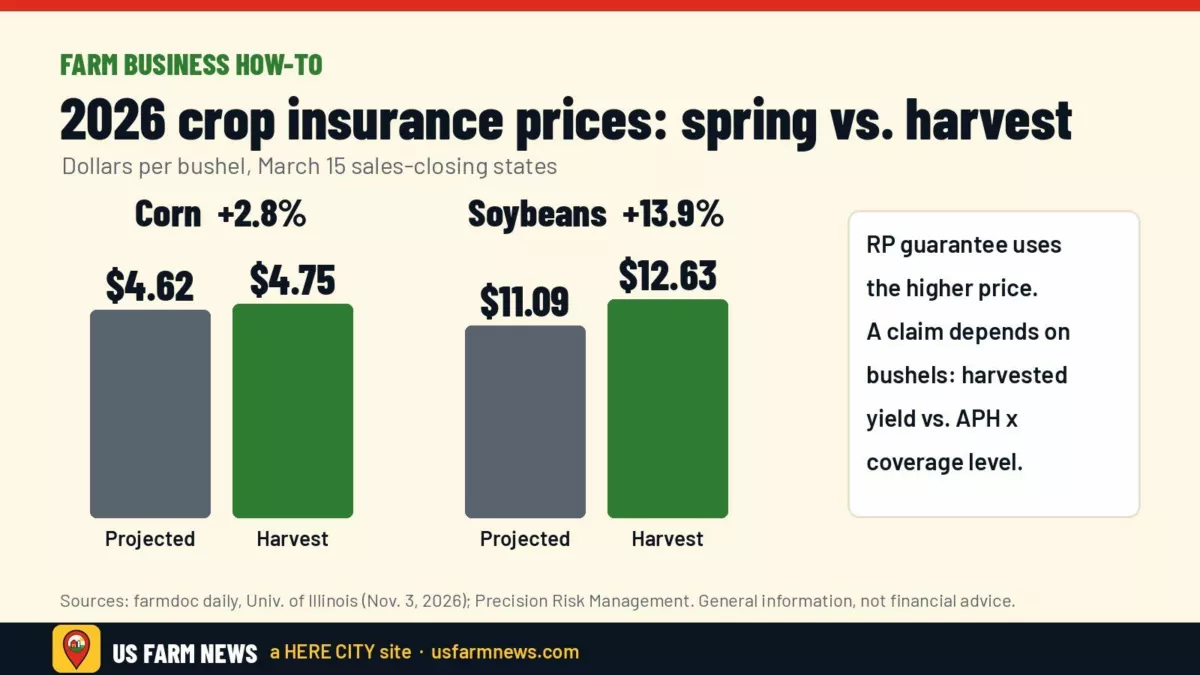
- The 2026 crop insurance harvest prices are $4.75 for corn and $12.63 for soybeans, both above the spring projected prices of $4.62 and $11.09, farmdoc daily reported.
- With Revenue Protection (RP), your guarantee now uses the higher harvest price, so a claim comes down to bushels: if your yield on a unit fell short of guaranteed bushels, you may still have a loss.
- In a farmdoc example, an 85% RP corn policy on a 220-bushel guarantee yield pays from 187 bu./acre or lower.
- Get production records to your agent early, and don’t sell or mix grain from a possible loss unit before you call.
The last piece of the 2026 crop insurance math is in. October futures averages set the harvest prices for corn and soybeans, and both finished above where they started the year. That raises the revenue guarantee on most Revenue Protection policies, but it doesn’t mean no one will collect. Here is how to tell whether you might have a claim, and what to do now.
The 2026 numbers
- Corn: harvest price $4.75, based on the December 2026 CME corn contract’s average settlement in October. That is 13 cents, or 2.8%, above the $4.62 projected price, according to farmdoc daily at the University of Illinois.
- Soybeans: harvest price $12.63, from the November 2026 contract’s October average. That is $1.54, or 13.9%, above the $11.09 projected price.
- Spring wheat: its harvest price was set in August at $6.92, up $0.73 from the $6.19 projected price, crop insurer Precision Risk Management (PRM) said.
PRM noted these figures are for states whose sales closing date is March 15, which covers most of its corn and soybean customers. Your agent can confirm the prices on your policy.
This is a change from recent years. farmdoc said the corn harvest price was below the projected price in each year from 2023 through 2025, and the soybean harvest price was below it from 2022 through 2025.
How a higher harvest price changes your policy
Revenue Protection (RP). Your guarantee is figured from the higher of the two prices. PRM lays out the formula as APH yield times coverage level times the higher price. Because the harvest price is used both for the guarantee and to value the crop you harvested, the price effectively cancels out. The question becomes whether your harvested bushels on a unit fell below your guaranteed bushels (APH times coverage level). If they did, every bushel of shortfall is valued at the harvest price.
RP with the Harvest Price Exclusion (RP-HPE). Here the guarantee is locked at the spring projected price, while the crop you harvested is valued at the higher October price. That makes a payment less likely, and farmdoc said it will take bigger yield losses to trigger one than under RP.
Yield Protection (YP). Losses are valued at the projected price. farmdoc said YP triggers at the same yield shortfall as RP, but pays less because it uses the lower spring price.
SCO and ECO. These area plans also need county yield losses this year. Because their coverage levels are higher (86% for SCO, and 90% or 95% for ECO), smaller county shortfalls can trigger them. Payments won’t be known until RMA releases 2026 county yields, which farmdoc said typically happens in June.
Worked examples
farmdoc’s scenarios use a corn guarantee yield of 220 bushels and a soybean guarantee yield of 70 bushels:
- Corn, 85% RP: pays when yield is 187 bu./acre or lower. At 180 bushels, the indemnity is $33.25 per acre. At 160 bushels, it is $128.25.
- Corn, 80% or 75% RP: payments start at 176 or 165 bushels or less, respectively.
- Soybeans, 85% RP: pays at 59.5 bu./acre or lower. At 58 bushels, the indemnity is $18.94 per acre. At 52 bushels, it is $94.73.
- Soybeans, 80% or 75% RP: payments start at 56 or 52.5 bushels or less, respectively.
You can check the corn math yourself. 220 bushels at 85% coverage guarantees 187 bushels. A 180-bushel yield is 7 bushels short, and 7 times $4.75 is $33.25. farmdoc also posts a free Excel calculator where you can enter your own APH yield.
PRM’s simplified example shows how much the price move adds. On a 100-acre corn field insured at 80% RP, the guarantee was $73,920 at the $4.62 projected price. At the $4.75 harvest price, it rose to $76,000, or $2,080 more protection.
Will many farms collect?
Probably not most of them, at least in Illinois. farmdoc pointed to USDA’s latest Illinois yield estimates of 208 bushels for corn and 68 for soybeans, both near or above trend, and said individual payments are not expected to be widespread there. Still, some farms and parts of the country will have yield losses large enough to trigger RP payments.
Your to-do list
- Pull your numbers by unit. Gather scale tickets, elevator settlements and bin measurements for each insured unit, and compare harvested bushels with guaranteed bushels.
- Report production early. PRM said reporting production early speeds up claim handling and payment, which can help with fall bills, input prepays and land rent.
- Call before you sell or mix grain. If you suspect a loss on a unit, PRM advises calling your agent before that grain is sold, fed or commingled, since an adjuster may need to measure it in the bin.
- Keep your records. Accurate production reports protect your APH and your future guarantees. For more on why record accuracy matters, see our story on how yield-monitor data became evidence in a North Dakota crop insurance case.
This is general information, not legal, tax or financial advice. Your policy terms, unit structure and quality adjustments determine any payment; confirm details with your crop insurance agent.
Frequently asked questions
What is the 2026 crop insurance harvest price for corn and soybeans?
The harvest price is $4.75 per bushel for corn and $12.63 for soybeans, based on October averages of the December corn and November soybean futures contracts. Both are above the projected prices of $4.62 and $11.09.
Can I have a Revenue Protection claim when prices went up?
Yes. When the harvest price is higher, RP payments depend on bushels. If a unit’s harvested yield comes in under your APH yield times your coverage level, you may have a loss, paid at the harvest price.
When will SCO and ECO payments be known?
They depend on county yields, which RMA typically releases in June of the following year.
More guides are in our Farm Management section.
Get the Daily Ag Business Briefing
Markets, policy and farm business in one free email each weekday.