A HERE CITY site

New hay tools for 2027 compared: Case IH WD6 windrower, Deere hands-free baling and Massey Ferguson’s single-row bale chute
Case IH's 285-hp WD6 windrower, Deere hands-free round baling and an MF single-row bale chute: published specs, claims and who each fits, side by side.
Key takeaways
- Three new hay tools shown at the 2026 Farm Progress Show target the same problem: short cutting windows and fewer skilled operators.
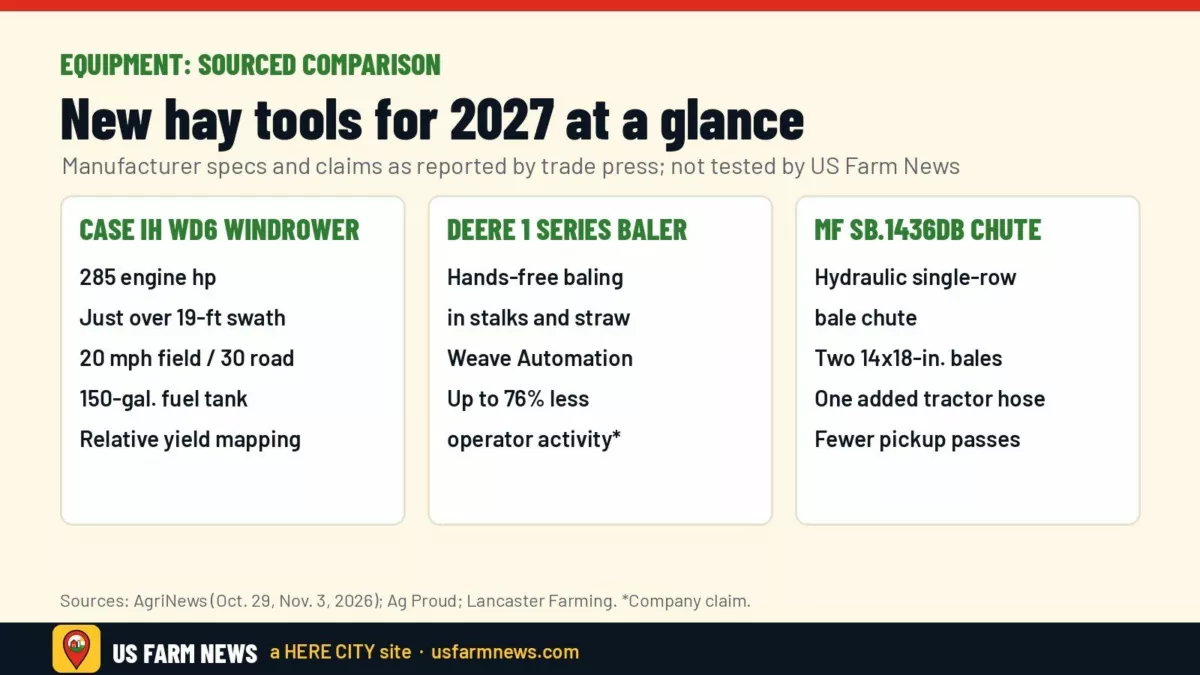
- Case IH’s WD6 windrower has 285 engine hp, a cutting swath just over 19 feet, field speeds to 20 mph and what the company calls the first relative yield mapping on a swather, AgriNews reported.
- John Deere says hands-free baling on its 1 Series round baler cuts operator activity by up to 76%; Massey Ferguson added a single-row bale chute for its SB.1436DB small square baler.
- The launches arrive in a weak market: AEM said U.S. tractor sales fell 16.4% in September from a year earlier.
If hay is part of your operation, the 2027 lineup has a clear theme. Manufacturers are adding speed, automation and data to windrowers and balers, aimed at growers who have more acres to cover in the same short weather windows. Here’s a side-by-side look at three new hay tools, based on what the companies and trade press have published. US Farm News has not tested these machines. Specs and claims below come from the manufacturers as reported by AgriNews, Ag Proud and Lancaster Farming.
Case IH WD6 series windrower
Ryan Kau, Case IH’s hay and forage customer segment lead, told AgriNews the WD6 is built for customers who “have short windows in the hay season” and in some cases are covering more acres. The published specs:
- Power: 285 engine horsepower.
- Speed: field speed up to 20 mph; road speed up to 30 mph.
- Cutting width: just over 19 feet. Kau called it the largest in the industry, and Ag Proud described it as the widest disc head available.
- Fuel: a 150-gallon tank, which Kau said is 25% more than before and lets an operator stay in the field for more than 10 hours.
- Header control: an active hydraulic float system that adds oil as needed to keep ground pressure steady. Kau said that should reduce scalping and lead to better later cuttings.
- Data: Relative Yield Mapping uses ground speed and crop pressure to estimate yield across the field. Data flows into Case IH’s FieldOps platform, which Ag Proud said comes through its Connectivity Included package without an annual subscription.
Who it fits: larger hay operations and custom cutters who need more acres per day and want yield data from hay ground, not just grain fields. Ask your dealer about price, header options and how the yield maps compare with bale counts or scale weights on your own fields.
John Deere 1 Series round baler with hands-free baling
Deere has extended hands-free baling to corn stalks and straw on its 1 Series round baler, Kaylene Ballesteros, Deere’s marketing manager for hay and forage equipment, told AgriNews. The system builds on features Deere already sold:
- Weave Automation, launched last year, has the baler weave across uneven windrows to feed the pickup evenly and make square-shouldered bales.
- Speed and gate automation stops the tractor at the set bale size, ejects the bale and lets the operator resume.
- AutoTrac guidance keeps the tractor going straight while the baler handles the weaving.
Ballesteros said the combination cuts operator activity by up to 76%, counting tasks like watching the display and looking back at the baler. She said that could let a less experienced person run the baler while a more skilled worker does something else. Deere also offers baling documentation that ties field records, such as fertilizer applied, to yield. Ballesteros described one customer who found he was over-applying fertilizer and saved $126 an acre, a single-customer example rather than a typical result.
Who it fits: operations that bale stalks or straw over many acres with tight labor. Check which tractors and guidance subscriptions the features require.
Massey Ferguson single-row bale chute for the SB.1436DB
For small-square hay, Massey Ferguson unveiled a hydraulic singulation chute for its SB.1436DB baler, Lancaster Farming reported. The baler turns out a pair of 14-by-18-inch bales side by side. The new chute pushes one bale ahead of the other so they land in a single straight row, which means fewer passes to pick them up than with the double-wide chute that is also offered.
- Adjustable paddles handle different bale lengths and set when each side releases its bale.
- Hookup: it runs off a hydraulic pump on the baler and needs just one added tractor hose to lift and lower the chute.
- Trailing design: caster wheels and suspension let it follow the baler over uneven ground. The design is patent-pending, and it can be raised and locked for transport.
Who it fits: commercial small-square producers whose bottleneck is bale collection, not baling speed.
At a glance
- Labor saved: WD6, longer days per tank and faster field speed. Deere, up to 76% less operator activity, according to the company. MF chute, fewer collection passes.
- Data: WD6, relative yield maps in FieldOps. Deere, baling documentation in its system. MF chute, none listed.
- Best match: WD6, large hay acres and custom cutting. Deere, stalks and straw. MF chute, commercial small squares.
The market backdrop
These launches come in a tough year for equipment sales. U.S. farm tractor sales fell 16.4% in September from a year earlier, and combine sales fell 10.9%, Lancaster Farming reported, citing the Association of Equipment Manufacturers (AEM). Year-to-date tractor sales through September were 135,325, compared with 154,869 a year earlier. AGCO CEO Eric Hansotia told analysts this fall that worldwide equipment demand has sunk to a more-than-10-year low, though he expects the industry to start recovering in 2027, Pro Farmer reported.
For buyers, soft demand can mean more room to negotiate on price and trade-ins. Get written quotes, ask about early-order programs, and price the data or guidance subscriptions some features need. Our recent look at Deere’s factory callbacks and what they mean for equipment buyers covers dealer inventory. For tractors, see our Deere 6R vs. Massey Ferguson 7S Mark 2 comparison.
Get the Daily Ag Business Briefing
Markets, policy and farm business in one free email each weekday.