A HERE CITY site

Democrats win Congress after farm-state Senate flips: What it means for the farm bill and ag committees
Democrats won the House and Senate, flipping Iowa, Kansas, Ohio and Texas seats. Here's what it means for the farm bill lame duck and the ag committees.
Key takeaways
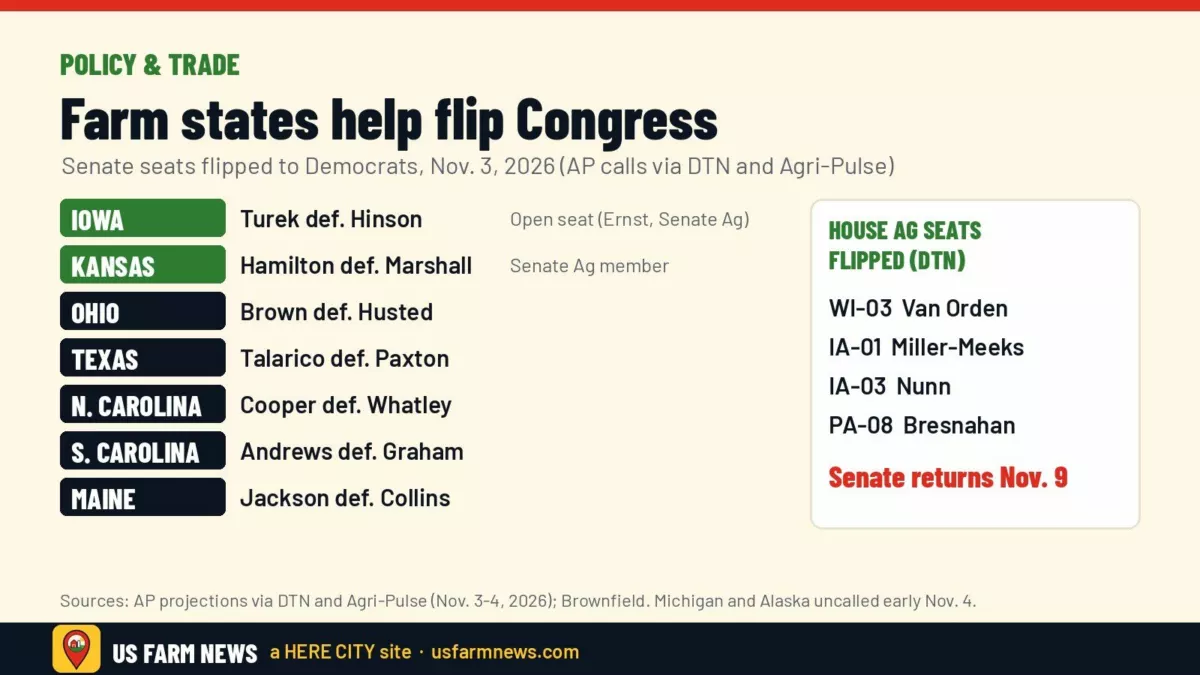
- Democrats captured both the House and Senate on Nov. 3, flipping at least seven Senate seats, including farm-state seats in Iowa, Kansas, Ohio and Texas, according to AP projections reported by DTN and Agri-Pulse.
- At least four House Agriculture Committee seats held by Republicans flipped, and Senate Ag Republican Roger Marshall of Kansas was defeated.
- Republicans keep their majorities until January. The Senate returns Nov. 9, and the lame duck is the last chance for this Congress to pass a five-year farm bill.
- The main obstacle is still the SNAP cost-share fight. Sen. Chuck Grassley said on Election Day that some compromise with Democrats may be needed.
Farm country helped flip Congress on Tuesday. Democrats won majorities in both chambers, and several of the deciding Senate wins came in states that grow much of the nation’s corn, soybeans, wheat and cattle. For farmers still waiting on a five-year farm bill, that changes the calendar and the math in Washington.
The Associated Press projected Democrats had won control of the House and Senate, AP reported early Wednesday. DTN’s election tracker said that by Wednesday morning Democrats had flipped seven Senate seats. Races in Michigan and Alaska were still uncalled, so the final size of the Senate majority was not yet known.
Why it matters for your operation
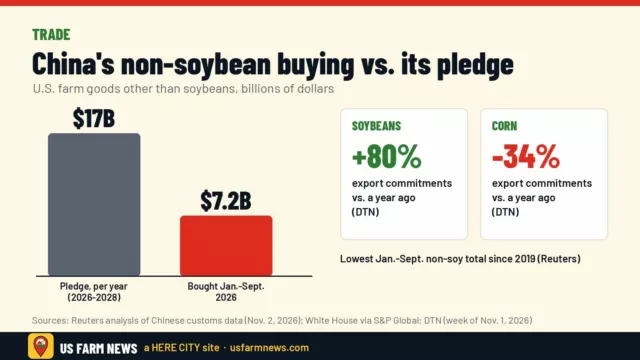
The 2018 farm bill’s last extension ran out Sept. 30, and Congress has not passed a full new farm bill since 2018, American Ag Network noted. The commodity programs, crop insurance rules, conservation money and trade promotion that shape a farm’s 2027 budget all ride on what happens next. The outcome also decides who writes those rules for the next two years, and how hard Congress pushes back on tariffs that have hit export markets.
There are now two paths. The outgoing Republican Congress could try to finish a bill in the lame-duck session. Or Democrats could wait until January, when they will hold the gavels, and start writing their own.
The farm-state races that flipped
Agri-Pulse and DTN, both citing AP calls, reported these results with direct ties to agriculture:
- Iowa Senate: Democrat Josh Turek beat GOP Rep. Ashley Hinson for the seat held by retiring Sen. Joni Ernst, a Senate Agriculture Committee member. Turek backs a farm bill, a federal right-to-repair law and limits on eminent domain for corporate projects, according to Agri-Pulse.
- Kansas Senate: Democrat Adam Hamilton, a Methodist pastor, defeated Sen. Roger Marshall, a Senate Ag Committee member. Hamilton has called for H-2A reform, year-round E15, more U.S. fertilizer production and doubling USDA export promotion funding, Agri-Pulse said.
- Ohio Senate: Former Sen. Sherrod Brown unseated Sen. Jon Husted. Brown told the Ohio Corn and Wheat Growers he backs year-round E15 and a national fertilizer stockpile, according to Agri-Pulse.
- Texas Senate: Democrat James Talarico defeated Attorney General Ken Paxton, who had the Texas Farm Bureau’s backing.
- Also flipped: North Carolina (Roy Cooper), South Carolina (Annie Andrews) and Maine (Troy Jackson), DTN reported.
On the House side, DTN listed Agriculture Committee seats that flipped in Wisconsin’s 3rd District (Derrick Van Orden lost), Iowa’s 1st (Mariannette Miller-Meeks) and 3rd (Zach Nunn), and Pennsylvania’s 8th (Rob Bresnahan). In western North Carolina, fourth-generation farmer Jamie Ager won an open seat Republicans had held. Iowa took an especially hard hit, DTN said: Republicans there lost three House districts, a Senate seat and the governor’s office, where Democrat Rob Sand won.
Who could run the agriculture committees
Both panels will have a new top Democrat, and with majorities that person would likely become chair. In the House, Rep. Shontel Brown of Ohio, who won reelection, and Rep. Jim Costa of California have both announced bids, DTN reported. In the Senate, Amy Klobuchar, the panel’s ranking Democrat, was elected Minnesota governor and will step down. American Ag Network said Colorado Sen. Michael Bennet is likely next in line, while New Jersey Sen. Cory Booker, who won a new term, has said he would welcome the job.
On the Republican side, current House Ag Chairman Glenn Thompson of Pennsylvania won reelection but is term-limited and has asked GOP leaders for a waiver. Georgia Rep. Austin Scott, the committee’s third-ranking Republican, also won and is expected to run for the top GOP slot, according to DTN. Democrats pick committee leaders early next year and don’t rely strictly on seniority, American Ag Network noted.
Can a farm bill pass in the lame duck?
Neither chamber is starting from scratch. Thompson’s bill cleared the House 224-200 in April, and in September Senate Ag Chairman John Boozman moved his own version out of committee 12-11 along party lines, American Ag Network said. Boozman’s bill includes year-round E15. The biggest sticking point is how SNAP costs are split between Washington and the states. Senate Republicans have offered a one-year delay of new state cost-share rules, and Agriculture Committee Democrats want two years.
Sen. Chuck Grassley, R-Iowa, signaled on Election Day that Republicans may have to give ground. He told Brownfield that “there may be some sort of compromise” with Democrats to reach the 60 votes needed. He also warned that time is short: “It’s not a lot of time between now and the end of this Congress.” Grassley told reporters a two-year SNAP delay would cost $18 billion but weighed it against the value of getting E15 done, DTN reported.
Before the election, Boozman told a University of Arkansas audience that the four committee leaders had been meeting and that he expects farmers to lobby members of both parties in person. He said farmers don’t want another one-year extension, and neither does he, Brownfield reported.
National Farmers Union President Rob Larew told Brownfield that lawmakers’ to-do list includes a strong farm bill, nationwide year-round E15 and possibly more economic aid for farmers.
What to watch
- Monday, Nov. 9: The Senate returns to Washington, Brownfield reported.
- Uncalled races: Michigan and Alaska will settle the size of the Senate majority. Alaska may not be final until mid-November, American Ag Network said.
- Committee picks: Watch whether Brown or Costa leads House Ag Democrats, and whether Bennet or Booker takes the Senate post.
- Trade: Several winners, including Hamilton and New Hampshire’s Chris Pappas, want Congress to reclaim more say over tariffs, according to Agri-Pulse.
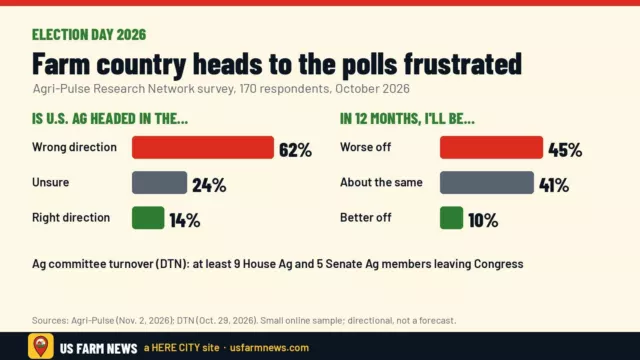
For background on the farm mood heading into the vote, see our story on the Election Day farm poll and agriculture committee turnover. More coverage is in our Policy & Trade section.
Get the Daily Ag Business Briefing
Markets, policy and farm business in one free email each weekday.