A HERE CITY site

Combine yield data helped build a $619,000 crop insurance fraud case. What it means for your farm’s precision data
Prosecutors say yield-monitor data contradicted yields two North Dakota farmers certified to insurers. How to keep your own precision records clean.
Key takeaways
- Federal prosecutors say combine yield-monitor data helped build a crop insurance fraud case against two North Dakota farmers, DTN and Valley News Live reported.
- The indictment alleges about $619,000 in improper indemnities on three policies. The charges are allegations and have not been proven in court.
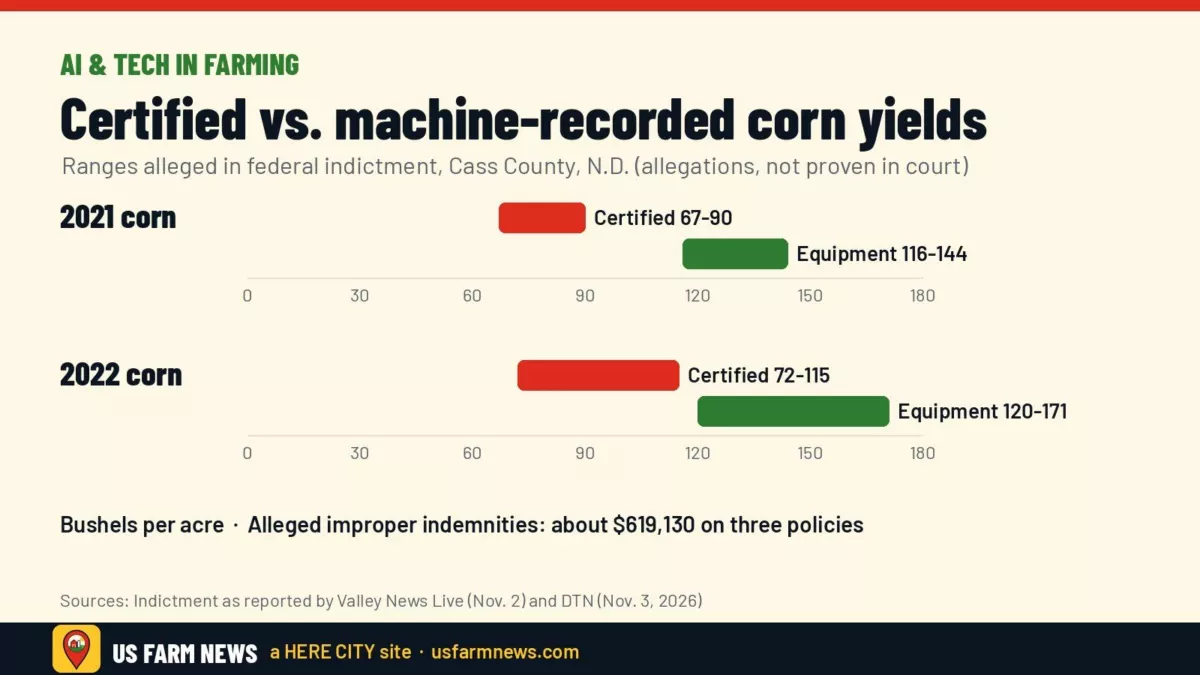
- Prosecutors say harvest equipment logged 116 to 144 bu./acre on four 2021 corn units where 67 to 90 was certified.
- The lesson for every farm: your precision ag records are business records. Keep them, keep them consistent with what you report, and know who can see them.
The data your combine logs at harvest can end up as evidence. A federal indictment unsealed in North Dakota last week alleges that two farmers reported much lower corn yields to their crop insurers than their own precision farming equipment had recorded. Prosecutors say those yield records helped investigators build the case.
The case is about alleged fraud, and the defendants have not been convicted of anything. But it is one of the clearest public examples yet of how yield maps and harvest logs can be used to check what a farm certifies to its insurer. Every operation that runs a yield monitor should think about that.
What prosecutors allege
The federal grand jury indictment, filed in North Dakota’s U.S. District Court, charges Daniel Scott Flaten and Derek Scott Flaten jointly on one conspiracy count over allegedly false statements made to the Federal Crop Insurance Corporation (FCIC). Each also faces two separate false-statement counts, according to DTN and Valley News Live. The indictment is dated Oct. 8. Daniel Flaten was arrested Oct. 26 and Derek Flaten on Nov. 2, and both have bonded out, DTN reported, citing court records.
Prosecutors allege that from about January 2021 through Jan. 31, 2023, Daniel Flaten understated corn and soybean production on insured units, blamed the shortfall on natural causes and sold some of his grain under Derek Flaten’s name. That allegedly made Daniel’s losses look bigger while inflating the production history on the other side. Higher actual production history (APH) raises the coverage a farm can buy in later years.
The numbers in the indictment, as reported by Valley News Live and DTN:
- 2021 corn, Cass County: 67 to 90 bu./acre certified across four units; harvest equipment logged 116 to 144 bu./acre.
- 2022 corn: certified yields of 72 to 115 bu./acre on five units, versus 120 to 171 bu./acre recorded by the equipment. DTN said the gap on those parcels averaged 52 bushels.
- Payments cited: $279,948 in indemnities on the 2021 Cass County corn, about $182,391 on the 2022 corn and $23,563 in federal disaster payments.
- Total alleged: about $619,130 in improper indemnities on three policies, plus about $103,966 in related premium subsidies.
The indictment also says two adjusters from one insurer questioned yields that ran far below the area, but the insurers ultimately paid the claims, Valley News Live reported. Prosecutors are seeking forfeiture. If convicted, each defendant faces up to five years on the conspiracy count and up to 30 years and a $1 million fine on each false-statement count, according to DTN.
Why yield data matters to every farm
For honest operators, the takeaway is not to fear their yield monitor. It is to treat precision data as part of the farm’s official records, just like scale tickets.
USDA’s Risk Management Agency already lets farms use that data. An RMA record-keeping guide for policyholders says precision farming and yield monitoring systems can support APH records if they are calibrated to the maker’s specifications. The yield map or summary report also has to show who grew the crop, the crop year, the farm and field ID, the crop, acreage, the harvest date and the total yield. The same guide says production records must be kept for 3 years after the year they are certified. Without them, a farm can be given an assigned yield, which is generally 75% of the prior approved yield, and lose optional units.
A practical checklist for your harvest data
- Calibrate and document it. Record when and how you calibrated the yield monitor each season. Uncalibrated data is less useful to you and to your agent.
- Reconcile by unit. Before you certify production, compare yield-monitor totals with elevator settlement sheets, scale tickets and bin measurements for each insured unit. If they disagree, find out why and write it down.
- Keep sales in the right name. Grain delivered under another person’s or entity’s name is at the center of this case. Make sure delivery and settlement records match who actually grew the crop, especially in family and multi-entity operations.
- Tell your agent early. Crop insurer Precision Risk Management advises calling your agent about a possible loss before the grain from that unit is sold, fed or mixed with other bushels, so an adjuster can verify it.
- Know where your data lives. Yield maps often sit in a manufacturer’s cloud platform, with a dealer or agronomist who has access too. Check your data-sharing settings, export copies for your own files and keep at least 3 years of records.
- Get advice when it matters. If an insurer, USDA or investigators ask for your precision data, talk with an attorney before you respond.
This is general information, not legal, tax or financial advice. Policy terms vary; confirm current record-keeping rules with your crop insurance agent.
What to watch
The case will now move through federal court in North Dakota. Many fall loss claims are being worked right now, and harvest prices for corn and soybeans came in above spring levels. That makes accurate production reports especially important this year. See how the 2026 harvest prices affect your crop insurance claim. For more on how data and AI are changing crop insurance, read our story on AI-powered crop insurance pricing.
Get the Daily Ag Business Briefing
Markets, policy and farm business in one free email each weekday.