A HERE CITY site

Plains Ranchland Values Jump Almost 10% While Farm Loan Rates Edge Up to 7.5%, Kansas City Fed Survey Finds
Kansas City Fed lenders say ranchland rose almost 10% and loan rates hit about 7.5%, while higher crop prices slowed the slide in farm income and repayment.
Key takeaways
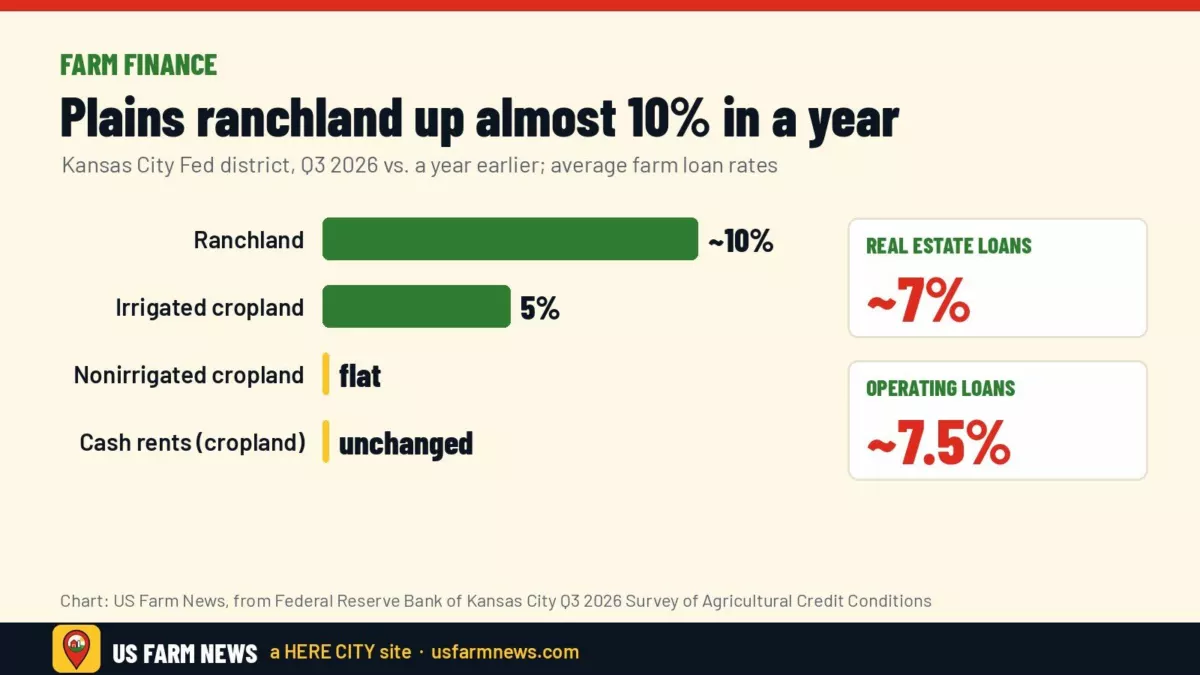
- Ranchland values in the Kansas City Fed’s district rose almost 10% from a year earlier, and irrigated cropland rose 5%. Nonirrigated cropland held steady.
- Average farm loan rates edged up to about 7% on real estate loans and 7.5% on operating loans, well above 20-year averages.
- Farm income and loan repayment still fell, but at the slowest pace since early 2024, helped by higher crop prices and crop insurance payments.
- Oklahoma went the other way: more than 40% of its lenders reported a year-over-year drop in farm income, versus 10% one quarter earlier.
Higher grain prices gave Plains farm finances some relief this summer and fall, according to the Federal Reserve Bank of Kansas City. Ranchland values kept rising, but borrowing became slightly more expensive. The bank’s third-quarter survey of agricultural lenders, released Thursday, found that farm income and loan repayment rates were still falling. The decline was the slowest since early 2024 across most of the district, which covers Kansas, Nebraska, Oklahoma, Colorado, Wyoming, northern New Mexico and western Missouri.
Why it matters for your operation
The survey gives an early look at the conditions borrowers will face in winter renewal meetings. Loan rates are not coming down. Kansas City Fed economists Francisco Scott and Ty Kreitman said average rates rose from the second quarter to about 7% on farm real estate loans and 7.5% on operating loans, and that the increase showed up in every state. Rates are still far above their 20-year averages, the bank said.
Lenders also reported fewer problem loans than a year ago. About 25% of lenders said over a tenth of their farm portfolio was on the watch list, the bank said, down from roughly 30% in 2025. However, slightly more lenders reported 5% to 10% of their loans on that list. Asset sales to raise cash were limited: a quarter of lenders said none of their farm borrowers planned to sell intermediate or long-term assets, and only about a fifth said more than 10% did.
Land values: ranchland leads
- Ranchland: up almost 10% from a year earlier across the district, and nearly 15% in Kansas, Missouri and the Mountain States.
- Irrigated cropland: up 5%.
- Nonirrigated cropland: flat overall; Kansas rose 7%, while Nebraska was the only state where dryland values declined this quarter.
- Cash rents: unchanged from a year earlier for irrigated and dryland cropland, after weakening earlier in 2026.
These figures fit the national pattern. American Ag Network reported that USDA’s August land survey valued the average U.S. acre of farm real estate at $4,500, a 3.4% annual gain. It also noted that the Chicago Fed found farmland values flat across its five Corn Belt states over the year ended in the second quarter. Strong cattle prices have helped make the Plains an exception, and the Kansas City Fed said in August that district ranchland values had reached record highs.
Where the stress is: Oklahoma and input costs
Oklahoma was the weak spot. Lenders there said high cattle prices had helped earlier, but drought and rising costs were now a bigger concern. About 30% of Oklahoma lenders reported slower repayment than a year earlier; in the rest of the district the share was roughly 15%.
Lender comments in the survey kept coming back to fuel, fertilizer and dry weather. A Kansas banker said input costs are “a major concern for grain farmers.” A Nebraska lender pointed to $6.00 diesel and possible fertilizer increases for 2027. An Oklahoma lender wrote that cow-calf producers have benefited from higher cattle prices, while farmers with few or no cows “are struggling.” Other bankers were more upbeat. One Nebraska lender expected “very limited working capital issues” after 2026 government payments, crop insurance and the grain rally.
Credit conditions were also discussed in Washington this week. Agri-Pulse reported that Senate Agriculture Committee members questioned three nominees for the Farm Credit Administration board, the agency that regulates the Farm Credit System, about tighter credit and financial pressure on farmers and ranchers. The nominees are John Grunewald of Oklahoma, Carl Bednarski of Michigan and James Russell Middleton of Virginia.
What to do before your renewal meeting
- Budget at today’s rates. Plan 2027 cash flow at operating rates near the 7.5% district average rather than counting on a decline.
- Bring updated numbers. Lenders still describe profit margins as narrow, so a balance sheet and break-evens that include your crop insurance and program payments will help.
- Use land equity carefully. Stronger land values help your balance sheet, but they do not make up for weak cash flow.
- Compare your FSA options. See our guide to FSA loan rates for November 2026, and our earlier report on what ag lenders expect for borrower profitability.
This article is general information, not financial advice. Talk with your lender or a farm financial adviser about your situation.
What to watch
- Chicago Fed AgLetter: the third-quarter Corn Belt land value survey is the next regional reading.
- Fall land auctions: sales after harvest often set the tone for land prices through the winter.
- Dec. 10: USDA’s next WASDE, which will show whether the recent crop price support holds.
Get the Daily Ag Business Briefing
Markets, policy and farm business in one free email each weekday.