A HERE CITY site

Ag lenders expect 40% of farm borrowers to lose money in 2026 as aid props up margins
Lenders expect 59% of farm borrowers to be profitable in 2026, up from 52%, but government aid is a growing share of income and working capital is tight.
Key takeaways
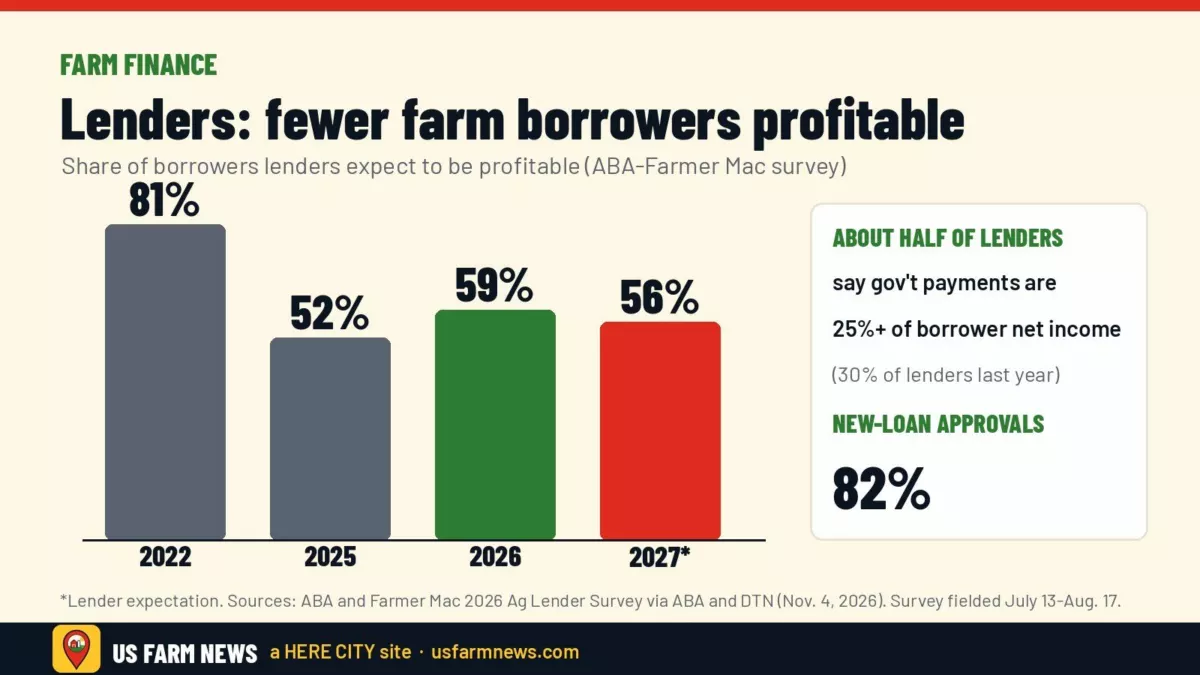
- Lenders in the annual American Bankers Association (ABA) and Farmer Mac survey estimate 59% of their farm borrowers will be profitable in 2026, up from 52% in 2025 but far below 81% in 2022.
- Roughly 40% of borrowers are expected to lose money this year, and lenders see the profitable share slipping to 56% in 2027.
- Government payments are carrying more of the load: about half of lenders said they make up at least 25% of borrowers’ net income, up from 30% of lenders a year earlier.
- Approval rates are still high, averaging 82% for new ag loans, but working capital is the top borrower worry for a fourth straight year.
Farm lenders are heading into loan-renewal season with a split picture. More of their borrowers made money in 2026 than bankers feared a year ago, yet a big share of that profit came from federal aid, and most lenders expect margins to stay thin in 2027. That is the main message of the annual agricultural lender survey from the American Bankers Association and Farmer Mac, made public Wednesday in Minneapolis, where ABA is holding its Agricultural Bankers Conference.
For a farm business, the survey is a preview of the questions a loan officer is likely to ask this winter: how much working capital is left, how dependent the operation is on government checks, and what 2027 input costs will do to cash flow.
Profitability: better than feared, still well below 2022
Three in four responding lenders, 75%, said farm profitability had weakened in their area this year, according to ABA. Even so, bankers estimated that 59% of their borrowers would end 2026 in the black, DTN reported. That compares with 52% in last year’s survey and 81% in 2022.
Lenders aren’t counting on a rebound. They expect the profitable share to dip to 56% next year, and only 5% of responding bankers think overall farm profitability will improve in 2027, according to DTN.
ABA’s Ryan Lee summed it up this way: borrowers are doing better than expected, “but that doesn’t mean financial stress has disappeared.” He said working capital “remains under pressure” and lenders are watching credit quality closely.
Livestock vs. crops
The gap between sectors shaped how bankers answered. Lenders whose portfolios lean toward livestock put the share of profitable borrowers this year at 66%. Among lenders focused on crop farms, the figure was 57%, DTN reported.
- Cotton overtook grains as the commodity lenders worry about most: 55% of bankers with cotton exposure rated their concern as high.
- Grains were close behind at 53%, though that is down from 69% in last year’s survey.
Government payments are a bigger share of income
Survey respondents pointed to projected record government payments, about $47 billion, as a key reason many grain farms stayed profitable, DTN said. Reliance on that money is climbing:
- About half of lenders said federal payments make up a quarter or more of what their borrowers net. A year ago, 30% of lenders said so.
- Nearly three-quarters reported that borrowers relied more on government payments in 2026.
- 67% expect that reliance to grow again in 2027.
That matters for planning because aid payments are set by Congress and USDA, not by the market. With Democrats taking control of Congress in January and the farm bill still unfinished, the size and timing of future help is uncertain. See our story on what the election means for the farm bill’s lame-duck chances.
Credit: more demand, more delinquencies, steady standards
Higher operating costs are pushing farmers to borrow more. Lenders said demand rose this year for both production loans and loans secured by farmland, and they expect demand in both categories to keep climbing over the next 12 months, according to DTN’s summary of the findings.
Loan quality is slipping from a strong starting point. Late payments and loan write-offs ticked up, and bankers think loan quality will slip again in the coming 12 months, yet levels are still healthy by historical standards. Fewer lenders plan to tighten underwriting or loan terms. Deterioration of ag loans ranked as lenders’ top institutional concern, ahead of competition from other lenders and swings in interest rates.
Inflation rose faster than any other concern on the list as higher energy prices fed into input costs. Many farmers had booked fertilizer before last spring’s price spike, which softened the blow in 2026, but lenders worry about what those costs will look like for 2027 planting, DTN said.
Farmer Mac chief economist Jackson Takach said lenders face “a delicate balance,” with credit demand rising as volatility, funding costs and competition all intensify.
Approvals and land values
- The average approval rate on new ag loan applications this year was 82%.
- They expect to approve 88% of renewal requests over the next year.
- Farmland values rose modestly in 2026, and most lenders expect little or no change in land values or cash rents in the year ahead.
The survey was conducted July 13 to Aug. 17 and drew responses from more than 600 agricultural lenders, ABA said. That means responses were collected before harvest and before the November election.
What it means for your renewal
Lenders told the survey that working capital is their borrowers’ biggest weakness, so expect it to get attention at your annual review. A few ways to prepare, based on the concerns lenders flagged:
- Separate aid from operating income. Show your lender what the farm earned with and without government payments, since bankers say those payments are a growing share of net income.
- Price 2027 inputs early. Lenders expect higher costs for next season. A cash-flow plan built on current fertilizer and fuel quotes will hold up better than one built on last year’s numbers.
- Know your insurance position. Our guide to 2026 crop insurance harvest prices explains how this fall’s prices affect claims.
- Revisit rent terms. If land costs are a pressure point, a variable cash lease is one way to share risk with a landowner.
This is general information, not legal, tax or financial advice. Talk with your lender and advisers about your own operation.
More farm business coverage is in our Ag Business section.
Get the Daily Ag Business Briefing
Markets, policy and farm business in one free email each weekday.