A HERE CITY site

Warm soils stall fall anhydrous as ammonia hits $1,007 a ton; 50-degree mark may slip weeks late
Iowa State says central Iowa's 50-and-falling date may run 10 to 15 days late this year. With anhydrous at $1,007 a ton, here's how to avoid losing nitrogen.
Key takeaways
- Soils across most of the Corn Belt are still too warm for fall anhydrous ammonia and manure. Iowa State University’s guideline is to wait until 4-inch soil temperatures are 50°F and falling.
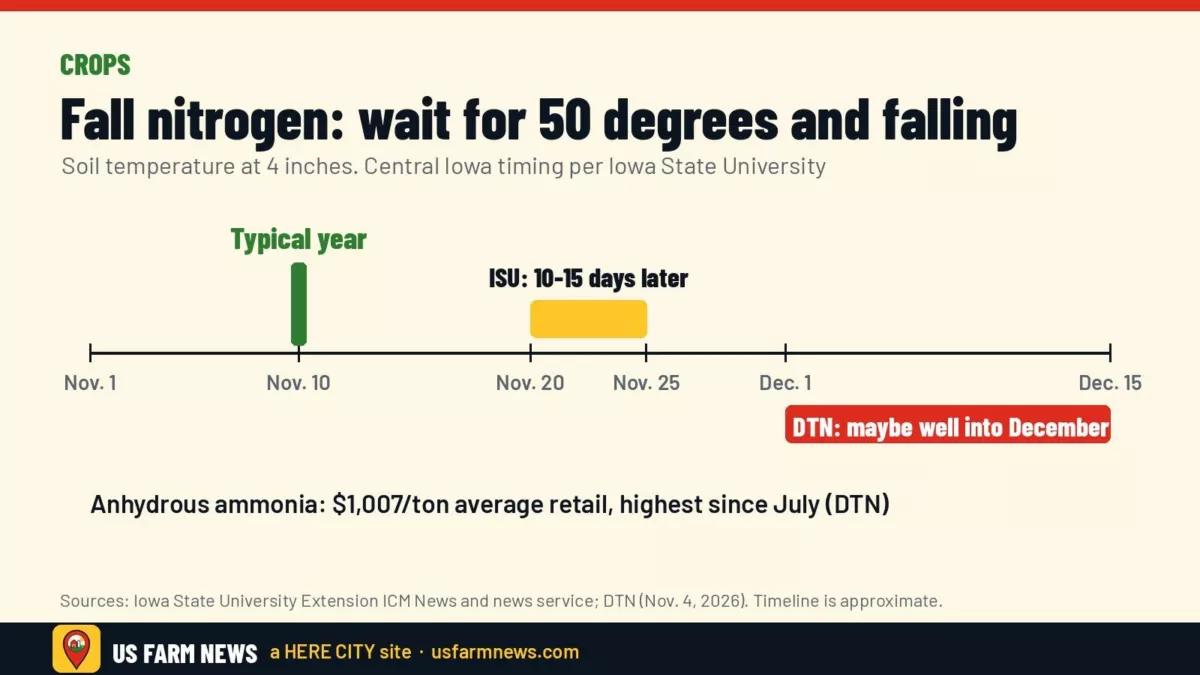
- Central Iowa usually reaches that point around Nov. 10, but ISU says this year’s very strong El Niño could push it back 10 to 15 days. A DTN meteorologist said it may not come until well into December.
- Anhydrous ammonia averages $1,007 a ton in DTN’s retail survey, its highest since July, so lost nitrogen is expensive.
- If you must apply early, ISU recommends a nitrification inhibitor and, for manure, fields with a cover crop.
Harvest is wrapping up, and the fall fertilizer rigs are ready, but in much of the Corn Belt the ground isn’t. Unusually warm soils are holding back fall applications of anhydrous ammonia and manure, and agronomists are urging growers to wait rather than risk losing nitrogen they have already paid for, DTN reported Wednesday.
The stakes are higher than usual this year. DTN’s weekly fertilizer survey shows anhydrous ammonia averaging $1,007 a ton at retail, the highest since July. Nitrogen that turns into nitrate and washes away before the 2027 corn crop can use it is money gone.
Why 50 degrees matters
Iowa State University recommends holding off on fall ammonia and manure until the soil 4 inches down is at or below 50°F and still cooling. The reason is biology. Fall nitrogen goes on mostly as ammonia, which turns into ammonium in moist soil. Ammonium is positively charged, so it sticks to soil particles. Soil microbes convert ammonium to nitrate, which carries a negative charge, isn’t held by the soil and can leach into tile lines or be lost to the air.
That microbial conversion, called nitrification, slows sharply below 50°F, although it doesn’t fully stop until soils reach freezing, according to ISU’s Integrated Crop Management (ICM) News. “There’s an exponential relationship between temperature and the transformation of ammonium to nitrate,” ISU agronomy professor Mike Castellano told DTN. He warned that being a couple of degrees early can make a big difference.
This year’s timing
In a typical year, soils in central Iowa cool to 50 degrees and keep dropping by about Nov. 10, according to ISU. ICM News said a very strong El Niño could delay that window by 10 to 15 days this year, and an Iowa State news release said the delay could leave less time to apply before winter.
DTN ag meteorologist John Baranick was more cautious still. He told DTN the threshold may not arrive until well into December, and that the only places with soils near or below 50°F right now are northern North Dakota and northern Minnesota. He said forecasts show the warm pattern lasting through November and into winter.
Applying too early can be costly. ICM News said ISU research has shown early fall manure applications can cost more than 40 bushels of corn per acre compared with late fall or spring application. Go too early, it warned, and the nitrogen lost can leave hauling costs higher than the manure is worth.
What agronomists recommend
- Watch soil, not the calendar. The Iowa Environmental Mesonet, run by Iowa State, publishes live soil readings at the 4-inch depth plus estimates by county. ISU suggests pairing them with the 6- to 10-day forecast. Baranick said that if soils are close to 50°F, check the two-week outlook for a warm-up.
- Use a nitrification inhibitor. Castellano recommended one for fall nitrogen. ICM News said more than two-thirds of Iowa farmers already use an inhibitor with fall ammonia.
- Treat manure, too. Liquid swine manure makes up about 70% of Iowa’s manure fertilizer, and inhibitors are less common there, DTN said. ISU professor Dan Andersen said one Iowa State study found that treating swine manure with an inhibitor held nitrification to roughly the pace you would see in soil about 5 degrees cooler.
- Put early manure on cover crops. If pits must be pumped before soils cool, Andersen advised applying to fields with a cover crop, which can take up nitrate before it leaves the field.
- Credit what stays. ISU’s N-FACT decision tool shows that high fall ammonium and nitrate levels can cut spring nitrogen needs by more than 50 pounds, ICM News said.
Why not just wait for spring?
Fall application spreads out the workload and avoids spring planting delays. Castellano said in the Iowa State release that, with best management practices, fall and spring applications perform about the same. He also said 30% to 50% of the synthetic nitrogen used in Iowa goes on in the fall, and the state doesn’t have the transport or storage to shift all of that to spring. Andersen said it takes about 75 working days for licensed applicators to pump Iowa’s swine manure from pits to fields.
Check your 45Z paperwork first
If you hope to earn a premium for low-carbon corn under the 45Z clean fuel tax credit, DTN noted that federal guidelines require a nutrient management budget completed before fertilizer goes on. See our how-to on the USDA 45Z feedstock calculator before the rig rolls.
Fertilizer costs are also one reason lenders are worried about 2027 budgets; see our story on the 2026 ag lender survey. More crop coverage is in our Crops section.
Frequently asked questions
When is it safe to apply fall anhydrous ammonia?
Iowa State recommends waiting until soil temperature at 4 inches is 50°F or lower and still falling. Check local soil temperature data and the 6- to 10-day forecast rather than a calendar date.
When does central Iowa usually reach 50 degrees?
Around Nov. 10 in a typical year. ISU said this fall’s strong El Niño could push that 10 to 15 days later.
What if I have to apply manure early?
ISU recommends adding a nitrification inhibitor and applying on fields with a growing cover crop to reduce nitrate loss.
Get the Daily Ag Business Briefing
Markets, policy and farm business in one free email each weekday.