A HERE CITY site

Bayer Ships First Convintro, a New Group 12 Herbicide for Waterhemp: What Growers Should Know for 2027
Bayer shipped the first U.S. Convintro (diflufenican) on Nov. 6. Extension rates it 60-70% on waterhemp alone, so it's a 2027 tank-mix partner, not a fix.
Key takeaways
- Bayer made its first U.S. delivery of Convintro, a Group 12 preemergence herbicide with the active ingredient diflufenican, to an Iowa retailer on Nov. 6.
- It targets waterhemp and Palmer amaranth, weeds Bayer says now resist up to nine herbicide sites of action. It is aimed at the 2027 corn and soybean season.
- Ohio State weed scientists rate it at about 60% to 70% waterhemp control when used alone, so it is meant to be a tank-mix partner, not a standalone program.
- EPA registered diflufenican on June 30, 2026; Bayer says growers should check state approval status in their area.
Corn and soybean growers fighting herbicide-resistant pigweeds will have a new site of action to work into 2027 weed plans. Bayer said it shipped the first U.S. load of Convintro herbicide on Nov. 6, trucking it from its Kansas City plant to New Century FS in Ruthven, Iowa.
Convintro’s active ingredient, diflufenican, is a Group 12 chemistry that blocks carotenoid production in susceptible weeds, which causes the bleaching symptoms typical of that group. Bayer Crop Science technical agronomist Jim McDermott told Brownfield it has been “about 30 years” since U.S. corn and soybean growers got a new mode of action.
The University of Nebraska-Lincoln’s CropWatch, citing EPA, described diflufenican as the first effective PDS-inhibiting herbicide for pigweed control in corn and soybeans. EPA granted the registration on June 30, 2026, according to CropWatch.
Why it matters for the 2027 budget
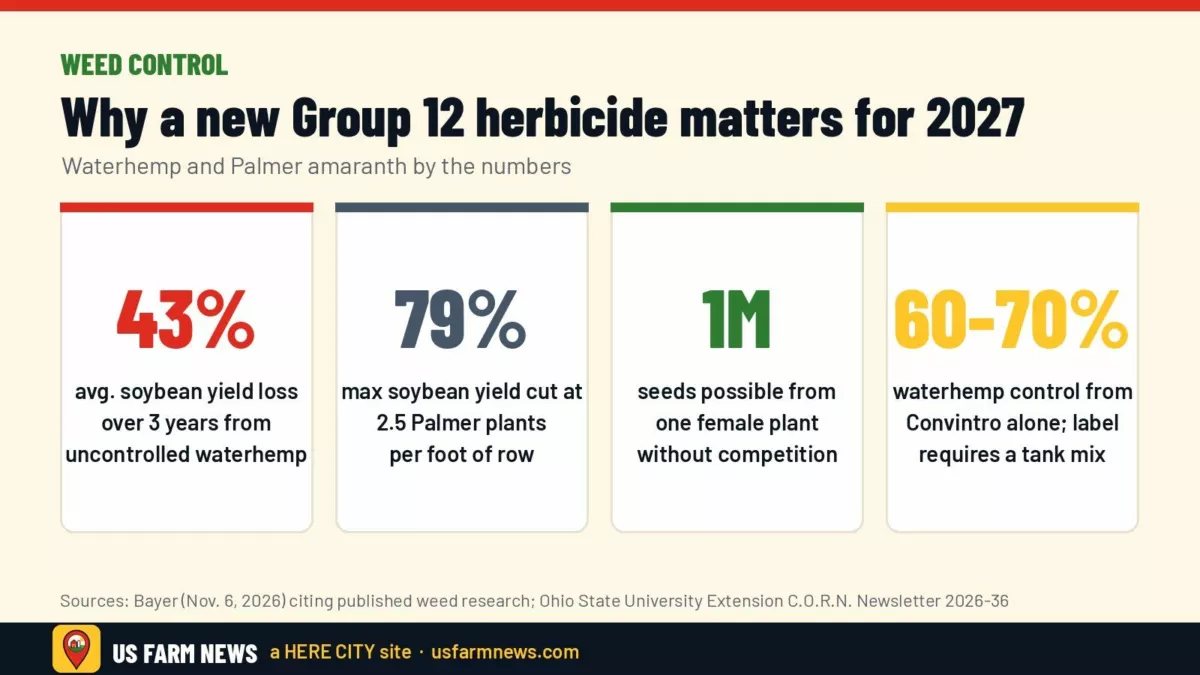
Waterhemp and Palmer amaranth are expensive problems because a single escape can seed a field for years. Bayer cites research showing:
- An average 43% soybean yield loss over three years from uncontrolled waterhemp.
- Soybean yield potential cut by as much as 79% at 2.5 Palmer amaranth plants per foot of row.
- Up to 1 million seeds from a single female plant growing without competition.
- Growth of up to three inches a day, with control getting hard once plants pass 3 to 4 inches.
Nebraska Extension said many waterhemp and Palmer populations in that state already carry resistance to multiple groups — most often 2, 4, 5, 9 and 27 — and some Group 14 resistance has been documented too. Since growers there have rarely used Group 12 products on row crops, CropWatch said it gives growers a genuinely different rotation and tank-mix option rather than another version of products they already lean on.
Northwest Iowa farmer Brent Swart, an American Soybean Association director, told Brownfield that weeds, waterhemp above all, are a never-ending fight.
How extension specialists say to use it
The key point from university weed scientists: Convintro is a helper, not a fix on its own. Ohio State University Extension weed specialist Alyssa Essman wrote that, based on trials in Ohio and across the Midwest, the product rates roughly a 6 on the university’s scale, or 60% to 70% waterhemp control, when applied alone. The label requires it to go out with other products that are effective on the target weeds.
Use details from Ohio State’s summary:
- Rates: 2.4 to 4.1 oz/A in field corn and 2.4 to 4.9 oz/A in soybeans.
- Timing: as early as 30 days and as late as 8 days ahead of planting for a preplant pass; for preemergence, anywhere from a week before seeding through 3 days after it.
- Limits: one application per year, and no tank mixing with isoxaflutole or products containing it.
- Target weeds: the pigweed family — waterhemp and Palmer amaranth plus smooth and redroot pigweed.
Watch for crop bleaching
Growers should expect the possibility of some white or bleached leaf tissue and stunting after emergence. Ohio State said the risk rises when crops are stressed by cold, wet weather, on soils with a pH of 7.5 or above, where organic matter is under 0.5%, in spray overlaps, in shallow-planted fields, or when the product is applied with soil-applied organophosphate insecticides.
As with most soil-applied residuals, both weed control and crop injury can swing with soil moisture and temperature around application, the extension article noted.
Supply and next steps
Bayer describes Convintro as a flexible partner for many residual herbicide groups that adds early-season residual activity and can ease pressure on post-emergence passes. The company said growers can check state-by-state approval status through their Bayer representative.
For planning purposes, practical steps before winter input orders include:
- Mapping which fields had waterhemp or Palmer escapes in 2026 and what groups were already used there.
- Asking your retailer about availability, since the product is new to the U.S. market.
- Building any Convintro plan around at least one other effective residual partner, per extension guidance, and reading the full label before use.
For more on fall and winter crop input decisions, see our report on why warm soils are delaying fall nitrogen, and browse the latest agronomy coverage in our crops section.
Frequently asked questions
Can Convintro be used alone?
No. Ohio State Extension says it must be tank-mixed with other products effective on waterhemp and Palmer amaranth; alone it rated about 60% to 70% waterhemp control in Midwest trials.
When can it be applied?
Once per year, either as a preplant pass 8 to 30 days ahead of seeding or as a preemergence pass from a week before to 3 days after seeding, according to Ohio State’s label summary.
Will it injure my crop?
Some bleaching and stunting is possible, especially under cold, wet conditions, high soil pH, very low organic matter, spray overlap or shallow planting, Ohio State said.
Get the Daily Ag Business Briefing
Markets, policy and farm business in one free email each weekday.