A HERE CITY site

Midwest Farmers Get Back Under 80 Cents per Premium Dollar: Illinois Bill Would Force a USDA Crop Insurance Rate Review
The Fair Premiums for Farmers Act would make USDA study crop insurance loss ratios by state. Lawmakers say a fix could save the Midwest $762 million a year.
Key takeaways
- Rep. Eric Sorensen, D-Ill., introduced the Fair Premiums for Farmers Act on Thursday, Nov. 12. It would make USDA study crop insurance loss ratios state by state and crop by crop.
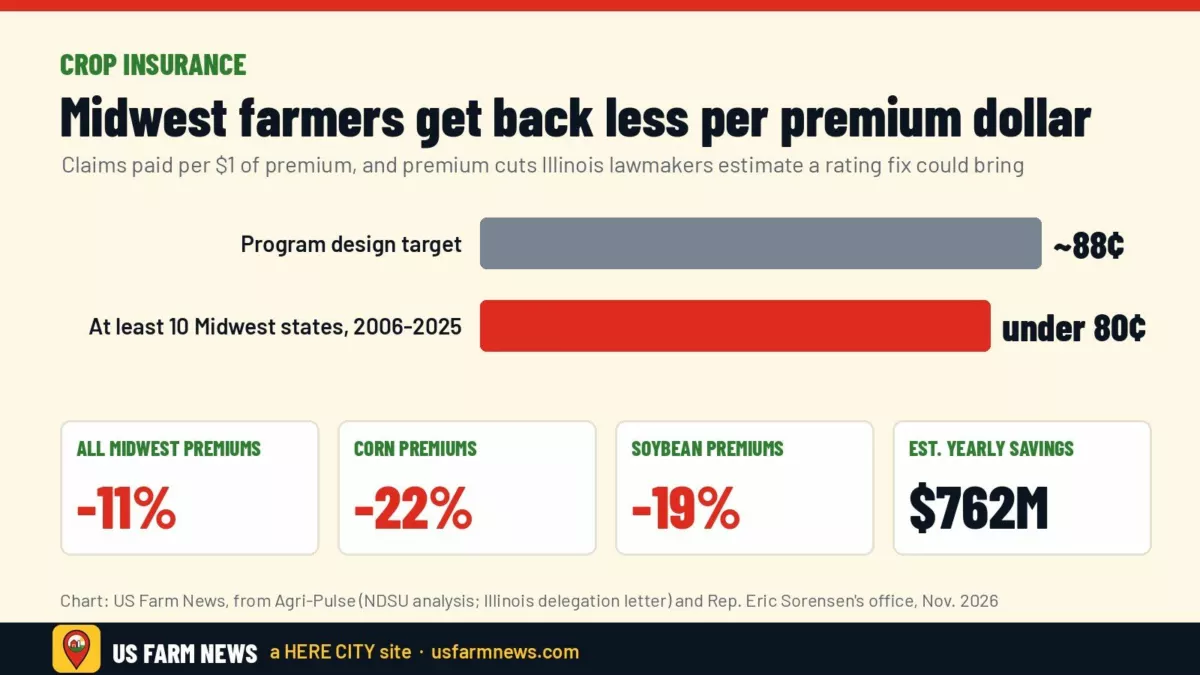
- The program is priced to return about 88 cents in claims per premium dollar, but a North Dakota State University analysis found at least 10 Midwest states got back less than 80 cents from 2006 to 2025, Agri-Pulse reported.
- Illinois lawmakers estimate that fixing the gap could save Midwest farmers $762 million a year, including 22% on corn premiums and 19% on soybean premiums.
- Nothing changes for your 2027 policy yet. The bill asks for a study and a plan within three years, not an immediate rate cut.
An Illinois congressman wants USDA to explain why Corn Belt farmers pay far more in crop insurance premiums than they collect in claims. Rep. Eric Sorensen introduced the Fair Premiums for Farmers Act on Thursday. His bill would order the Risk Management Agency to measure how claims compare with premiums in each state, crop by crop, and then propose a way to close the gaps.
Premiums are one of the larger cash costs on a row-crop farm, and the farmer pays them every year whether or not there is a claim. If the Midwest really is overpaying relative to its risk, a rating change would go straight to corn and soybean growers’ bottom lines. The opposite is also true: other regions could see their rates go up.
What a loss ratio is, and why the Midwest number looks low
A loss ratio divides the indemnities paid to farmers by the premiums collected. By law the program has to be actuarially sound, so over time total premiums should roughly match total claims, Sorensen’s office said in its release.
Agri-Pulse reported that federal crop insurance is generally set up so that about 88 cents of each premium dollar comes back to farmers as claims. A North Dakota State University analysis it cited found that in at least 10 Midwestern states, policyholders got back less than 80 cents per dollar from 2006 through 2025.
Sorensen’s office pointed to soybeans in particular. It said 10-year average loss ratios for soybeans grown in Illinois, Indiana, Iowa, Missouri, Nebraska, Ohio and Wisconsin have been very low, with some close to one-quarter of the national average.
University economists have flagged the same pattern. In a 2024 analysis cited by Agri-Pulse, researchers from the University of Illinois and Ohio State, including Gary Schnitkey and Carl Zulauf, concluded that Corn Belt premiums have generally run ahead of losses. “If premium rates more accurately reflected losses, Midwest farmers would pay less, while other areas would pay higher premiums,” they wrote.
What the bill would do
According to the bill text as described by Agri-Pulse, the Federal Crop Insurance Corporation would have to:
- Break out loss ratios state by state for each crop it insures, covering the 10 years before the law takes effect.
- Identify which policies and plans of insurance drive those loss ratios.
- Examine the kinds of disasters, such as extreme weather, that could produce losses far larger than expected for a given crop.
- Write a plan to adjust premiums within three years, while still meeting the actuarial-soundness requirement in the Federal Crop Insurance Act.
- Put the study and the draft plan out for public comment before sending them to Congress.
WMBD radio in Peoria noted that the bill calls for analysis and recommendations; it would not cut anyone’s premium right away.
The $762 million claim
Sorensen joined Rep. Nikki Budzinski and Sens. Dick Durbin and Tammy Duckworth, all Illinois Democrats, on a letter to USDA last week. Agri-Pulse reported that the letter estimated a premium adjustment could save Midwest farmers about $762 million a year, an 11% cut in premium costs overall. Corn premiums would fall 22% and soybean premiums 19% under their estimate. The group also wants USDA to look at refunding part of 2026 premiums.
Sorensen told Agri-Pulse that crop insurance has become “cost prohibitive” for some farmers in his district. He said he has heard from corn and soybean growers who are wondering whether to buy coverage at all.
USDA has already said it is looking at the question. At a House Agriculture Committee hearing in June, Undersecretary for Farm Production and Conservation Richard Fordyce told Sorensen that RMA was working on a rating study, Agri-Pulse reported.
Why the timing matters
Democrats will control both chambers of Congress in January, which gives a Democratic sponsor from a farm district more leverage than he had this year. Sorensen told Agri-Pulse he is open to passing the measure on its own or attaching it to a larger bill. He said he raised the issue during the 2024 farm bill markup. For background, see our coverage of what the new Congress means for the farm bill.
Any rate shift would also create losers. If premiums fall where loss ratios are low, they would likely rise in regions where claims have run high, which is the trade-off the university researchers described. Expect pushback from lawmakers in those areas.
What to do now
- Don’t drop coverage over this bill. It does not change 2027 rates. Your coverage level, unit structure and add-ons still matter more to your bottom line this year. Our guide to 2027 SCO and ECO changes covers what to ask your agent.
- Know your own numbers. Ask your agent for your county’s premium and indemnity history so you can see whether your area fits the pattern the lawmakers describe.
- Watch for RMA’s rating study. USDA could adjust rates administratively before any bill passes.
Frequently asked questions
Will the Fair Premiums for Farmers Act lower my 2027 crop insurance premium?
No. As introduced, it requires a study and a plan to adjust premiums within three years. It does not change current rates.
What is a crop insurance loss ratio?
It is the indemnities paid to farmers divided by the premiums collected. The program is priced so that about 88 cents of each premium dollar comes back as claims over time.
Which states have low soybean loss ratios?
Sorensen’s office named Illinois, Indiana, Iowa, Missouri, Nebraska, Ohio and Wisconsin. It said some of their 10-year averages were close to one-quarter of the national average.
Get the Daily Ag Business Briefing
Markets, policy and farm business in one free email each weekday.