A HERE CITY site

China Extends Its Tariff Pause to January, but U.S. Soybeans Still Pay a 13% Duty vs. 3% for Brazil
China kept its 24% extra tariff on U.S. goods suspended two more months but left a 10% duty in place, so U.S. soybeans still trail Brazil into January.
Key takeaways
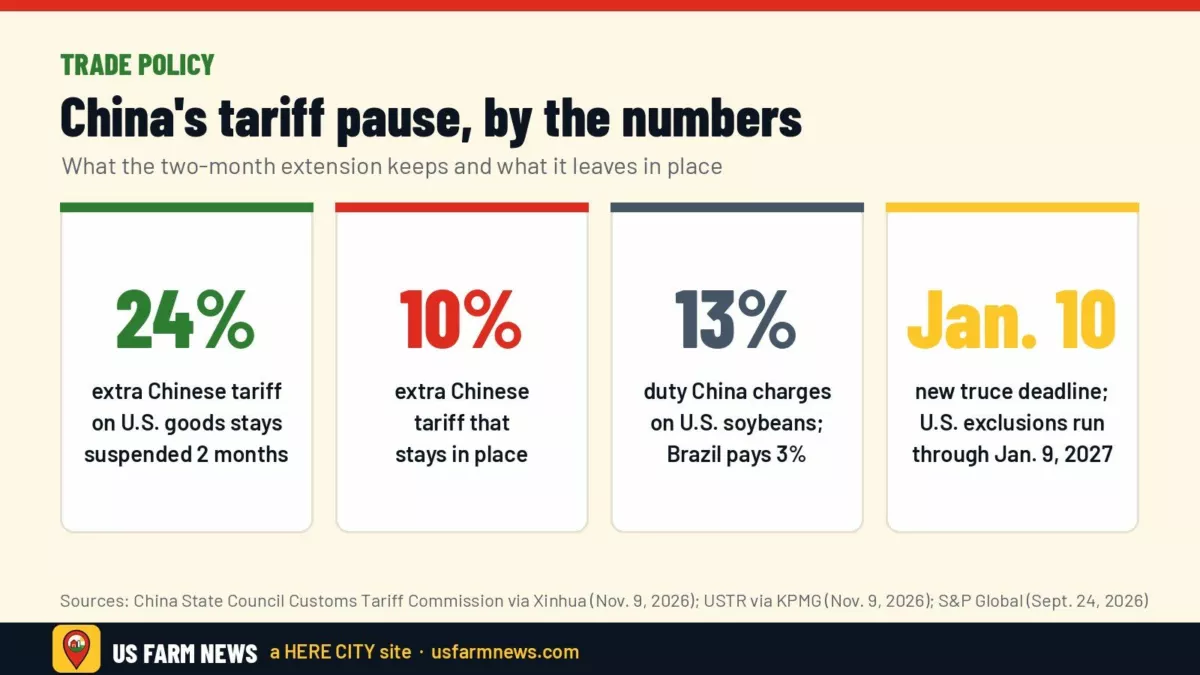
- China will keep its 24% extra tariff on U.S. goods suspended for two more months but leave a 10% extra duty in place, its State Council tariff commission said Monday.
- Washington matched the move by extending all 178 Section 301 tariff exclusions on Chinese goods through Jan. 9, 2027.
- U.S. soybeans still face a 13% Chinese import duty versus 3% for Brazilian beans, according to S&P Global.
- The new deadline is Jan. 10, 2027, and U.S. officials are pressing Beijing to speed up farm purchases.
The U.S.-China trade truce that farm exporters have leaned on for a year was set to run out on Nov. 10. Instead, both governments formally pushed it back two months this week, keeping the current tariff setup, and its soybean handicap, in place into the new year.
China’s Customs Tariff Commission of the State Council said Monday it will continue to suspend the 24% additional tariff on imports from the United States for another two months while keeping the 10% additional tariff, according to an English-language summary published by the Chinese government’s Xinhua news agency. The change took effect at 1:01 p.m. Beijing time on Nov. 10, which was late Monday night in the U.S. Midwest.
Why it matters for grain and livestock sellers
Had the pause lapsed, the higher Chinese rate could have snapped back onto U.S. farm goods in the middle of the fall soybean export season. The extension removes that cliff for now. It does not remove the extra 10%, which is the piece U.S. soybean groups have been asking to scrap.
According to S&P Global, China charges a total 13% duty on U.S. soybeans, made up of the 3% most-favored-nation rate plus the additional 10% levy, while Brazilian soybeans pay only the 3% rate. That gap matters most in the months when Brazil’s new crop starts competing for Chinese crush demand.
- China’s side: 24% extra tariff stays suspended for two months; 10% extra tariff stays on, the tariff commission said.
- U.S. side: The Office of the U.S. Trade Representative extended all 178 current Section 301 product exclusions, which had been scheduled to expire Nov. 9, through Jan. 9, 2027, KPMG said in a summary of the USTR notice.
- Deadline: Treasury Secretary Scott Bessent said in September that the truce reached in Busan, South Korea, would be extended from Nov. 10 to Jan. 10, S&P Global reported.
Purchase pledges are the real test
The truce rests on Chinese buying commitments. Under those pledges, China is to take at least 25 million metric tons of U.S. soybeans annually from 2026 through 2028 and buy $17 billion worth of other American farm and food products each year, according to S&P Global and Quartz. In September, Bessent said China had been meeting its soybean target but was running behind on the other farm purchases, S&P Global reported.
That second pledge is where the shortfall shows. US Farm News reported earlier this month that China’s non-soybean purchases of U.S. farm goods are running far short of the $17 billion pace. In late September, eFeedLink reported that Beijing planned to cut tariffs on U.S. corn, wheat, meat and dairy, but left soybeans off that relief list.
Washington leaned on that point again Monday. In a video call with Chinese Vice Premier He Lifeng, Bessent and trade chief Jamieson Greer urged Beijing to follow through on earlier commitments, farm purchases among them, Quartz reported, citing Treasury and USTR statements. Greer said China needs to take tangible steps on buying farm goods and on rare earths and other critical minerals, according to the USTR account.
Soybean futures jumped on the U.S. appeal before giving the gains back, Quartz reported, citing Bloomberg. January soybeans settled at $11.82¼ on Monday, down 6¾ cents, according to Brownfield Ag News. Traders were also bracing for Tuesday’s USDA crop report, which Brownfield said was expected to show record soybean yield and production.
Chinese state buyers booked at least 20 cargoes of U.S. soybeans, roughly 1.3 million tons, in mid-October, their first purchases after the late-September summit, according to Quartz.
The Section 301 wild card
China’s statement carried a warning. The tariff commission said it has noted repeated U.S. statements that it intends to swap tariffs levied under the International Emergency Economic Powers Act (IEEPA), since struck down in court, for duties under Section 301. China will watch what Washington does next and adjust its countermeasures as needed, the commission said, according to Xinhua.
For farmers, that means the truce could still be reopened if the U.S. tariff structure changes before January.
What to watch
- Tuesday, noon ET: USDA’s November WASDE and Crop Production reports, which set the supply side for U.S. soybean exports. See our WASDE preview.
- Thursdays: USDA Weekly Export Sales, the best weekly read on whether Chinese buying is keeping pace with the 25-million-ton pledge.
- Jan. 9-10, 2027: The new expiration dates for the U.S. exclusions and the truce itself.
Frequently asked questions
Did China remove its tariffs on U.S. soybeans?
No. China kept its 24% extra tariff suspended but left a 10% extra duty in place, so U.S. soybeans face a total 13% duty versus 3% for Brazilian beans, according to S&P Global.
When does the extended truce end?
The truce now runs to Jan. 10, 2027, and the U.S. extended its Section 301 exclusions through Jan. 9, 2027.
What has China promised to buy?
China pledged to buy at least 25 million metric tons of U.S. soybeans in each year from 2026 to 2028 and $17 billion of other U.S. farm goods annually, according to S&P Global.
Get the Daily Ag Business Briefing
Markets, policy and farm business in one free email each weekday.