A HERE CITY site

Diesel Finally Dips but Stays $2.29 Above Last Year: How to Cut Your Fuel Bill and Claim the 24.3-Cent Farm Fuel Tax Credit
Diesel fell 16.5 cents to $6.127 but is still $2.29 above a year ago. How to use dyed fuel, claim the farm fuel tax credit on Form 4136, and time purchases.
Key takeaways
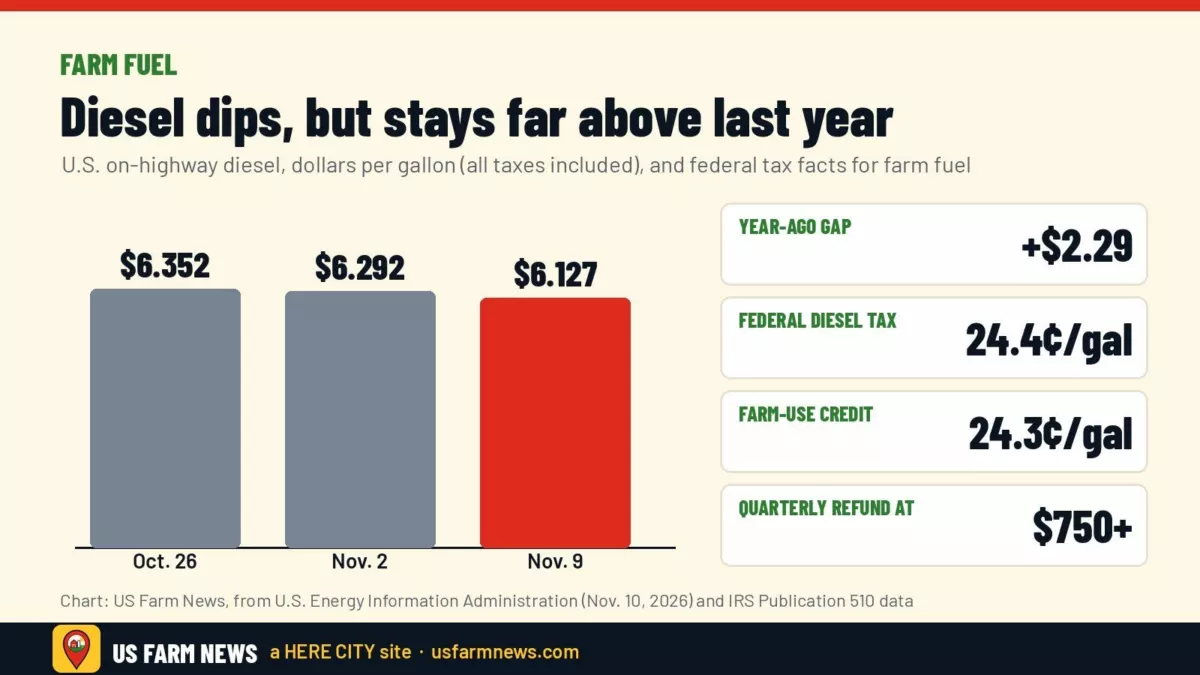
- On-highway diesel averaged $6.127 a gallon on Nov. 9, down 16.5 cents in a week but still $2.29 above a year ago, the Energy Information Administration said.
- Off-road dyed diesel is cheaper but not cheap. A Michigan distributor quoted $4.88 this week, more than 60% above February, Brownfield reported.
- Undyed, tax-paid diesel that you burn on the farm can earn back the federal tax as a credit of 24.3 cents a gallon, claimed on IRS Form 4136.
- Keep receipts and usage logs. Fuel used on the highway, even to haul grain or cattle, does not qualify.
For the first time this fall, some farmers are seeing diesel prices fall. That is a good time to lock in a better price for winter and spring, and to make sure you aren’t paying federal fuel tax you can get back. Here is a practical guide built from IRS Publication 510, EIA price data and what farmers and fuel dealers told Brownfield this week.
This is general information, not legal, tax, or financial advice. Talk to your tax preparer about your own situation.
Where diesel prices stand
- National on-highway average: $6.127 a gallon on Nov. 9, according to EIA, down from $6.352 two weeks earlier. EIA’s prices include all taxes.
- Midwest: $6.201, down 20.1 cents in a week, EIA said.
- AAA: the national average was $6.10 on Thursday, 17 cents lower than a month ago, Brownfield reported.
- Farm delivery: A farmer near the Michigan-Ohio line told Brownfield he was quoted about $4.71 a gallon for off-road diesel, down from roughly $5.17 on his previous load. He said it was the first delivered-price drop he had seen all harvest.
Michigan distributor Crystal Flash listed dyed diesel at $4.88 and premium diesel at $5.65 this week, Brownfield reported.
Step 1: Know how much fuel you burn
Price changes matter more when you know your volume. The farmer Brownfield talked to estimated he burns close to two gallons an acre, plus what his trucks use. At that rate, 1,000 acres takes about 2,000 gallons. The 46-cent drop between his last two quotes would save about $920 on a load that size. Pull last year’s fuel bills, split them into field use and highway use, and you have a baseline for contracting and for the tax credit below.
Step 2: Buy dyed diesel for off-road work
Federal excise tax on diesel is 24.4 cents a gallon. Dyed diesel is charged only the 0.1-cent leaking underground storage tank (LUST) tax, according to IRS Publication 510. State fuel taxes on dyed diesel vary, so check your state’s rules.
The trade-off is strict. Dyed fuel can’t legally be burned in a registered highway vehicle. The IRS penalty for using it in a taxable way is $1,000 or $10 a gallon, whichever is larger, and the $1,000 part goes up after the first violation. Keep separate tanks clearly labeled.
Step 3: Claim the tax back on undyed fuel used on the farm
Sometimes taxed diesel ends up in farm equipment, for example when you fill a tractor at a regular pump or from a tank that also serves trucks. Publication 510 lists fuel used “on a farm for farming purposes” as a nontaxable use, which means you can claim a credit or refund for the tax you paid.
What counts as farming use, per the IRS:
- Working the soil and raising or harvesting crops.
- Raising, feeding and caring for livestock, poultry or bees.
- Running, maintaining and improving the farm and its equipment.
- Drying, handling and storing a raw commodity, but only if you grew more than half of what you are handling that year.
- Custom work done for you on your farm, such as a neighbor harvesting or a custom applicator spraying. You are treated as the buyer who used that fuel.
What doesn’t count: diesel burned on public roads or anywhere else away from the farm, even when the load is livestock, feed, grain or equipment. Personal use doesn’t count either.
Landlord and tenant: If ownership is unclear, the IRS says the person who paid for the fuel makes the claim. If an owner and tenant split the cost evenly, each claims the credit on half the gallons.
Step 4: Pick the right form
- Form 4136 with your income tax return. Most farms use this. In an IRS example, the credit rate for undyed diesel is 24.3 cents a gallon, so 3,000 gallons gives a credit of about $729. Individuals enter it on Schedule 3 of Form 1040.
- Form 8849 quarterly refund. If the tax on your nontaxable-use fuel reaches $750 or more, you can file for a refund during the year instead of waiting for tax time. Under $750, you claim it on Form 4136.
- Missed it? Publication 510 says you may be able to claim on an amended return. That generally has to be filed within 3 years of the original return or within 2 years of paying the tax, whichever is later.
Two details trip people up. First, the credit counts as income. If you deducted the full fuel cost, tax included, as an expense, the IRS example has you report the credit as income on a later Schedule F. Second, Form 4136 asks for your actual fuel cost from your records. Don’t attach receipts to the return, but keep them in case the IRS asks.
Step 5: Decide whether to contract now
A one-week drop is not a trend, and the market is still unsettled. Biofuel groups are fighting state requests to waive 2027 renewable fuel rules, and crude oil rose $2.21 on Thursday, Brownfield reported. If you have storage, splitting purchases across several deliveries lowers the risk of buying everything at a high point. The Michigan farmer told Brownfield he buys in 1,000-gallon loads to manage cost. Ask your supplier about booking part of your spring need at today’s price and leaving the rest open.
Related: USDA’s Harvest Fuel Relief payments and year-end farm tax planning for 2026.
Frequently asked questions
Can I get the federal tax back on diesel I put in my grain truck?
Not for highway miles. The IRS treats diesel burned away from the farm, including road miles, as non-farm use even when you are hauling crops or livestock.
How much is the farm fuel tax credit on diesel?
The IRS example in Publication 510 uses a credit of 24.3 cents a gallon on undyed diesel used for a nontaxable purpose. The tax charged is 24.4 cents.
When can I file for a quarterly fuel tax refund instead of waiting?
When the tax on your nontaxable-use fuel is $750 or more. Smaller amounts are claimed as a credit on Form 4136 with your income tax return.
Get the Daily Ag Business Briefing
Markets, policy and farm business in one free email each weekday.