A HERE CITY site

Chevron Will Restart Its 42-Million-Gallon Iowa Biodiesel Plant on Landus Soy Oil as Deere Puts Trucks on B100
Chevron's idled Ralston, Iowa, biodiesel plant is set to restart by mid-2027 with Landus soy oil, and Deere put five trucks on B100. What it means for beans.
Key takeaways
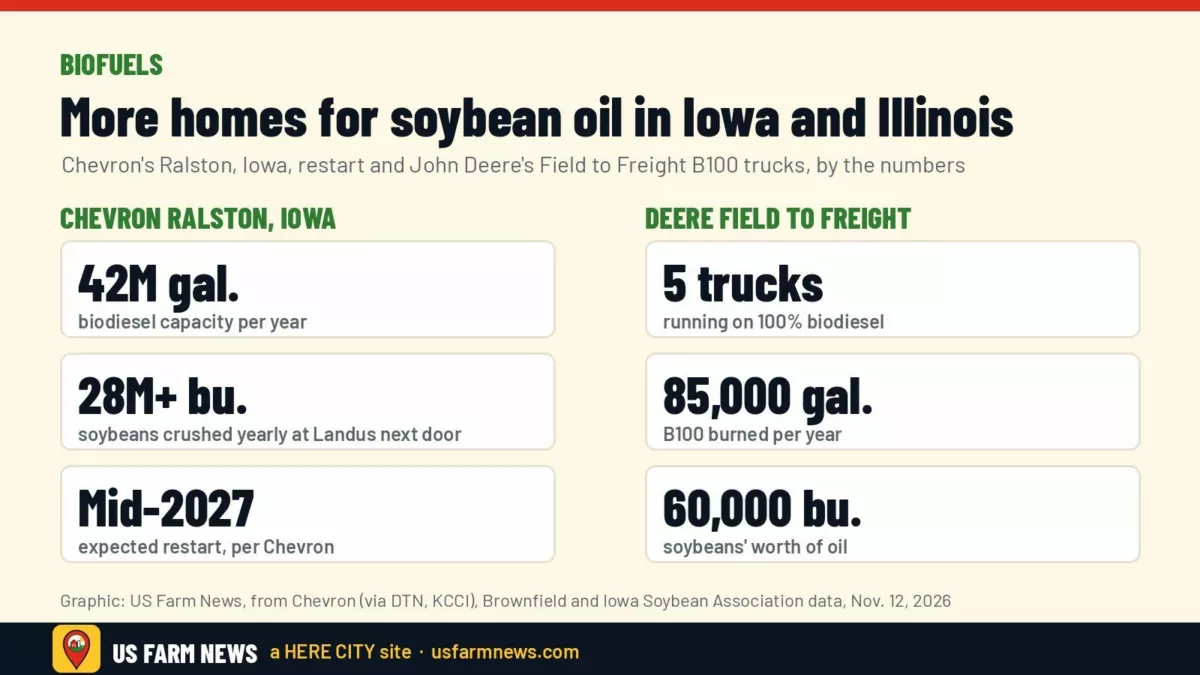
- Chevron will restart its 42-million-gallon-a-year biodiesel plant in Ralston, Iowa, which it idled in March 2024. A Chevron spokesperson told DTN the plant likely won’t run again until mid-2027.
- Soybean oil will come from the neighboring Landus Cooperative plant, which Chevron says handles upward of 28 million bushels of beans annually.
- Separately, John Deere put five semis on 100% biodiesel (B100). It expects them to burn more than 85,000 gallons a year, made from the oil of about 60,000 bushels of soybeans.
- The risk to watch: Louisiana and Alabama have asked EPA to waive their 2027 Renewable Fuel Standard obligations, and biofuel and soybean groups want EPA to say no.
Two announcements on Thursday pointed to stronger demand for soybean oil. Chevron said it will bring an idled Iowa biodiesel plant back into production. The same day, John Deere started running part of its parts-delivery truck fleet on pure biodiesel. Both companies tied the moves to an improved market for biomass-based diesel. That market leans heavily on the federal Renewable Fuel Standard, which two Southern governors now want to roll back.
For soybean growers, more crush and more biodiesel demand nearby can mean a firmer local basis. That is the case the Illinois Soybean Association made at Deere’s launch. For anyone pricing beans for 2027, it is also a reminder of how much oil demand rides on policy decisions made in Washington.
Chevron’s Ralston plant: what’s restarting and when
Chevron Renewable Energy Group shut the Ralston plant in March 2024, together with a biodiesel plant in Madison, Wis., citing poor market conditions, DTN reported. KCCI reported that the Iowa site can make 42 million gallons of biodiesel a year. Chevron got the facility in 2022 when it bought Renewable Energy Group for $3.2 billion, Agri-Pulse noted.
The restart rests on a commercial and operating agreement with Landus, the farmer-owned cooperative whose soybean processing plant sits next door. In its release, Chevron called the Landus plant the largest mechanical crush facility in the country. It said Landus recently upgraded that plant.
Don’t expect biodiesel from Ralston this winter. A Chevron spokesperson told DTN there is no firm date, but the company expects the plant to be back online around mid-2027. Before production resumes, Chevron plans a staged process covering hiring, maintenance, safety and readiness checks. The company said it is still working out how many jobs the restart will add and when.
“Restarting the Ralston facility reflects improved market conditions,” Andy Walz, Chevron’s president of downstream, midstream and chemicals, said in the release.
Deere’s B100 trucks: 85,000 gallons a year
In Milan, Ill., Deere launched what it calls Field to Freight at its North American Parts Distribution Center. Five new 2027 Freightliner Cascadia trucks leased through Penske will haul parts to warehouses and dealers on B100, according to Optimus Technologies, which supplies the fuel system.
The Optimus setup carries two fuel tanks. The Iowa Soybean Association said each truck starts on regular diesel, heats the biodiesel tank with warmth from the engine, runs on B100 once warm and flushes back to diesel before shutdown. If B100 isn’t available, it switches to diesel automatically.
Nate Green, Deere’s director of biofuels, told Brownfield the trucks should cover about 700,000 miles in a year and burn 85,000 gallons of B100. He said that much fuel equals the oil from roughly 60,000 bushels of soybeans. Chevron supplies the fuel from its biodiesel plant in Seneca, Ill., which runs mostly on soybean oil and distillers corn oil, the soybean association said.
Five trucks is a small test. Deere’s logistics network burns nearly 4 million gallons of diesel a year, Optimus said, and the trial is meant to show whether B100 can work across more of it. Deere has already approved B30 blends for its Tier 4 engines, according to the soybean association.
KJ Johnson, governmental affairs director for the Illinois Soybean Association, told Brownfield that processing more beans at home helps local prices. “It drives our basis at the end of the day too,” he said.
The policy risk: state waiver requests
The demand behind both moves depends heavily on the RFS. Agri-Pulse reported that the blending mandates EPA finalized this year are the highest in the program’s two-decade history.
That support is now being challenged. In a Nov. 9 letter, Louisiana Gov. Jeff Landry and Alabama Gov. Kay Ivey asked EPA to waive RFS obligations for their states, arguing that the program raises fuel prices, Farm Policy News reported in its roundup of coverage. The request covers only the 2027 compliance year. The American Soybean Association has urged EPA to reject it.
Monte Shaw, executive director of the Iowa Renewable Fuels Association, pointed to Ralston as proof that the RFS numbers translate into “real investments, real markets for farmers, and real jobs in rural communities,” KCCI reported.
What it means for your marketing
- Local basis: Growers within trucking distance of Ralston could see more competition for beans once the plant runs. That is more than six months out, so don’t count on it for current sales.
- Soybean oil: December soybean oil futures closed Thursday at 63.42 cents a pound, down 46 points, Brownfield reported. Watch oil’s share of the crush value when you compare forward bids.
- EPA’s decision: A decision granting the state waivers would be bearish for oil demand. A rejection would keep the 2027 volumes in place. Our lame-duck farm bill and E15 coverage tracks the related ethanol fight.
For current prices and export demand, see our latest markets coverage.
Get the Daily Ag Business Briefing
Markets, policy and farm business in one free email each weekday.