A HERE CITY site

Rantizo Brings Its U.S.-Built Harvest 100 Spray Drone to the Central Valley: Published Specs and What to Ask Before You Hire a Crew
Rantizo says its Houston-built Harvest 100 drone can cover 500 acres a day. Here are the published specs, the gaps, and what to ask before hiring or buying.
Key takeaways
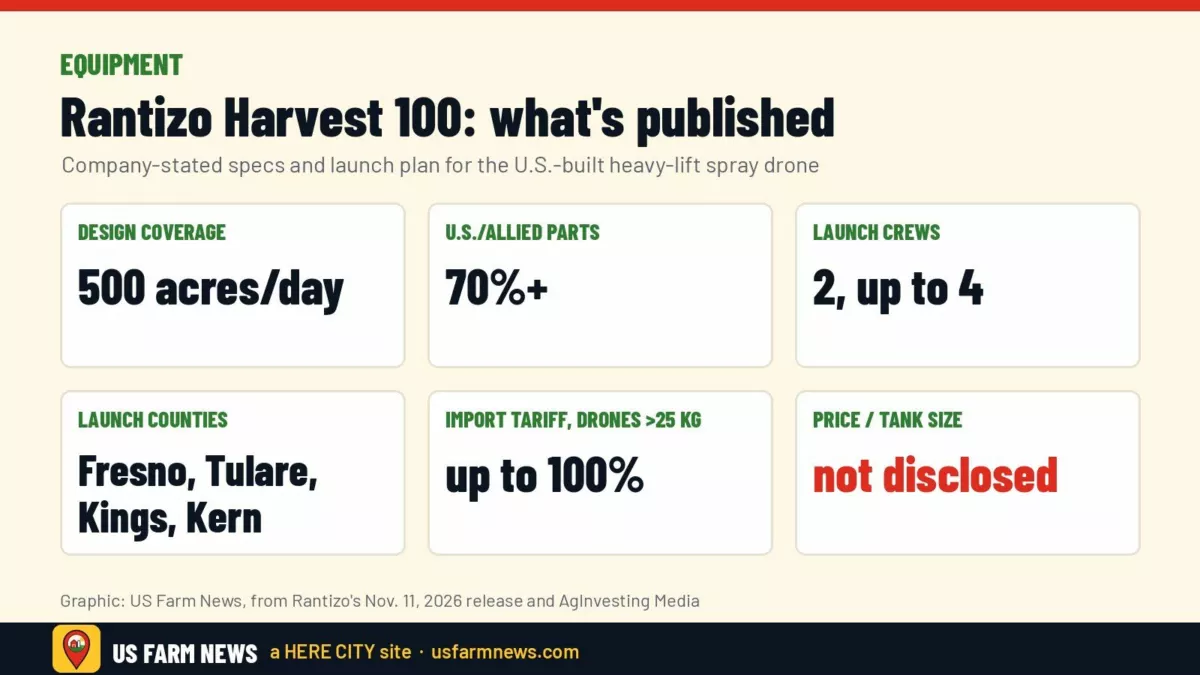
- Rantizo says its Houston-built Harvest 100 heavy-lift spray drone is designed to cover 500 acres a day and uses more than 70% U.S. or allied parts.
- The company will start custom application in Fresno, Tulare, Kings and Kern counties, Calif., with two pilot crews and add up to four as contracted acreage grows.
- Farms can book a Rantizo crew for one job or a full season, or own the drone outright, lease it or finance it and run it themselves. Rantizo has not published a price or tank size.
- Federal rules are squeezing imports: since Sept. 3, 2026, imported drones over 25 kg can face tariffs of up to 100%, Rantizo said.
Rantizo, a Houston drone builder that started trading on Nasdaq last month, says California’s Central Valley will be the first U.S. market for its Harvest 100 heavy-lift agricultural drone. The company announced on Nov. 11 that it will begin offering spray and seeding work in four Central Valley counties. Its pitch is aimed at orchards and vineyards, where ground rigs struggle on wet or tight ground.
This matters beyond California. Import tariffs and FCC restrictions are pushing up the cost of the foreign-built drones that have dominated farm spraying. Growers and custom applicators will need to know which domestic machines are available and what questions to ask about them. Here is what Rantizo has disclosed, and what it hasn’t.
Harvest 100: the published specs
According to Rantizo’s Nov. 11 release and coverage by AgInvesting Media, the Harvest 100:
- Is designed and built at the company’s Houston plant and, the company says, more than 70% of its parts come from the U.S. or allied countries.
- Is designed to meet FAA requirements and the National Defense Authorization Act (NDAA) rules that apply to drone sourcing.
- Has a design target of 500 acres a day per aircraft. That is a company figure, not an independent field result.
- Is built for beyond-visual-line-of-sight (BVLOS) flight and for flying in swarms, which still requires FAA approval to use.
- Takes swappable payloads, so the same aircraft can spray, seed or do forestry work.
Rantizo puts the aircraft in the large-drone class, over 55 pounds. In its release the company cited an FAA forecast that the active U.S. fleet of those drones will grow from 8,295 in 2025 to 55,509 by 2030.
Not disclosed: price, tank capacity, swath width, flight time per battery, and droplet or nozzle options. Those numbers decide your real cost per acre, so get them in writing before you sign.
How you can use it
Rantizo is selling both a service and the aircraft. A grower or retailer can hire a Rantizo field team for a single job or a whole season. They can also buy, lease or finance a Harvest 100 and fly it with their own staff after pilot training from the company.
In California, the company plans to send out mobile two-person crews that share equipment across the four counties instead of setting up separate bases. It will start with two crews and grow to as many as four next season if contracts support it. Rantizo said it will work with experienced California license holders to handle state licensing and county registrations.
Rantizo also has master spray agreements with two big national farm retailers, Nutrien and Helena. Those deals approve it as a drone applicator for their grower networks. The company’s own release cautions that those agreements do not guarantee any acreage or revenue, a point AgInvesting Media also made.
Rantizo said it holds FAA certifications and operating authorizations in more than 15 states.
Why domestic drones are getting more attention
Rantizo’s release laid out the federal policy changes it is counting on:
- June 2025: Executive Order 14307 told federal agencies to give priority to U.S.-made drones.
- December 2025: The FCC put foreign-made drones and key drone components on its Covered List. Unless exempted, new foreign models cannot get equipment authorization.
- Sept. 3, 2026: Section 232 tariffs of up to 100% began applying to imported drones heavier than 25 kilograms at maximum takeoff weight.
For farms that already own a foreign-built sprayer drone, those rules mainly affect replacements, new models and parts. Check with your dealer about parts supply before the spring rush.
Questions to ask before you hire a drone crew or buy a drone
- Cost per acre, all in: What does the crew charge per acre or per hour, and does that include travel, water hauling and product loading?
- Tank, swath and rate: What gallons per acre can it apply at the stated acres per day? Does that rate meet the product label?
- Licensing: Who holds the state applicator license and the county registration, and who carries liability insurance for drift?
- FAA authority: Is the operator approved for the type of flight planned, such as swarm or BVLOS work, and in your state?
- Records: Will you get a spray record with the date, product, rate and treated acres for your files and for your crop insurance and food-safety audits?
- Buy versus hire: If you are thinking about buying, compare the lease or finance payment against what you would pay for custom application on your acres. Count pilot labor and training time.
Drone spraying is part of a wider shift toward autonomous field equipment. See our earlier look at driverless planting with Sabanto and the rest of our machinery and tech coverage.
Get the Daily Ag Business Briefing
Markets, policy and farm business in one free email each weekday.