A HERE CITY site

North Dakota’s NSF AgTech Engine Puts $500,000 Into Five Farm Trials, From AI Cultivators to Spore-Detecting Disease Alerts
Five ag tech projects share $500,000 for 2027 farm trials in North Dakota, including an AI cultivator and free disease alerts. What to watch before buying.
Key takeaways
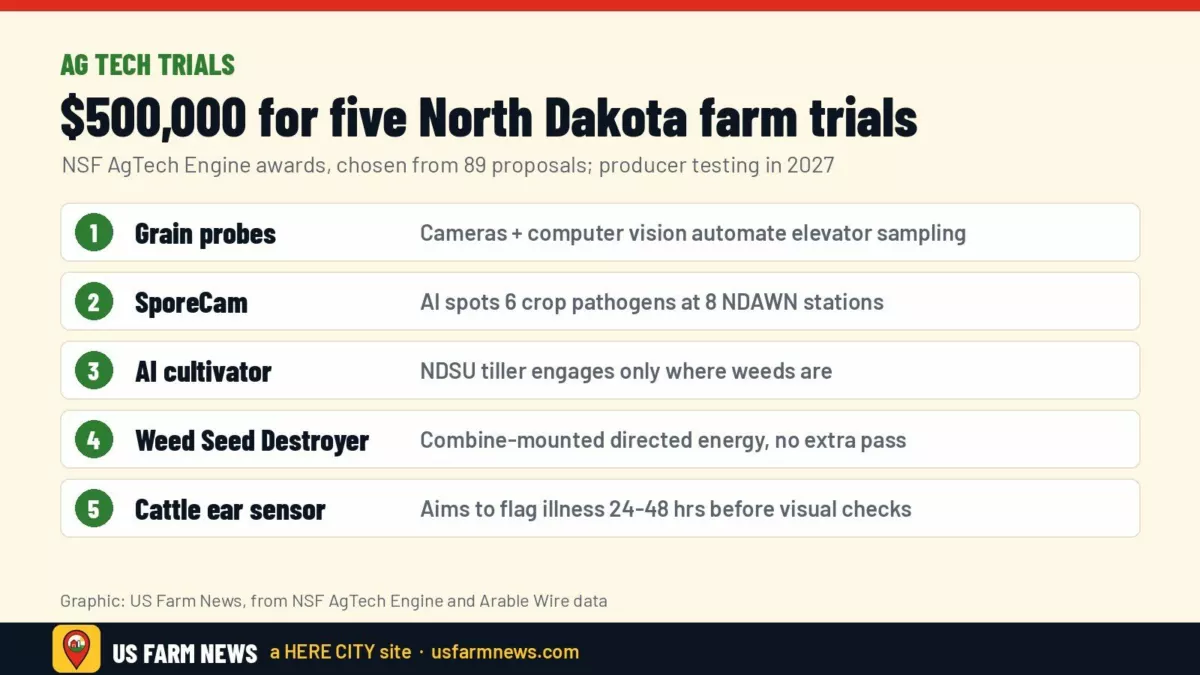
- The NSF AgTech Engine in North Dakota is putting $500,000 into five technologies picked from 89 proposals, with on-farm testing set for 2027.
- Three lean on AI or computer vision: a camera-guided grain probe, an airborne-spore disease monitor and a weed-spotting cultivator from NDSU.
- The others are a combine-mounted weed seed destroyer and an ear-tag sensor meant to flag cattle respiratory disease 24 to 48 hours before visual checks.
- The awards pay for testing, not proof: watch the trial data before you budget for any of these tools.
A North Dakota program funded by the National Science Foundation is betting $500,000 that five new farm technologies can prove themselves in real fields, feedyards and elevators next year. Several of them use artificial intelligence to do jobs that now take a person’s eyes: sampling grain, spotting crop disease and finding weeds.
The NSF AgTech Engine, based at North Dakota State University, announced the awards Nov. 5. A panel of producers with livestock, dairy, row-crop and small-grain experience, plus independent agronomists, chose the projects from 89 proposals, the Engine said. Each applicant could request up to $100,000. Producers will help test the projects in 2027, according to Red River Farm Network.
The five projects
1. Camera-guided grain probes (Elevator of Things)
Champaign, Ill.-based Elevator of Things retrofits the probes elevators already own with cameras and computer vision so sampling can run automatically. Arable Wire reported that the system overlays live data on camera footage so each sample can be traced, which the company says can cut down on grading disputes. The system has been field-tested; the North Dakota money goes to testing and production engineering ahead of a market launch.
Farm takeaway: If your elevator adopts it, ask whether you can see the sample video and data tied to your load.
2. Airborne disease alerts (Scanit Technologies)
Scanit’s SporeCam pulls particles out of the air and uses AI trained on years of analysis to identify fungal pathogens, according to Arable Wire. The company plans to install the monitors at eight weather stations in the North Dakota Agricultural Weather Network (NDAWN) to track six crop pathogens in real time. Growers will get free alerts that combine pathogen detections with weather data, so they can spray ahead of an outbreak or skip a fungicide pass when disease isn’t present, the Engine said.
Farm takeaway: This is the one most growers could use without buying anything. Watch for how the alerts compare with your own scouting next season.
3. AI smart cultivator (NDSU)
A team at NDSU’s Peltier Institute for Advancement in Agriculture Technology is developing a cultivator that mounts on a tractor, spots weeds with cameras and AI, and engages individual tillers only where they’re needed. It is designed to run on tractors farmers already have. Red River Valley trials will measure weed control, crop safety and how much soil stays undisturbed.
4. Weed Seed Destroyer (Global Neighbor)
Xenia, Ohio-based Global Neighbor mounts its device on a combine and treats weed seeds with dual-wavelength directed energy, which it says is not a laser, so they don’t germinate after landing back on the field. The goal is a nonchemical tool against herbicide-resistant weeds that needs no extra trip across the field.
5. Early warning for sick cattle (Seismi)
Seismi’s sensor clips onto existing ear tags. The Engine said the sensor will be tried on a family farm and in a large commercial feedyard to see if it can flag signs of illness 24 to 48 hours before people can see them. Arable Wire reported that the device tracks heart rate and respiratory signs along with activity and behavior, aimed at bovine respiratory disease.
Why it matters
Each project targets a cost farmers already pay: labor at the probe, fungicide passes that may not be needed, herbicide-resistant weeds and cattle treated too late. In the announcement, the Engine’s chief executive, Hollie Mackey, said “Farmers know what will work on their farm,” and that the program puts tools in producers’ hands early and uses their guidance to improve them.
Arable Wire made an important point: the money pays for testing, not certified savings, yield gains or fewer spray trips. None of these products has independent North Dakota results yet.
How to judge AI farm tools like these
- Ask for local data. A disease alert or weed detector that works in one region may miss in another. The point of these trials is regional performance data, so wait for it.
- Count the false alarms. For alert systems, ask how often the tool flags a problem that isn’t there, and how often it misses one. Both cost money.
- Check fit with what you own. The NDSU cultivator and Seismi sensor are built to work with existing tractors and ear tags. Retrofit tools usually lower the cost of a trial.
- Know who owns the data. Grain-sample video, spore counts and animal health records are valuable. Get the terms in writing.
For more on vetting farm AI, see our farm data checklist for AI assistants and our coverage of BloomX’s robotic pollination funding.
Frequently asked questions
Who is running the North Dakota ag tech trials?
The NSF AgTech Engine in North Dakota, supported by the U.S. National Science Foundation and based at North Dakota State University, chose the five projects.
When will the technologies be tested on farms?
Red River Farm Network said producers will help test them in 2027.
Will growers have to pay for the SporeCam disease alerts?
The Engine said the alerts, which pair pathogen detections at eight NDAWN sites with weather data, will be free to growers.
Get the Daily Ag Business Briefing
Markets, policy and farm business in one free email each weekday.