A HERE CITY site

Deere’s free JD AI assistant opens to more farmers in mid-November: 5 steps before you ask it anything
Deere's free JD assistant answers questions from your own Operations Center data and opens broadly in mid-November. Here's how to prepare your records first.
Key takeaways
- John Deere plans to open its JD AI assistant to Operations Center users broadly in mid-November, Business Insider reported. Until now it has been limited to an early-access waitlist.
- JD and Operations Center are free, a Deere product manager said. The assistant answers plain-language questions using your own field, machine and operations records.
- Deere says it does not sell farm data or use it for commodity trading, and farmers can cut off data sharing with third parties.
- The answers are only as good as your records. Clean up field boundaries, operator names and imported data first, and check early answers against what you already know.
The farm-data chatbot John Deere introduced at the Farm Progress Show in September is about to reach a lot more farmers. Deere will make its JD assistant broadly available in mid-November, Melissa Neuendorf, Deere’s principal product manager for customer AI solutions, told Business Insider in a story published Nov. 2. So far, access has come through an early-access program in which farmers joined a waitlist.
Many operations already send planting, spraying and harvest data to Operations Center without looking at much of it. That makes JD worth understanding before you try it, because the tool’s value depends almost entirely on what is already in your account.
What JD does
JD sits inside Operations Center, Deere’s free online hub for field, machine and operating data. Instead of clicking through maps and reports, a user types a question. Deere’s own examples, as reported by AgDaily and The Robot Report, include:
- How did fuel use during tillage this year compare with the previous three years?
- How did planter singulation differ between fields, and how did that affect yield?
- Which of my sprayer operators gets over the most acres in an hour?
- When do historical trends suggest harvest should start?
Neuendorf told Business Insider that sorting through large farm datasets can take weeks and that AI can do much of that work “in minutes.” She described a farmer who noticed one field had fewer weeds than others while driving by, then used the mobile app to ask JD how that field had been managed in earlier years.
Data from other brands of equipment can be brought into Operations Center, and JD can analyze it along with Deere machine data, according to Business Insider. JD is available on the Operations Center web and mobile apps, and Deere plans to add it to in-cab displays later, AgDaily reported.
JD builds on Help AI, a tool Deere released in August 2025 that answers questions about equipment setup and troubleshooting, The Robot Report said. Deere has not said which large language model runs JD. Neuendorf told The Robot Report the company wants to be able to change the underlying engine as the technology moves.
Who sees your data
Data privacy is the main reason many farmers hold off on AI tools, Iowa State University professor Matt Darr told Business Insider, because information about crops and yields can move commodity markets. Along with JD, Deere published a Farmer Data Commitment with 10 principles. According to AgDaily, Deere says in that policy that farmers control their data and choose which third parties receive it, that it does not sell farm data or use it for commodity trading or speculation, and that farmers can stop data flowing to third parties.
Those are company commitments, not independent audits. Read the terms yourself and check your account’s sharing settings. Our story on how yield-monitor data became evidence in a crop insurance case is a reminder that farm records can travel further than you expect.
Can you trust the answers?
Growers get one chance a year to raise a crop, Darr noted, so a wrong answer is costly. Katya Kheistver of agtech company OneSoil told Business Insider that farmers often build trust in AI by testing whether its answers match what they already know. Neuendorf said JD is set up to tell users when field data is missing rather than guess.
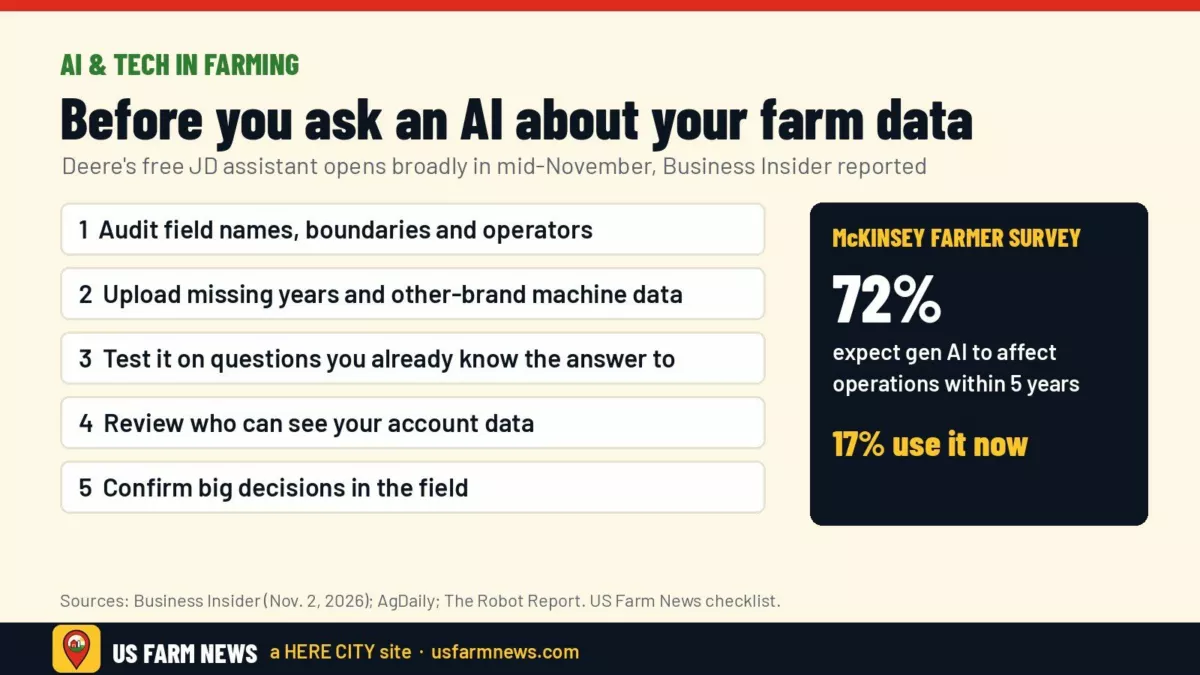
A McKinsey survey of 5,500 farmers worldwide, published in September, found 72% expect generative AI to affect their operations within five years, while only 17% use it now, Business Insider reported.
A checklist before you start
- Audit your records. Make sure field boundaries, field names, crop years and operator names are correct. Duplicate or misnamed fields will confuse any comparison.
- Fill the gaps. If some machines are not connected, or some years were never uploaded, import what you can. A missing year will make a “past three years” question incomplete.
- Start with questions you can check. Ask about something you already know, such as last year’s harvest dates or acres sprayed, and compare the answer with your own notes.
- Review data sharing. Look at which advisers, dealers or agronomists can see your account, and remove anyone who no longer needs access.
- Treat answers as a starting point. Use JD to find patterns faster, then confirm big decisions, like seed or input changes, with field checks and your agronomist.
For more on public-sector AI in agriculture, see our report on USDA and NASA’s satellite and AI crop data work. More coverage is in our Machinery & Tech section.
Frequently asked questions
Does John Deere’s JD AI assistant cost anything?
No. A Deere product manager told Business Insider there is no charge for either JD or Operations Center.
When can I use JD?
It has been available through an early-access waitlist. Business Insider reported that Deere will make it broadly available in mid-November 2026.
Does JD work with non-Deere equipment?
Data from other brands can be imported into Operations Center, and JD can analyze it with your Deere data, according to Business Insider.
Get the Daily Ag Business Briefing
Markets, policy and farm business in one free email each weekday.