A HERE CITY site

$53 Million AI Project Hunts for the Next Herbicide as Resistant Waterhemp Spreads: What Farmers Can Do Now
An MIT-led, $53 million ARPA-H project will use AI to design new weed killers, but results are years off. What it is and how to fight resistance meanwhile.
Key takeaways
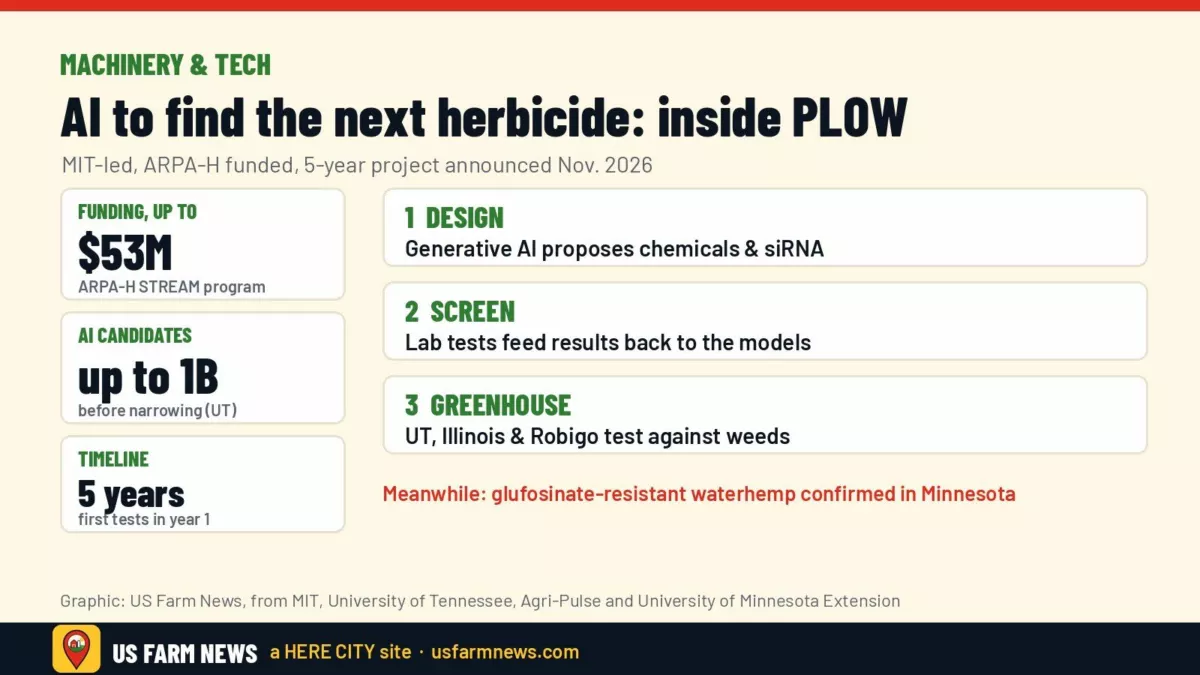
- An MIT-led team has up to $53 million from the federal ARPA-H agency to use generative AI to design new weed-control molecules, including RNA-based options.
- The AI models could propose as many as 1 billion candidate compounds before scientists narrow them for lab and greenhouse testing at the University of Tennessee and other partners.
- The project, called PLOW, runs five years; the first greenhouse tests of RNA candidates are due by the end of year one, so nothing from it will be in your sprayer for 2027.
- Meanwhile, resistance keeps spreading: Minnesota confirmed waterhemp that survives glufosinate, the main remaining postemergence option in some fields.
Herbicide-resistant weeds have outrun the pace of new chemistry for years. A federally funded project announced this month is betting that artificial intelligence, borrowed from drug discovery, can speed up the search for what comes next.
The Massachusetts Institute of Technology will lead the effort, worth up to $53 million, through the Advanced Research Projects Agency for Health (ARPA-H), MIT said. The project is known as PLOW, short for Precision Learning for On-target Weed control, and falls under an ARPA-H program called STREAM that focuses on agricultural inputs. The team also includes the University of Tennessee, the University of Illinois, UNC-Chapel Hill, the Broad Institute and biotech company Robigo.
Why it matters to your bottom line
Weeds that survive a pass compete with the crop for water, nutrients and space, cutting yields and adding trips and product costs, Agri-Pulse noted in its report on the project. Each lost mode of action narrows a grower’s options and makes the remaining ones more valuable.
Lead investigator Christopher Voigt, who heads MIT’s biological engineering department, framed it as a supply question as well as a resistance one. He warned that resistance mutations combined with supply-chain security worries over herbicide ingredients could leave the country “without these core agrochemicals,” MIT reported. MIT also said new alternatives could cut U.S. reliance on imported phosphorus, a key input for glyphosate.
How the AI part works
According to MIT, the work is split among three teams:
- Design: generative AI models will propose chemical compounds or small interfering RNA (siRNA) aimed at the same plant enzymes that glyphosate and other herbicides hit. The models will also weigh cost to make, the chance a weed develops resistance, and the risk to people and the environment.
- Screening: a high-throughput lab group at MIT and the Broad Institute will test large libraries of candidates and feed the results back to improve the models.
- Greenhouse testing: scientists including Neal Stewart and Scott Lenaghan of the UT Institute of Agriculture, Patrick Tranel of the University of Illinois and Robigo will see how the best molecules perform against real weeds.
UT said the models may flag up to 1 billion possible alternatives before the list is cut down. Stewart called the project “a game changer in crop agriculture” because it applies AI-driven drug discovery methods to herbicides. The team also plans to engineer microbes that break down farm chemicals before they reach food, soil or water, MIT said.
The practical takeaway: don’t wait for it
This is early-stage research, not a product. The first tests come in the project’s first year, and the full effort runs five years, according to UT. Any compound that emerges would still have to go through development and federal registration before it reaches a dealer.
The resistance problem on your farm is moving faster. In March, University of Minnesota Extension confirmed the state’s first glufosinate-resistant waterhemp, likely the second U.S. case after Illinois. At four Minnesota sites, waterhemp was already resistant to six herbicide sites of action, leaving glufosinate as the only working postemergence choice there. In field tests on the Dodge County farm where the problem surfaced, a full labeled rate of Liberty 280 SL gave about 60% control, the scientists reported.
UMN’s advice for now:
- Start the season with a strong preemergence residual program: several effective sites of action at the full labeled rate for your soil and crop.
- Mix and rotate sites of action to slow further resistance.
- Follow label rates, additives and timing for glufosinate, including weed height.
- Add nonchemical tactics where they fit.
New tools are arriving slowly. For one that’s close to market, see our report on the Group 12 herbicide for waterhemp and Palmer amaranth, and for equipment that cuts herbicide use, our look at smart sprayer costs and break-evens.
What to watch
- First-year greenhouse results on RNA-based candidates.
- Whether other ARPA-H STREAM projects target crop inputs farmers buy.
- More resistance confirmations as university labs test fall seed samples.
Get the Daily Ag Business Briefing
Markets, policy and farm business in one free email each weekday.