A HERE CITY site

Halter Launches Mav, an AI Herd Assistant Built on Collar Data: 6 Questions to Ask Before You Trust Farm AI
Halter's Mav answers herd, grazing and breeding questions from collar data. It's NZ dairy-only for now, U.S. ranchers next. What to check before you trust it.
Key takeaways
- Halter, the New Zealand maker of smart cattle collars, launched Mav, an AI assistant that answers questions about herd health, grazing and breeding using the farm’s own collar data.
- It’s available now only to Halter’s New Zealand dairy customers on Pro and Unlimited plans; the company says beef operations and U.S. ranchers are next, without giving a date.
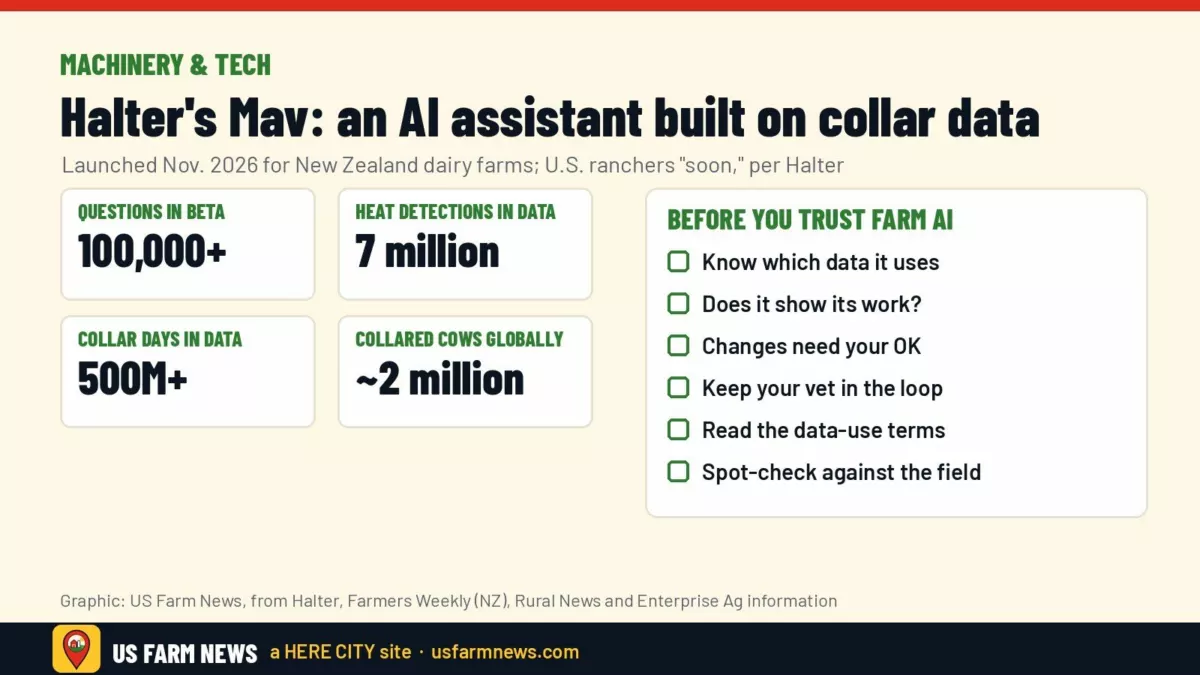
- Farmers asked more than 100,000 questions during the beta, and Mav is free during beta for eligible New Zealand users, according to Halter.
- In a UC Davis look at 16 fruit orchards, a veteran manager’s yield estimates beat camera counts, a reminder that AI output still needs a human check.
The next wave of farm AI isn’t another app to learn. It’s a chat window sitting on top of data a farm already collects. Halter, whose collars record cattle behavior, health and grazing data, this week launched Mav, an AI assistant that turns the collars’ constant stream of readings into plain-language answers and daily reports. It’s starting with dairy farms in New Zealand, but the company says U.S. ranchers are on the list, and the launch shows what to expect, and what to ask, as these tools arrive in American barns and pastures.
What Mav does
Farmers can ask Mav for a morning read on the herd, a list of animals that need checking, or a comparison of this season’s grass growth with earlier years, and they can schedule those answers as a daily update, according to New Zealand’s Farmers Weekly and Rural News. Halter says Mav can also take action: a farmer can tell it to change mating dates, add a supplement record or move cattle between groups, then approve the change before it happens. Users can upload reports, milk dockets or photos for Mav to consider, and send a read-only link to a vet or consultant, the company’s product page says.
North Otago dairy farmer Nathan McLachlan, an early user, told Farmers Weekly that Mav texts him a farm report every morning at 7 a.m., covering hectares grazed, pasture covers, heat detections, cows mated and calvings. He said it also flags collar problems and suggests grazing round lengths.
Halter gave Rural News a mating-season example: on a big dairy, around 50 cows might come into heat in one day. The collars already flag them, but the farmer still has to weigh each cow’s heat history, timing and intensity. Mav can sort through those factors together to point out which cows deserve a closer look, the company said.
The data behind it
Behind Mav is an anonymized pool of Halter data that the company considers among the world’s biggest combined grass-and-cattle datasets, Rural News reported. The company counts 10,000 cumulative breeding seasons in it, along with 7 million heat detections and 1.2 million health cases, from more than 500 million days of collar wear. Halter says about two million cows wear its collars worldwide.
“Mav takes all of that information and helps them work out what to do with it,” founder and CEO Craig Piggott told Farmers Weekly. According to Halter, Mav is built on a top-tier AI model, with its reasoning designed by the company’s in-house farmers, vets and farm operators.
Availability and cost
For now, Mav is limited to Halter’s New Zealand dairy customers on its Pro and Unlimited plans, and it’s free to them during the beta, according to Halter’s U.S. product page. The company says it is working to bring Mav to beef operations, to Australia and to ranchers in the United States “soon.” Rural News said Halter serves 1,200 New Zealand dairy customers and plans a progressive international rollout. No U.S. pricing has been announced.
Why it matters: AI is only as good as the check on it
Halter itself says Mav can get things wrong “like any AI,” which is why it shows its reasoning, never changes anything without approval and refers animal health and complex calls to a vet or consultant. Outside research points the same way. UC Davis researchers who spent three years studying 16 tree fruit farms in California and Washington found that cameras counting buds and fruit tended to overestimate yield, and one longtime farm manager who trimmed the camera counts by 14% based on block history and weather produced the more accurate estimates, Enterprise Ag reported this week. The lesson for any farm AI: it saves time sorting data, but the person who knows the ground still has to sign off.
Practical checklist before you trust an AI farm assistant
- Know what data it uses. Answers drawn from your own sensors and records are more useful than generic advice. Ask which data streams feed it.
- Ask about mistakes. Does it show how it reached an answer? Can it make changes on its own, or does it require your approval, as Halter says Mav does?
- Keep the vet in the loop. Use AI to triage, not to diagnose. A shareable read-only view, like the one Halter offers, makes it easier to bring in your vet or nutritionist.
- Read the data terms. Halter says farm data stays with the company, isn’t sold and isn’t given to outside AI firms to train their models. Get that in writing from any vendor.
- Check permissions. Make sure employees can only do through the assistant what they can already do in the main app, a safeguard Halter says it uses.
- Spot-check the output. Compare AI reports with what you see in the pasture for the first few weeks, the same way the UC Davis orchard manager checked the cameras.
For more on how AI is showing up in farm software, see our AI assistants checklist and our report on AI dairy cameras and herd assistants at EuroTier.
What to watch
- A date and pricing for Mav for U.S. beef customers.
- Whether rival virtual-fencing and herd-monitoring companies add similar chat assistants.
- Vendor data-use terms as AI tools draw on pooled farm data.
Get the Daily Ag Business Briefing
Markets, policy and farm business in one free email each weekday.