A HERE CITY site

AI Cameras and Herd Assistants at EuroTier 2026: What GEA, Lely and Nedap Showed, and 6 Questions for Dairies
GEA previewed an AI herd assistant; Lely and Nedap showed cameras that flag calving and lameness. What each does, what's still in testing and what to ask.
Key takeaways
- At EuroTier 2026 (Nov. 10-13, Hannover, Germany), dairy suppliers showed AI tools that watch cows through cameras or summarize sensor data, with no new wearables needed.
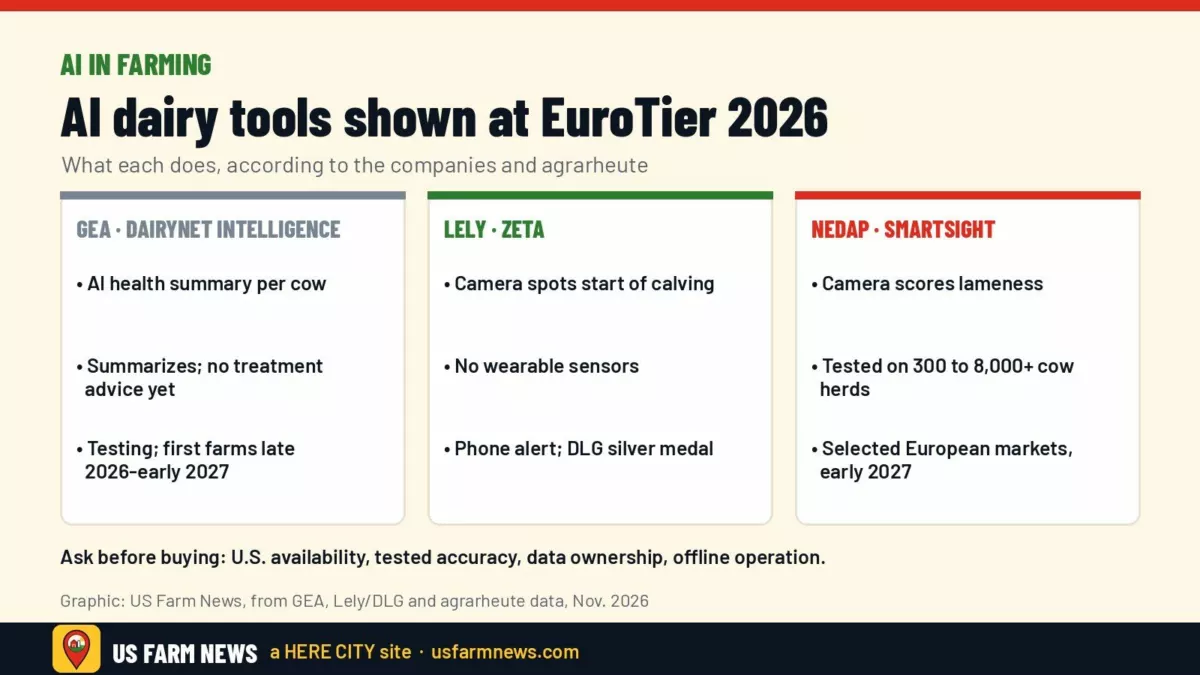
- GEA previewed DairyNet Intelligence, an AI assistant that writes a short health summary for each cow. It is still in testing, with a first rollout on selected farms planned for late 2026 or early 2027.
- Lely’s Zeta camera spots the start of calving and alerts the farmer; it won a DLG silver medal. Nedap’s SmartSight camera scores lameness and was tested on herds of 300 to more than 8,000 cows in Europe and North America, agrarheute reported.
- Before buying, ask where the data lives, how accuracy was measured and what happens when the internet goes down.
EuroTier, the livestock technology show in Hannover, Germany, wrapped up last week, and the clear theme for dairy was artificial intelligence that turns data a farm already collects, or a camera over the alley, into a short list of cows that need a look.
Several of these tools are European launches first. But GEA, Lely and Nedap are familiar names in U.S. milking and herd-management equipment, so their direction is worth tracking for anyone planning a parlor, robot or software upgrade in the next few years.
What was shown
GEA DairyNet Intelligence: a herd assistant
GEA said its new assistant pulls together milk yield, cow activity, somatic cell count and conductivity data in its DairyNet herd management system, along with data from its CattleEye and CowScout tools. Instead of clicking through several screens, a user sees a brief AI-written summary of the cow’s current health on her detail page.
The company was clear about limits. The system “does not yet recommend specific actions,” GEA said, and a chat-style feature built on preset questions, such as which cows need attention now, is still being tested. GEA plans to switch on the AI functions for a limited set of farms first, beginning late this year or early next, and use their feedback to guide development.
One design choice stands out for rural farms with spotty internet: GEA said an on-farm industrial computer, the DairyNet Box, stores and processes key herd data locally, so core functions keep working during an outage and sync later.
Lely Zeta: a calving camera
Lely’s Zeta AI calving monitor uses computer vision to watch cows without wearable sensors. It reads behavior, posture and movement to flag cows close to calving or already in labor, and sends notifications, according to Lely’s announcement on the EuroTier site. It earned a silver medal in the DLG’s EuroTier 2026 Innovation Award.
The German farm publication agrarheute added that the camera tracks the time between contractions, lets the farmer replay the last five minutes and sends a phone alert when a calving looks like it needs help. Dimmable LED lights let the farmer check in at night.
Lely also showed Lely Hub, a Lely-managed device that sits between its robots and the farm computer to handle security, updates and backups.
Nedap SmartSight: a lameness camera
Nedap’s SmartSight uses a camera in a cow passage to analyze movement and posture and detect lameness early, agrarheute reported. It combines that with data from cow sensors, milk metering and animal ID to build hoof-trimming work lists ranked by severity and recovery. The system was validated on farms with 300 to more than 8,000 cows in Europe and North America and is due in selected European markets from early 2027, according to the report.
Why it matters to a dairy’s bottom line
Labor is the common thread. Each of these tools tries to replace a task that eats hours: walking pens for lame cows, checking close-up cows overnight, or digging through reports to find a cow with a rising cell count. Catching lameness, mastitis or a hard calving earlier can save treatment costs, milk and sometimes the calf or cow.
The flip side is that none of the companies published independent accuracy figures for these AI features in the material we reviewed, and GEA’s functions are explicitly in testing.
Six questions to ask before you buy
- Is it sold here, and when? Confirm U.S. availability, pricing and dealer support. Some of these launches are Europe-first.
- How was accuracy tested? Ask for results on herds like yours, including how many alerts were false alarms and how many problems it missed.
- Does it suggest or decide? GEA’s assistant summarizes; it does not prescribe. Know who makes the treatment call.
- Where is the data stored, and who owns it? Ask whether data stays on the farm, goes to the cloud, or both, and whether you can export it.
- What happens offline? Local processing, like GEA’s on-farm box, keeps alerts working when the connection drops.
- What does it add to your current system? Cameras that need no collars can cut sensor costs, but check whether they integrate with your existing herd software.
We laid out a similar checklist for AI tools in crop software in our look at AI assistants in farm software.
Frequently asked questions
Is GEA DairyNet Intelligence available now?
No. GEA said the AI functions are in testing and will reach a limited group of farms first, starting late 2026 or early 2027.
Does Lely Zeta need sensors on the cows?
No. Lely says Zeta uses cameras and computer vision to watch behavior, posture and movement, without wearable sensors.
Where was Nedap SmartSight tested?
On farms with 300 to more than 8,000 cows in Europe and North America, agrarheute reported.
Get the Daily Ag Business Briefing
Markets, policy and farm business in one free email each weekday.