A HERE CITY site

U.S. Barge Fleet Could Shrink 17% by 2035, CoBank Says, and Farmers Will Feel It in Basis
CoBank projects the inland barge fleet falls to 16,240 by 2035 as new barges top $1 million, lifting freight and widening basis for river-linked grain farms.
Key takeaways
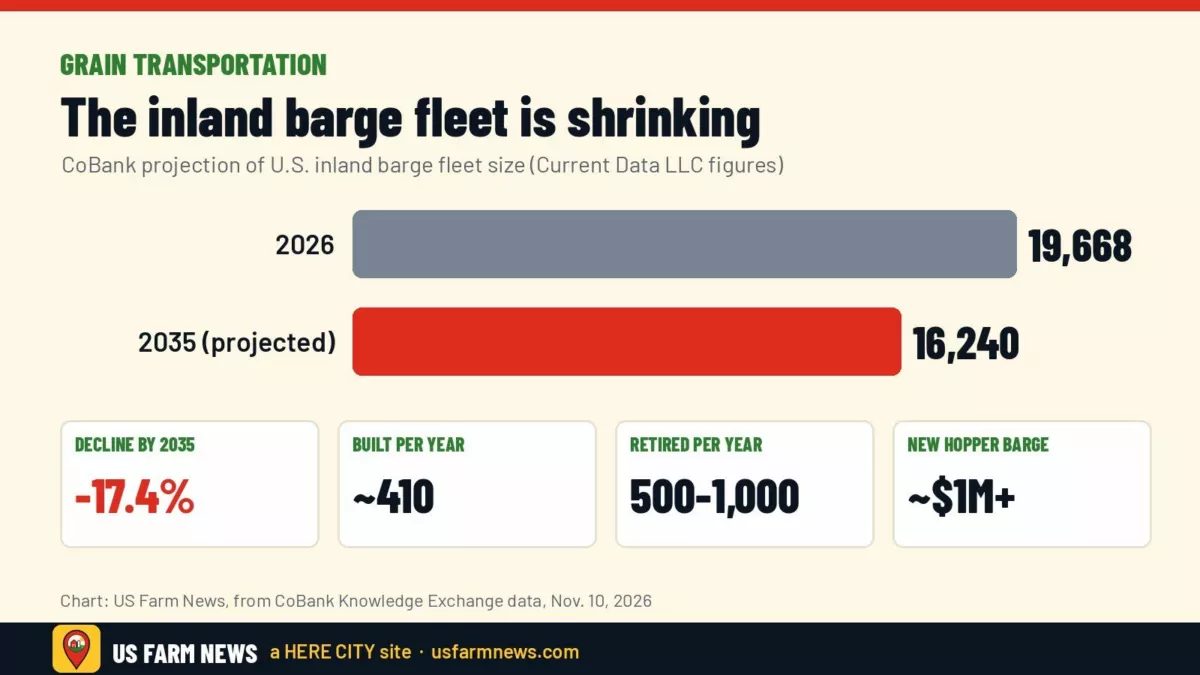
- CoBank projects the inland barge fleet will fall from 19,668 vessels in 2026 to 16,240 by 2035, a 17.4% drop.
- About 410 barges are built each year while 500 to 1,000 are retired, and a new hopper barge now costs roughly $1 million or more, CoBank said.
- Fewer barges means higher freight and weaker basis, especially for farms and elevators that ship down the Mississippi to the Gulf.
- USDA expects grain and oilseed exports to grow 9% by 2035, so demand for river freight is rising while supply shrinks.
The towboats and hopper barges that carry much of the Corn Belt’s crop to the Gulf are wearing out faster than they are being replaced, and a new analysis from CoBank says farmers will end up covering much of the bill through wider basis.
In a report released Nov. 10, the Farm Credit System lender projected the U.S. inland barge fleet will shrink by 17.4% by 2035, falling to 16,240 barges from 19,668 this year. That is roughly 3,400 fewer barges at a time when USDA expects U.S. grain and oilseed exports to climb 9% over the same stretch.
“The U.S. is facing a barge retirement wave,” Tanner Ehmke, CoBank’s lead grains and oilseeds economist, said in the bank’s announcement.
Why it matters to your grain check
Freight is subtracted from the export price before an elevator posts its bid. When barge rates climb, the river terminal keeps less margin to pass back, so the local cash bid drops relative to futures. CoBank said tighter barge supply also slows grain movement, which pushes more bushels into storage and widens both basis and carries.
Ehmke put it more bluntly in an interview with Brownfield Ag News. Higher Mississippi River barge rates are coming, he said, and as for who pays, “it’s going to be the farmer.”
Operations in the upper Midwest and along the river that depend on Gulf export demand are the most exposed. For a farm deciding whether to sell at harvest or store, a structurally wider basis changes the math on what it costs to hold grain and when a carry is worth capturing.
The numbers behind the forecast
- Fleet size: 19,668 barges in 2026, down nearly 7.6% in the past decade, according to Current Data LLC figures cited by CoBank.
- Age: The average barge is now 17.6 years old, up from 13.8 years in 2016. Grain hopper barges usually last 25 to 30 years.
- Builds vs. retirements: roughly 410 new barges a year, against 500 to 1,000 taken out of service.
- Replacement cost: roughly $1 million or more for a new hopper barge, compared with about $650,000 a decade ago.
- River’s share: the Mississippi carries about half of U.S. corn and soybean exports and a third of wheat exports, CoBank said, citing USDA.
Why owners aren’t building more
Steel is the biggest cost in a new barge. CoBank said U.S. steel plate stays well above world prices, partly because of the Section 232 tariffs, while labor, fiberglass and borrowing costs have also climbed. At the same time, many carriers still set rates off older barges that were paid for and depreciated long ago. Freight has risen, the bank said, but not enough to justify replacing the fleet at today’s prices, so most owners are stretching the life of what they have.
Brownfield reported that Ehmke sees a need for investment now to head off a squeeze on farmers later. He also told Brownfield the cost of replacement barges has risen sharply over the past 10 years.
Low water and locks add to the risk
Low water on the Mississippi in recent falls has forced lighter loads and shorter tows, effectively cutting capacity further. Aging locks and dams are another weak point; one breakdown can stall traffic for days. Railroads compete for some of the business, but CoBank said rail equipment, terminal bottlenecks and export elevator limits keep trains from taking over barge volumes. The Missouri River’s navigation season also ended early this fall because of drought.
Congress has a possible fix in the pipeline. CoBank pointed to the proposed Water Resources Development Act of 2026, which would put more than $6 billion toward ports, waterways and related projects.
“Freight values are already above historical norms, even during periods that were traditionally considered off-season,” Ehmke said in the release.
What to watch
- Weekly: USDA’s export inspections (Mondays) and its Grain Transportation Report (Thursdays), which tracks barge rates and grain movement.
- Lame duck: whether the Water Resources Development Act moves before Congress adjourns.
- Your basis: compare current Gulf-linked bids with your three-year average before deciding how much grain to carry into spring.
Frequently asked questions
How much will the barge fleet shrink?
CoBank projects the inland fleet will fall to 16,240 barges by 2035 from 19,668 in 2026, a 17.4% decline, if current build and retirement rates hold.
How does barge freight affect my local price?
Elevators subtract freight from the export value, so higher barge rates usually mean weaker cash bids relative to futures, CoBank said.
Can rail replace the lost barge capacity?
Only partly. CoBank said rail equipment, terminal bottlenecks and export elevator limits keep railroads from absorbing displaced barge volumes.
Get the Daily Ag Business Briefing
Markets, policy and farm business in one free email each weekday.