A HERE CITY site

Sold Cattle Early Because of Drought? Two IRS Rules Can Defer the Tax, and Notice 2026-54 Adds Time
Drought-forced livestock sales can be deferred a year or rolled into replacements. IRS Notice 2026-54 extends 2026 replacement deadlines in 49 states. How-to.
Key takeaways
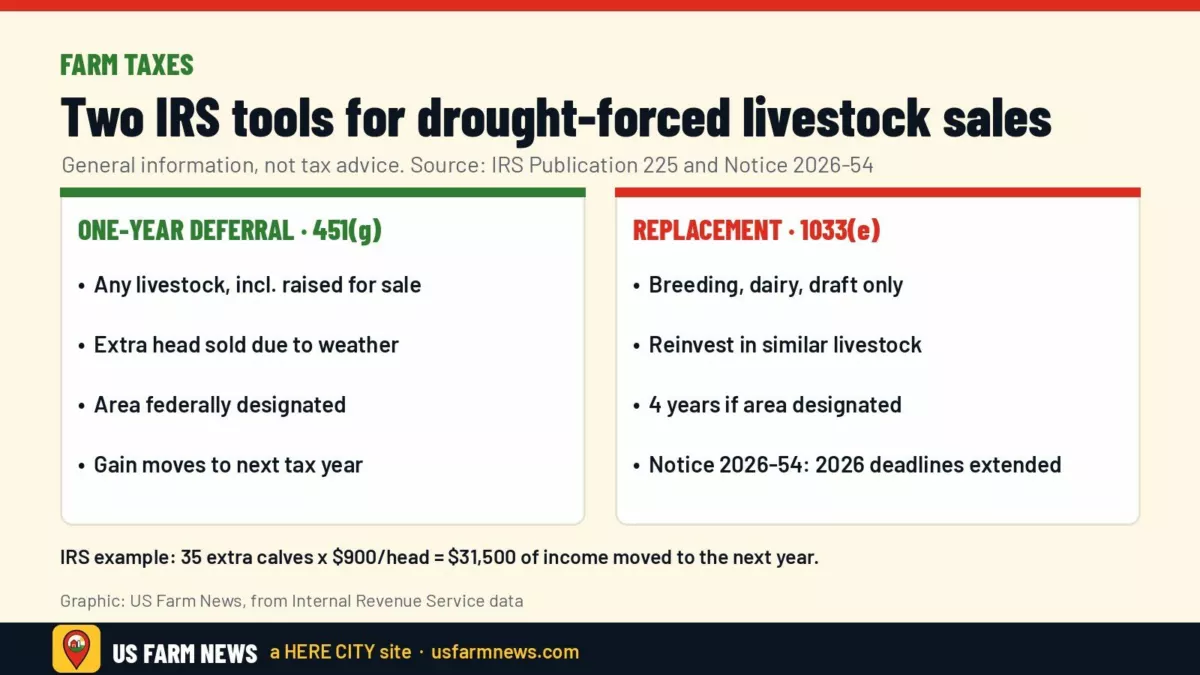
- Ranchers who sold extra livestock because of drought can often push the taxable gain into a later year under two IRS rules: a one-year deferral (Section 451(g)) or a replacement rule for breeding, dairy and draft animals (Section 1033(e)).
- IRS Notice 2026-54 extends the replacement deadline for drought sales in 49 states, D.C. and Puerto Rico. If your four-year window was set to close at the end of 2026, you get until the end of your next tax year.
- The relief keys off drought reported in your county or a neighboring county in any week from Sept. 1, 2025, to Aug. 31, 2026.
- Both rules require a written statement with your return. Talk to your tax preparer before year-end.
With drought designations still coming in from USDA and January feeder cattle futures above $335, according to Brownfield Ag News, many cow-calf operations sold deeper than usual this year. The IRS has two tools that can keep a forced sale from creating a one-year tax spike, and its annual drought notice just gave many herds more time to rebuild.
This is general information, not legal, tax, or financial advice. Every operation’s situation is different, so check the details with a qualified tax professional.
What changed: Notice 2026-54
Each September the IRS publishes a list of counties where the U.S. Drought Monitor showed severe (D2), extreme (D3) or exceptional (D4) drought during the prior 12 months. This year’s list, in Notice 2026-54, reaches into 49 states plus D.C., Puerto Rico and some other jurisdictions, the agency said.
The notice matters for anyone who already sold breeding, dairy or draft animals because of drought and is using the four-year replacement period. If that window was scheduled to close at the end of 2026, and your county or any county bordering it is on the list, the deadline rolls forward. According to the IRS, those producers can now buy replacements any time through the end of the following tax year, and the extension keeps going until the region has a full drought-free year ending Aug. 31.
Tool 1: Push one year’s extra sales into next year (Section 451(g))
This option fits most cattle sold early, including calves and yearlings raised for sale and even poultry. According to IRS Publication 225, the Farmer’s Tax Guide, you can postpone reporting the gain on the extra animals until the following tax year if:
- you would not have sold those additional head this year under your normal practice,
- the sale happened only because of drought, flood or another weather condition, and
- that weather led to a federal disaster designation covering your area. A USDA designation counts, and sales made before the designation can still qualify if the same drought led to it.
How the math works. The IRS example: a rancher who normally weans and sells 100 calves sold 35 extra at weaning because of drought, for 135 head and $121,500 that year, or $900 a head. The amount that can be moved to the next year is $900 times the 35 extra head, or $31,500. The calculation is done separately for each class of livestock, such as cattle, hogs or sheep.
The deferral only shifts income one year, which helps most when this year’s income is unusually high or next year’s is expected to be lower.
Tool 2: Replace the herd and defer the gain (Section 1033(e))
This rule applies to animals held for breeding, dairy or draft use, but not to slaughter livestock, sporting animals or poultry, the IRS said. A drought sale of excess breeding stock is treated like an involuntary conversion. If you reinvest the proceeds in similar livestock within the replacement period, you generally report gain only to the extent the sale price exceeds what you spend on replacements.
- The usual replacement period is two years, according to the IRS.
- If the drought led to a federal designation, the window runs four years, measured from the end of the earliest tax year that included part of the gain.
- Notice 2026-54 extends it further where drought has continued, as described above.
Publication 225 notes that young animals sold to shrink a breeding herd because of drought are treated as held for breeding. Breeding and dairy stock sales are reported on Form 4797, not Schedule F.
Paperwork checklist
- For a 451(g) deferral, attach a statement to the return for the year of sale. It should say you are postponing gain under section 451(g), and show evidence of the weather condition, the designation date if known, how the drought forced the sale, your normal number of sales, total head sold and how many were drought sales, and your calculation for each class.
- For a 1033(e) replacement, attach a statement in the year you first realize gain, with evidence of the weather conditions and the number of animals you would normally have sold. Attach another statement in the year you buy replacements describing them.
- Missed it? For a 451(g) deferral, the IRS says you can still elect it on an amended return filed within six months of the original due date, not counting extensions, marked “Filed pursuant to section 301.9100-2.”
- Keep the proof: save the Drought Monitor maps for your county and its neighbors, your USDA designation notice and sale barn records showing normal versus actual sales.
Check whether your county is designated
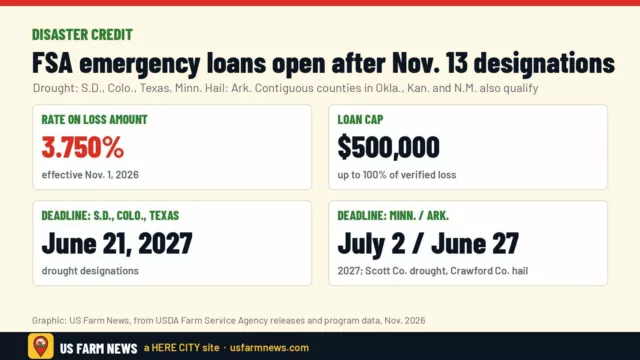
USDA’s Farm Service Agency kept adding drought designations last week, including counties in South Dakota, Colorado, Texas and Minnesota on Nov. 13. Those designations also open FSA emergency loans; see our guide to applying for FSA emergency loans. For grazing losses, the Livestock Forage Disaster Program may also pay.
Frequently asked questions
Do feeder calves qualify for the drought tax deferral?
Calves raised for sale can qualify for the one-year Section 451(g) deferral if they were extra sales forced by drought in a federally designated area. The longer Section 1033(e) replacement rule is only for breeding, dairy and draft animals.
How long do I have to replace breeding cattle sold in a drought?
In a federally designated area, generally four years, counted from the end of the first tax year with gain. Under Notice 2026-54, windows that were set to end in 2026 run to the end of your next tax year if your region is on the list.
Which drought dates count for Notice 2026-54?
Severe, extreme or exceptional drought reported in your county or a neighboring county in any week from Sept. 1, 2025, through Aug. 31, 2026.
Get the Daily Ag Business Briefing
Markets, policy and farm business in one free email each weekday.