A HERE CITY site

New Drought and Hail Designations Open FSA Emergency Loans in 5 States: Who Qualifies, the 3.75% Rate and How to Apply
USDA's Nov. 13 disaster designations opened FSA emergency loans in S.D., Colo., Texas, Minn. and Ark. The counties, the $500,000 cap and how to apply.
Key takeaways
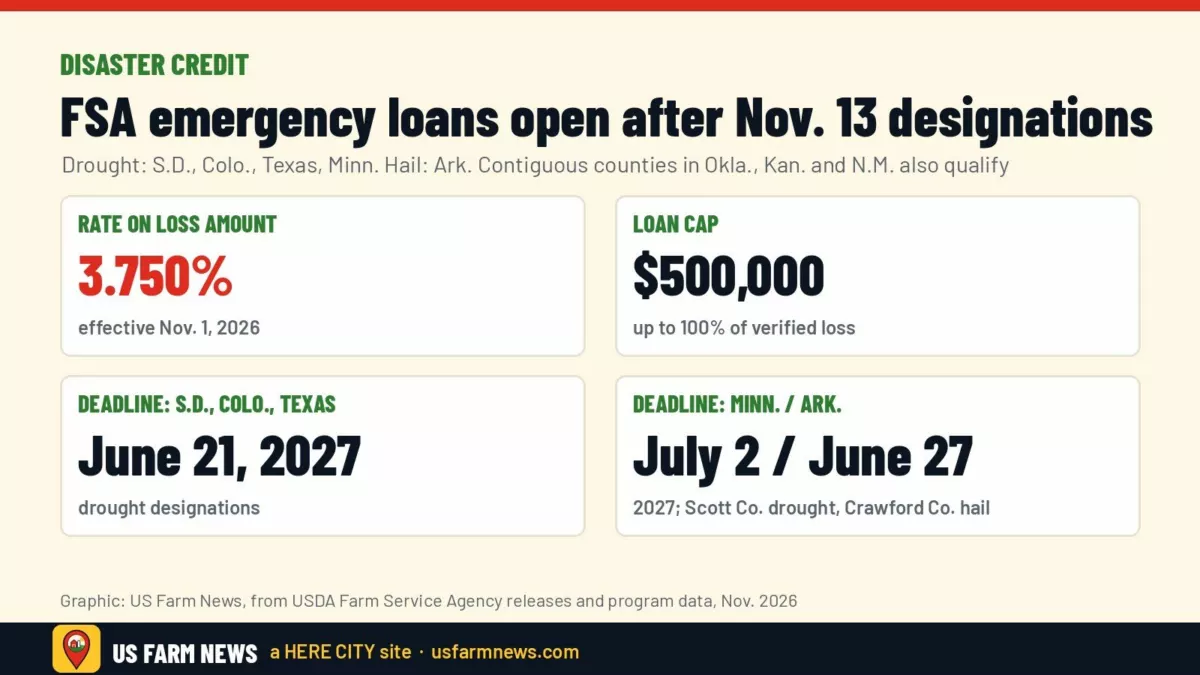
- USDA’s Farm Service Agency issued new disaster designations on Nov. 13, 2026 for drought in South Dakota, Colorado, Texas and Minnesota and hail in Arkansas, opening emergency loans in those counties and the counties next to them, including parts of Oklahoma, Kansas and New Mexico.
- Emergency loans can equal the full amount of a verified crop or property loss, to a maximum of $500,000. The rate on the loss amount is 3.750% as of Nov. 1, FSA says.
- Deadlines: June 21, 2027 for the South Dakota, Colorado and Texas drought designations, June 27, 2027 for the Arkansas hail designation and July 2, 2027 for Minnesota.
- You must show you can’t get enough credit elsewhere. For loans over $100,000, that usually means written turndowns from commercial lenders.
Farmers and ranchers in dozens of drought-hit counties across the Plains and upper Midwest became eligible for low-interest federal emergency loans this week. On Nov. 13, USDA’s Farm Service Agency (FSA) announced Secretarial disaster designations covering primary counties in four states for drought and one Arkansas county for hail, plus neighboring counties that qualify automatically.
These loans are not grants, and they are not the same as the drought payments under the Livestock Forage Disaster Program we covered in our LFP how-to. They are credit for operations that took a real hit and can’t borrow enough elsewhere. Here’s who is covered, what the loans can pay for and how to apply.
This is general information, not legal, tax, or financial advice. Your local FSA office has final say on eligibility, and a lender or accountant can help you decide whether more debt makes sense for your operation.
Which counties are covered
According to FSA’s Nov. 13 releases, the drought designations were triggered by U.S. Drought Monitor readings: at least eight straight weeks of severe (D2) drought during the growing season, or any extreme (D3) or exceptional (D4) drought.
- South Dakota (drought): primary counties Edmunds, Faulk and Walworth. Contiguous: Brown, Campbell, Corson, Dewey, Hand, Hyde, McPherson, Potter and Spink. Deadline June 21, 2027.
- Colorado (drought, fast track): primary counties Baca and Lincoln. Contiguous: Arapahoe, Bent, Cheyenne, Crowley, Elbert, El Paso, Kiowa, Kit Carson, Las Animas, Prowers, Pueblo and Washington in Colorado; Morton and Stanton in Kansas; Union in New Mexico; and Cimarron in Oklahoma. Deadline June 21, 2027.
- Texas (drought, fast track): primary counties Collin, Cooke, Dallas, Denton, Ellis, Grayson, Montague, Parker, Tarrant, Upton and Wise. Contiguous Texas counties include Clay, Crane, Crockett, Ector, Fannin, Glasscock, Henderson, Hill, Hood, Hunt, Jack, Johnson, Kaufman, Midland, Navarro, Palo Pinto, Reagan and Rockwall, plus Bryan, Jefferson, Love and Marshall in Oklahoma. Deadline June 21, 2027.
- Minnesota (drought, fast track): primary county Scott. Contiguous: Carver, Dakota, Hennepin, Le Sueur, Rice and Sibley. Deadline July 2, 2027.
- Arkansas (hail): primary county Crawford. Contiguous: Franklin, Madison, Sebastian and Washington in Arkansas, and Adair and Sequoyah in Oklahoma, according to the Oklahoma Farm Report. Deadline June 27, 2027.
Oklahoma Farm Report noted that seven Oklahoma counties picked up eligibility as contiguous counties because they border primary disaster areas in other states. If your county isn’t listed, check with your FSA office; other designations are issued throughout the year.
What the loans can pay for
FSA says the money can go toward fixing or replacing property the farm depends on, covering the year’s production costs and basic household living costs, restructuring the business and refinancing some existing debt. Examples in the releases include replacing equipment or livestock.
- Loan size: as much as the full verified loss, whether crop or physical, but no more than $500,000, according to FSA’s program page.
- Rate: 3.750% for the amount of actual loss, effective Nov. 1, 2026, per FSA’s current rate table.
- Term: FSA says repayment typically runs 1 to 7 years when the loss involves crops, livestock or other non-real-estate assets, and as long as 40 years when land or buildings were damaged.
How FSA figures a production loss
Under the federal rules for the program (Subpart I of Part 764 in Title 7 of the federal code), a crop production loss loan can’t exceed the calculated loss, which works like this:
- Take your normal yield and subtract the disaster-year yield to get the loss per acre.
- Multiply by the acres planted to that crop.
- Multiply that volume by the market price FSA sets for the crop.
- Subtract any crop insurance indemnities or other compensation you received or will receive for the loss.
The crop also has to be a basic part of your total operation, and your disaster yield must fall below FSA’s normal yield for it. That means a strong crop insurance payout can shrink or erase an emergency loan, so have your claim figures handy.
For physical losses such as damaged buildings or equipment, the rules generally require the property to have carried hazard insurance when the damage happened.
Who qualifies
The regulations and FSA’s program page list several tests. Among them:
- You operated the farm in a designated or contiguous county at the time of the disaster and suffered substantial losses.
- You intend to keep farming.
- You can’t get enough credit elsewhere at reasonable rates and terms. FSA requires one written credit denial from a commercial lender for loans of $300,000 or less and two for larger loans. For loans of $100,000 or less, FSA can waive that requirement in some cases.
- You agree to repay any duplicate federal disaster aid for the same loss.
How to apply
- Call your county FSA office first. Ask whether your county is covered, which disaster number applies and what paperwork it wants.
- Gather loss records: production and sales records, insurance claim documents, inventory records for lost livestock and repair estimates.
- Prepare a farm operating plan and current financial statements; FSA says both are part of the application.
- Get your lender’s answer in writing if you’re turned down for credit.
- Apply well before the deadline. Applications must reach FSA within eight months of the designation date.
FSA also points producers to the Disaster Assistance Discovery Tool and Loan Assistance Tool on farmers.gov. FSA’s regular operating and ownership loan rates for November are in our FSA loan rate guide.
Frequently asked questions
What is the FSA emergency loan interest rate?
FSA lists 3.750% for the amount of actual loss, effective Nov. 1, 2026.
How much can I borrow with an FSA emergency loan?
As much as your full verified loss, up to $500,000. Insurance payments and other compensation for the same loss are subtracted.
When do I have to apply?
Within eight months of the designation. For the Nov. 13 drought designations that means June 21, 2027, in South Dakota, Colorado and Texas and July 2, 2027, in Minnesota; the Arkansas hail designation deadline is June 27, 2027.
Do contiguous counties qualify?
Yes. Producers in counties next to a primary disaster county are also eligible for emergency loans, FSA says.
Get the Daily Ag Business Briefing
Markets, policy and farm business in one free email each weekday.