A HERE CITY site

Louisiana and Alabama Seek a 2027 RFS Waiver as Biodiesel Mandate Tops U.S. Capacity; Farm Groups Push Back
Two governors asked EPA to partly waive 2027 biofuel volumes. Farm groups object, and Illinois economists say up to 14 billion lbs. of feedstock is at stake.
Key takeaways
- The governors of Louisiana and Alabama have asked EPA to partly waive the 2027 Renewable Fuel Standard volumes, arguing the rules would cause “severe economic harm” to their states.
- Farm and biofuel groups, including the Renewable Fuels Association and the American Soybean Association, want EPA to reject the petitions. RFA says 22 governor requests for a general waiver since 2008 have all failed.
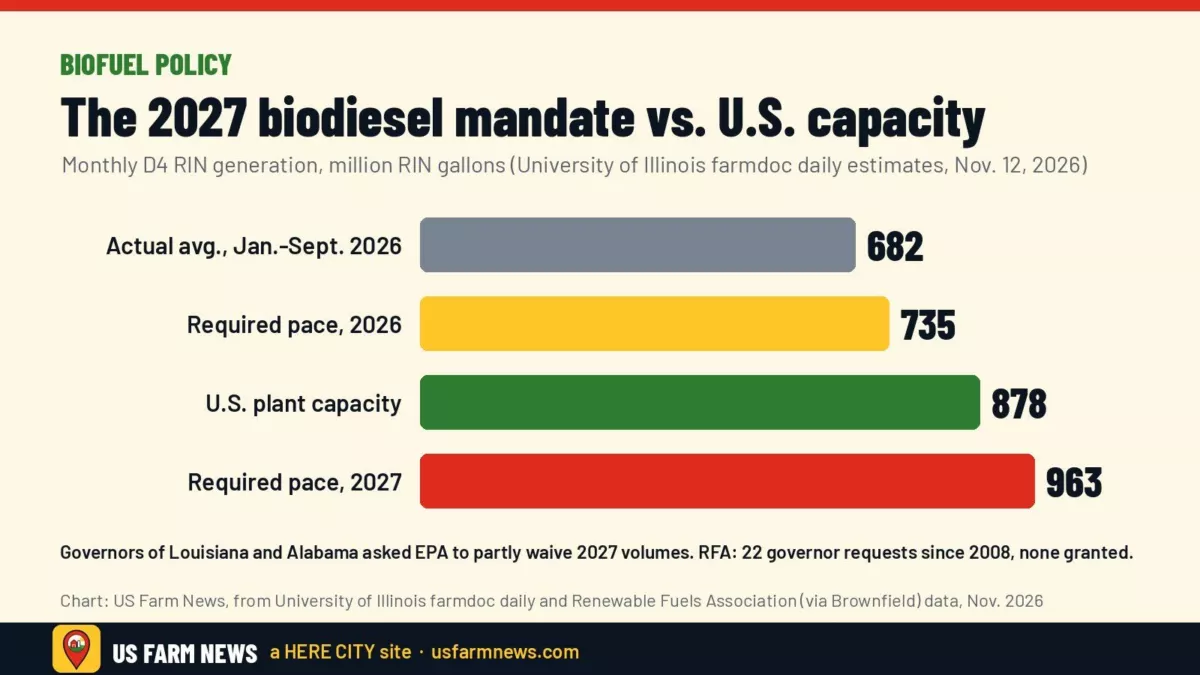
- University of Illinois economists estimate the 2027 biomass-based diesel requirement works out to 963 million RIN gallons a month, above U.S. plant capacity of about 878 million.
- At stake for soybean growers: a cut big enough to match domestic capacity would equal roughly 5 billion pounds of feedstock demand, the economists calculated.
A fight over next year’s biofuel mandate has opened in Washington, and soybean and corn growers have a direct stake in how it ends. The governors of Louisiana and Alabama have petitioned the Environmental Protection Agency to scale back the 2027 Renewable Fuel Standard (RFS) for their states, and farm groups are urging the agency to say no.
The request lands just as the 2027 volumes are looking hardest to meet. That matters for the price of soybean oil, crush margins and local basis, because biomass-based diesel has become one of the biggest new outlets for U.S. soybeans.
What the governors want
Citing high fuel prices, Louisiana Gov. Jeff Landry and Alabama Gov. Kay Ivey wrote to EPA chief Lee Zeldin seeking partial relief from 2027 RFS obligations, according to Agri-Pulse. In their letter, the governors said the 2027 standards would “severely harm” the economies of their two states and the Southeast. University of Illinois economists wrote in farmdoc daily that the governors call the request “targeted, prospective and temporary,” and that Landry is lobbying Texas, Mississippi and Arkansas to file too.
Landry blamed the RFS for higher pump prices in a social media post, Agri-Pulse reported. Refiners make a similar cost argument: the American Fuel & Petrochemical Manufacturers put the two-year compliance bill for 2026-27 at $106 billion, which works out to 26 to 35 cents on every gallon of gasoline and diesel, according to farmdoc daily.
Why farm groups are pushing back
The Renewable Fuels Association sent EPA a letter on Friday, Nov. 13, asking the agency to throw out the requests without opening them for public comment, Brownfield reported. RFA CEO Geoff Cooper told Brownfield that state governors have filed 22 requests for a general RFS waiver since 2008, and “exactly zero of those have been approved by EPA.”
Cooper also argued the economics run the other way. A waiver requires proof of severe harm, he told Brownfield, and no governor can show that “when ethanol is selling for a dollar a gallon less than gasoline.”
The American Soybean Association said in a Nov. 10 statement that granting the petitions would “strike a major blow” to domestic soybean markets. ASA said national average costs for biofuel blends are below those for petroleum fuels and that one petition wrongly claimed a waiver would help agriculture and poultry producers. The group credited current RFS volumes with a surge in domestic soybean demand and billions of dollars of new crush capacity, which it said improves on-farm basis and lowers soybean meal costs for livestock feeders.
Scott Irwin, an agricultural economist at the University of Illinois, told Agri-Pulse he was surprised the two states chose severe economic harm as their legal basis. He called it a very high bar that EPA has never accepted in a prior waiver request, putting the record at “a perfect 0-4” by his count. He suggested other states might instead argue inadequate domestic supply, which he sees as easier to prove.
Why 2027 is the pressure point
The petitions target the year when the numbers are tightest. In an updated balance sheet published Nov. 12, farmdoc daily’s economists estimated that net biomass-based diesel (D4) RIN generation needs to hit 8.82 billion RIN gallons this year. For 2027 the requirement climbs to 11.55 billion, or 63% more than in 2025.
- Required monthly pace: 735 million RIN gallons in 2026 and 963 million in 2027.
- Actual pace: generation averaged 682 million RIN gallons a month through September 2026, peaking at 838 million in June.
- Plant capacity: about 878 million RIN gallons a month, using EIA operable capacity. Even running flat out, U.S. plants would come up about 84 million short each month in 2027.
- Imports: the gap would have to be filled mostly by imported fuel, which dropped to 0.18 billion gallons last year and has all but disappeared this year. Imported fuel doesn’t qualify for the 45Z credit, the economists noted.
If generation stays at September’s level for the rest of 2026, the economists estimate the year would end with a deficit of about 0.60 billion RIN gallons, and that would push the 2027 requirement up to roughly 11.88 billion.
What it could mean for soybean demand
The farmdoc analysis put rough numbers on the feedstock at risk. A physical gallon of biomass-based diesel takes about 8 pounds of feedstock such as soybean oil. By their math:
- Trimming 2027 by roughly 1.01 billion RIN gallons, enough to bring it down to domestic capacity, would erase about 5 billion pounds of feedstock use.
- Holding 2027 at this year’s level, a reduction of 2.73 billion RIN gallons, would erase about 14 billion pounds.
Not all of that would come from soybean oil, but it shows why ASA and crushers are watching closely. Biodiesel makers, such as the plant restart we covered in Chevron’s Ralston, Iowa, plan, are counting on steady RFS demand, and crushers are counting on them.
What to watch
- EPA’s response. RFA wants a quick rejection with no comment period. If EPA opens a docket instead, expect a long fight.
- More petitions. farmdoc daily expects more states to file. Watch Texas, Mississippi and Arkansas.
- Related EPA decisions. Small refinery exemptions and the reallocation of exempted volumes will also shape 2027 demand, the economists said.
- Congress. Iowa Renewable Fuels Association’s Monte Shaw told Agri-Pulse the better fix for fuel prices is legislation allowing year-round E15 sales, an issue still pending in the lame-duck session.
Related: more policy and trade news.
Frequently asked questions
Which states asked EPA to waive the 2027 RFS?
Louisiana and Alabama filed the requests. Louisiana’s governor has urged Texas, Mississippi and Arkansas to join, according to farmdoc daily.
Has EPA ever granted a governor’s RFS waiver request?
No. RFA says all 22 governor requests for a general waiver since 2008 were rejected or went unanswered.
Why does the RFS matter to soybean farmers?
Biomass-based diesel uses soybean oil as a major feedstock. University of Illinois economists estimate that cutting 2027 volumes to match U.S. plant capacity would remove about 5 billion pounds of feedstock demand.
Get the Daily Ag Business Briefing
Markets, policy and farm business in one free email each weekday.