A HERE CITY site

Anhydrous Up 17% From a Year Ago as Farmers Plan 2027 Fertilizer; StoneX Analyst Flags Phosphate, Sees No Quick Relief
Retail anhydrous hit $1,003 a ton in early November, up 17% from a year ago, DTN says. A StoneX analyst sees no quick relief and worries most about phosphate.
Key takeaways
- Retail anhydrous averaged $1,003 a ton in the first week of November, 17% higher than a year earlier, according to DTN’s retailer survey.
- All eight fertilizers DTN tracks cost more than a year ago. Urea is up 11%, MAP 7% and DAP 3%.
- StoneX analyst Josh Linville told Brownfield that Strait of Hormuz disruptions remain the biggest price driver and that phosphate worries him most for 2027.
- He doesn’t expect new U.S. plants to bring relief for 12 to 18 months and urges farmers to talk with suppliers now.
Farmers finishing 2027 input budgets are looking at fertilizer bills that are higher than last year across the board, and the analyst many retailers follow says relief isn’t coming soon.
DTN’s weekly survey of farm retailers found that prices were mixed from October into the first week of November, with no product moving 5% or more in a month. But on a year-over-year basis every one of the eight major products is more expensive, led by anhydrous ammonia.
Where retail prices stand
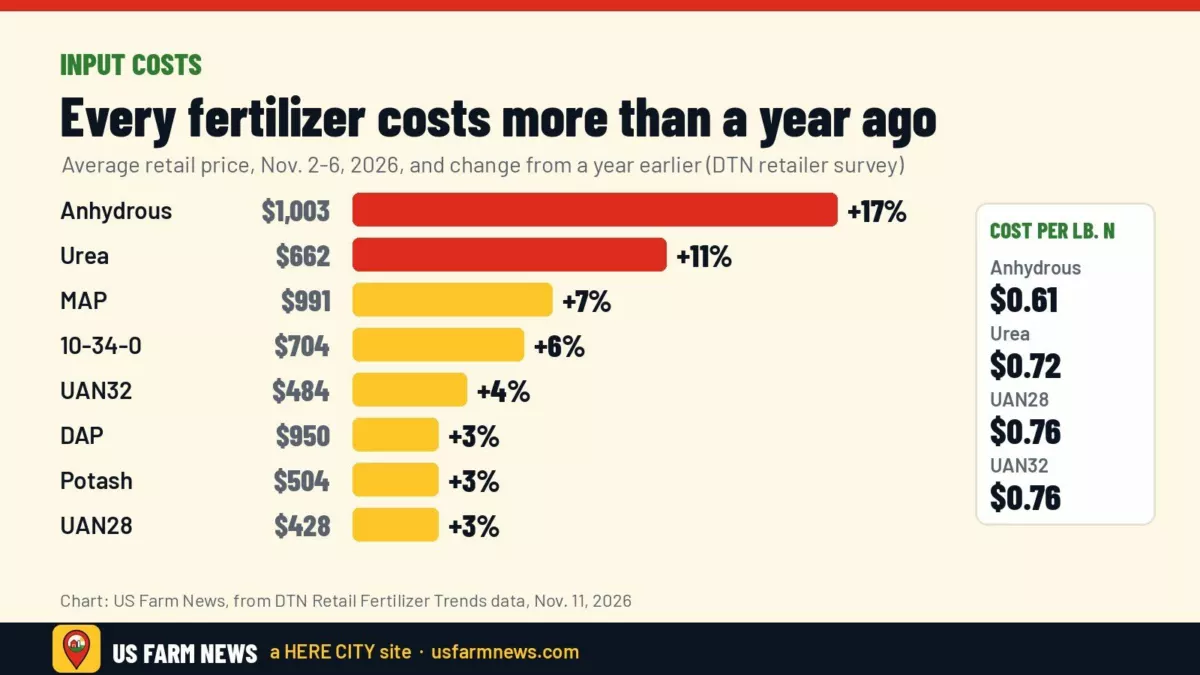
Average retail prices for Nov. 2-6, 2026, per DTN, with the change from a year earlier:
- Anhydrous: $1,003/ton, up 17%
- Urea: $662/ton, up 11%
- MAP: $991/ton, up 7%
- 10-34-0: $704/ton, up 6%
- UAN32: $484/ton, up 4%
- DAP: $950/ton, up 3%
- Potash: $504/ton, up 3%
- UAN28: $428/ton, up 3%
Month to month, DAP, MAP, potash, 10-34-0 and anhydrous edged up, while urea and both UAN grades slipped slightly, DTN said.
Cost per pound of nitrogen
For nitrogen buyers, the per-pound math still favors anhydrous even after its run-up. DTN put anhydrous at $0.61 per pound of N, urea at $0.72 and both UAN28 and UAN32 at $0.76. That gap is one reason many Corn Belt growers still lean on fall-applied ammonia, though warm soils this fall have pushed some applications later, as we reported in our story on waiting for 50-degree soils.
The bigger swing came earlier in the year. DTN’s figures show retail anhydrous jumped from the mid-$800s per ton last winter to more than $1,100 in the spring before easing over the summer and climbing again this fall.
What’s driving it
Josh Linville, vice president of fertilizer at StoneX, told Brownfield in a Nov. 12 interview that disruptions in the Strait of Hormuz are still the largest single factor in world fertilizer prices. Some cargoes are getting out of the region, he said, but volumes remain “far from what normal is.”
Phosphate is his top concern heading into 2027. He told Brownfield it rose the most, did not come back down over the summer the way nitrogen did, and is badly out of line with grain prices. Many farmers have said they will cut back on phosphate rather than pay current prices, he noted.
Location matters too. In an earlier interview with RFD-TV, Linville said regions with little or no nearby production, such as the Pacific Northwest, face longer lead times, which forces earlier purchase decisions and adds price risk. RFD-TV reported that fertilizer costs have climbed as much as 40% this year for some farmers.
Is relief coming?
Not quickly, by Linville’s read. Several new domestic plants have been announced, but he told Brownfield on Nov. 13 that it will be a long time before they produce their first ton, and he doesn’t see relief from them in the next 12 to 18 months. Stronger demand during the fall application season also gave prices a lift, he said.
Tight margins are shaping buying behavior. Linville said 2026 farm financials “are not good” and 2027 doesn’t look much better, so many growers have been waiting for prices to fall. He said he doubts much relief will arrive by spring.
What farmers can do now
- Talk to your supplier, even if you’re not buying yet. Linville’s advice is to share your 2027 plans with your retailer or co-op. That doesn’t mean signing a blank check, he said, but it helps the supplier decide how much product to position for you.
- Price nitrogen per pound of N, not per ton, when comparing anhydrous, urea and UAN.
- Revisit phosphate and potash rates with current soil tests before deciding how much to apply in 2027.
- Build input costs into your 2027 crop budget and loan request now, especially if your lender will want cash-flow projections this winter. See our guide to FSA loan rates for November.
DTN updates its retail fertilizer survey each week. Related: more markets coverage.
Get the Daily Ag Business Briefing
Markets, policy and farm business in one free email each weekday.