A HERE CITY site

Soybeans Gain 37 Cents and Feeders Jump $17 in a Rebound Week as Mexico Pushes Corn Sales to a Marketing-Year High
Soybeans rose 37¾ cents and feeders nearly $17 this week as Mexico drove corn sales to a marketing-year high. Here's what to watch, from Crop Progress to COF.
Key takeaways
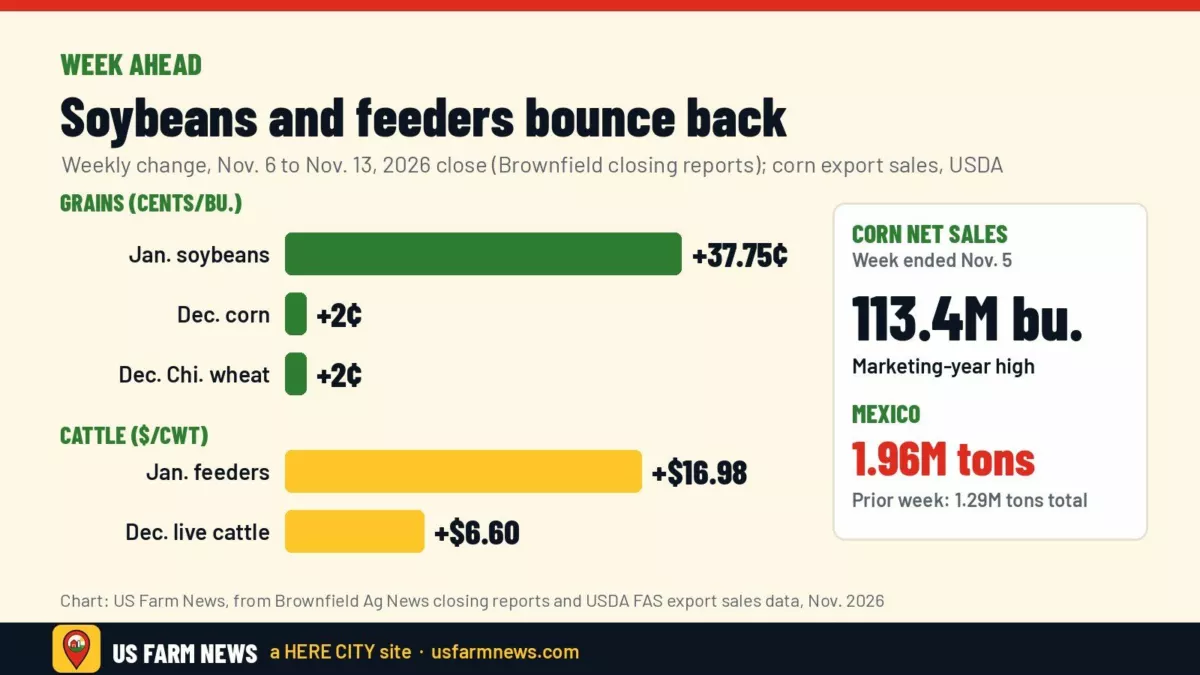
- January soybeans finished Friday at $12.31½, up 37¾ cents from the Nov. 6 close, after a broad fund-driven rally to end the week, according to Brownfield closing figures.
- Cattle reversed the prior week’s slide: January feeders gained nearly $17 on the week to $335.35, and December live cattle rose $6.60.
- Corn net export sales reached 113.4 million bushels (2.88 million metric tons) in the week ended Nov. 5, a marketing-year high, with Mexico taking more than two-thirds, USDA data show.
- Next week: Crop Progress on Monday, Nov. 16, then Cattle on Feed and Milk Production on Friday, Nov. 20. The next WASDE is Dec. 10.
Grain and livestock futures closed out the week ended Nov. 13 on the plus side, with soybeans and feeder cattle doing most of the work. Friday’s session brought gains across soybeans, corn and wheat as funds and technical traders bought, Brownfield reported. Earlier in the week, the market digested USDA’s November supply and demand report, which we covered in our WASDE story.
For farmers who still have grain to price or calves to sell, the week offered some relief after the losses of early November. Here is where the main contracts finished, what drove them, and the reports that could move prices next week.
Where futures finished the week
Weekly changes below compare the Nov. 13 close with the Nov. 6 close, both from Brownfield’s daily closing reports. They are for reference only; check CME Group for official settlements.
- January soybeans: $12.31½, up 37¾ cents on the week and up 12½ cents on Friday.
- December soybean meal: $329.80, up $10.60 on the week.
- December corn: $4.43½, up 2 cents on the week and 3 cents on Friday.
- December Chicago wheat: $5.93¼, up 2 cents on the week and 9 cents on Friday.
- December live cattle: $220.65, up $6.60 on the week.
- January feeder cattle: $335.35, up $16.98 on the week and $3.67 on Friday.
- December lean hogs: $55.45, up $1.93 on the week.
- December Class III milk: $17.28, up 55 cents on the week.
The feeder cattle gain roughly erased the $13.40 drop we reported in our Nov. 7 week-ahead preview.
Corn: Mexico steps up
The biggest demand headline came from USDA’s weekly export sales report for the week ended Nov. 5. Net corn sales came to 2,881,400 metric tons, more than double the 1,294,600 tons booked the week before, according to USDA’s commodity summary. Brownfield put the total at 113.4 million bushels, a marketing-year high.
- Mexico bought 1,955,300 tons and Colombia 307,400 tons, Brownfield said, citing USDA.
- Mexico also booked 594,400 tons (23.4 million bushels) for delivery in the 2027/28 marketing year.
- On Friday morning, USDA announced another Mexico purchase of about 300,300 tons, mostly for 2026/27, Brownfield reported.
The catch: total corn exports for the marketing year still lag last year’s pace. Exports so far are 1.089 billion bushels compared with 1.509 billion a year earlier, Brownfield said. A strong week helps, but one week does not close a gap of more than 400 million bushels.
Soybeans: China keeps buying, but sales cooled
Soybean net sales slipped to 1,154,800 tons, or 42.4 million bushels, the lowest in four weeks, Brownfield said. China accounted for 689,200 tons and Spain 198,000, while unnamed buyers canceled 234,100 tons. Even so, soybean exports for the marketing year stand at 1.153 billion bushels, well ahead of the 648.4 million shipped by this point a year ago.
Before Friday’s open, China bought 134,000 tons of U.S. soybeans and Vietnam 120,000 tons, all for 2026/27, Brownfield reported. In South America, Brazil’s crop agency CONAB left its soybean estimate unchanged at 181.617 million metric tons. Traders are watching planting and growing weather in Brazil and Argentina.
Wheat: oversold, but demand is thin
Net wheat sales dropped to 6.7 million bushels, the smallest weekly total so far this marketing year, with Mexico and Japan the main buyers, Brownfield reported. Wheat exports for the marketing year total 449.7 million bushels compared with 634.5 million a year ago. Rain in the Plains has eased some drought stress on the winter wheat crop as it heads toward dormancy, Brownfield said. Overseas, consultancy SovEcon cut its estimate of Russia’s 2026/27 wheat exports to 36 million tons.
Cattle and hogs
Cattle futures climbed on technical buying on Friday while the market waited for cash trade, Brownfield said. Early dressed sales in Nebraska were around $335, about $5 below the prior week’s weighted average. At the Ogallala auction in Nebraska, steers sold $7 to $14 higher and heifers $8 to $18 higher.
Cash hogs closed sharply higher as packers bid more aggressively to finish the week. The national daily direct weighted average for barrows and gilts was $43.10, up $3.46, Brownfield reported. Hog supplies remain ample, which keeps the focus on demand. Net pork export sales rose 6% on the week to 39,500 tons, led by Mexico.
What to watch next week
- Monday, Nov. 16, 4 p.m. ET: NASS Crop Progress. As of Nov. 8, corn harvest in the 18 major states was 81% complete versus an 86% five-year average, NASS said, while soybeans were 92% harvested versus 91%. Our look at late-harvest crop insurance duties covers the Dec. 10 end of coverage.
- Wednesday, Nov. 18: Broiler Hatchery.
- Thursday, Nov. 19: Livestock Slaughter.
- Friday, Nov. 20, 3 p.m. ET: Cattle on Feed and Milk Production, both from NASS.
- Weekly export sales: another check on whether Mexico’s corn buying and China’s soybean buying continue.
- Later dates: USDA’s next WASDE comes Dec. 10, and CONAB updates its Brazil outlook Dec. 17, Brownfield noted.
Thanksgiving week follows, with NASS reports on Monday and Tuesday, Nov. 23 and 24, including Cold Storage, before the holiday on Thursday.
Market information is for general reference and is not trading advice.
Get the Daily Ag Business Briefing
Markets, policy and farm business in one free email each weekday.