A HERE CITY site

A Red Crown Rot Look-Alike Turns Up in Illinois Soybeans: What Growers Should Do Before Ordering 2027 Seed
Illinois confirmed Fusarium neocosmosporiellum, a fungus that mimics red crown rot in soybeans. Yield impact is unknown. How to sample and why it matters.
Key takeaways
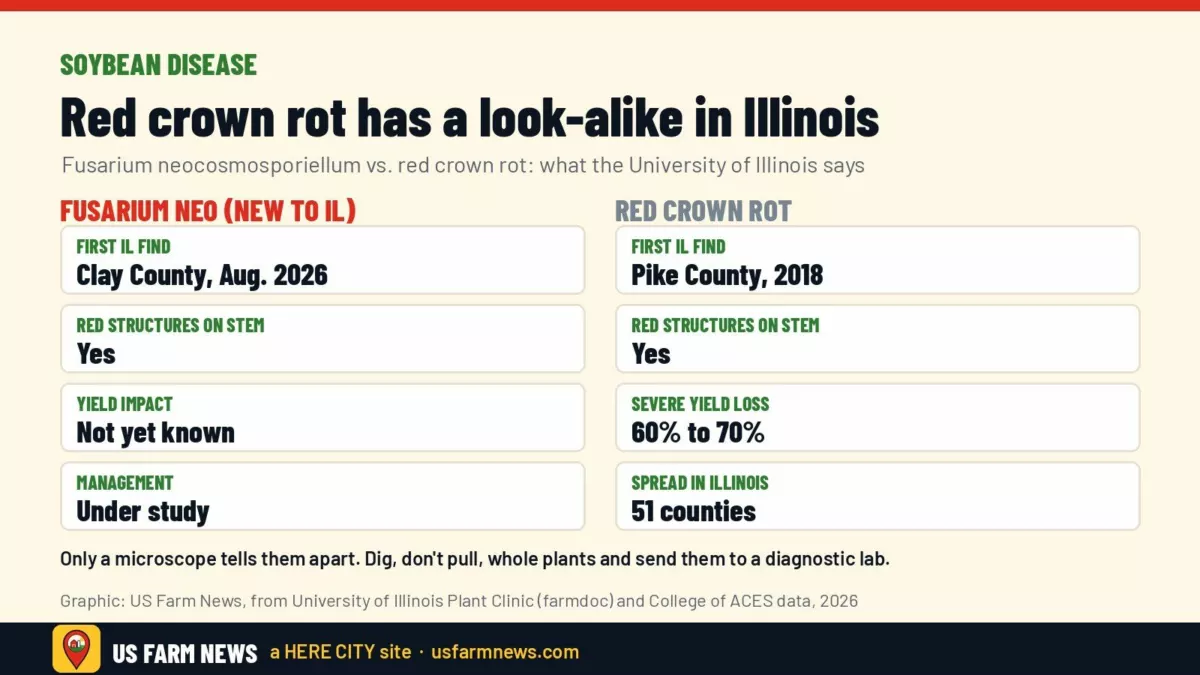
- The University of Illinois Plant Clinic has confirmed Fusarium neocosmosporiellum, a fungus tied to Neocosmospora stem rot, on soybeans from Clay County, Ill. It is the state’s first report.
- The fungus forms small red structures on lower stems and crowns, the same field sign growers use to spot red crown rot. Telling them apart takes a microscope.
- Researchers say yield impact and management are not yet known. Red crown rot, by contrast, can cut yields 60% to 70% in severe cases and has been found in 51 Illinois counties.
- Before ordering 2027 seed, send suspect plants to a diagnostic lab. Dig them, don’t pull them.
Soybean growers who have learned to scout for red crown rot by looking for tiny red specks at the base of dying plants now have a complication. University of Illinois plant pathologists have confirmed a second fungus in the state that leaves nearly the same calling card.
The Plant Clinic identified Fusarium neocosmosporiellum in a soybean sample sent from Clay County in August, the clinic’s scientists wrote in an Oct. 22 farmdoc report. It is the first Illinois report of the pathogen on soybeans. Boris Camiletti, a University of Illinois plant pathologist, discussed the find with Brownfield on Nov. 13.
Why it matters for your 2027 plan
A wrong diagnosis can lead to spending money on the wrong fix. Scientists know a good deal about red crown rot. They know much less about the new fungus, and the two can look nearly identical from the road or the cab.
Red crown rot is the bigger known threat. Severe infestations can reduce yield by 60% to 70%, and the disease has spread to 51 Illinois counties since it was first confirmed in Pike County in 2018, according to the university’s College of ACES. It has also been detected in seven other states: Iowa, Indiana, Ohio, Nebraska, Missouri, Kentucky and Wisconsin.
For the new fungus, the farmdoc authors say field damage and yield loss have not been established, and management options are still being studied. Accurate identification matters because the right management can depend on which pathogens are present, Mandy Bish, a University of Missouri Extension crop pathologist, said in a Successful Farming report.
How the two diseases look alike
According to the farmdoc report, plants carrying the new fungus can show:
- Yellowing and browning between leaf veins, the same leaf pattern seen with red crown rot and, to a lesser degree, sudden death syndrome and brown stem rot.
- Wilting and discolored vascular tissue inside the stem.
- Under the right conditions, small, round, red fruiting bodies (perithecia) on lower stems and crowns. Those are also a hallmark of red crown rot.
The Clay County plants were stunted, dried out and completely brown. When clinic staff examined the red structures under a microscope, the spores inside did not match those of the red crown rot fungus. DNA sequencing confirmed the identity.
“When we looked at those under the microscope, we realized pretty quickly the spores did not match,” Diane Plewa, director of the Plant Clinic, said in a Successful Farming report. Camiletti told Brownfield, “It’s not new to the U.S.,” noting it has turned up in southern states.
The farmdoc report lists earlier soybean findings in Missouri (2025), Mississippi (2021), Arkansas (2015), Alabama and Georgia, and a 2024 report in North Carolina. The fungus has also been found on peanuts in Texas.
A sample can carry more than one problem
The Illinois sample also tested positive for Phytophthora root rot, which makes it hard to say which organism caused the symptoms, Plewa said in the Successful Farming report. Missouri researchers found the new fungus in 2025 while checking suspected red crown rot fields, and Bish said samples with red crown rot often test positive for other pathogens too. Missouri’s survey work is supported by the United Soybean Board and the Missouri Soybean Merchandising Council.
What to do now
- Don’t rely on red specks alone. Plewa said visual identification is no longer reliable when two diseases produce similar red structures.
- Send samples to a lab. The Illinois clinic asks for whole plants dug from the ground, not pulled, ideally several showing different stages of decline. Plewa also advised keeping samples cool before shipping, Successful Farming reported. Illinois growers use the clinic’s online submission form; growers in other states can use their own land-grant diagnostic lab.
- Re-check fields you blamed on SDS. If a field showed what looked like sudden death syndrome or red crown rot this year, Camiletti told Brownfield, it deserves a second look and a lab sample.
- Write down where you saw it. Mapping problem spots this fall will help when you talk with your seed dealer and agronomist about 2027 varieties and treatments.
Camiletti also cautioned that rotation alone has not proven to beat red crown rot, because its inoculum can persist in soil for years, the College of ACES reported. That makes accurate diagnosis even more important before you change a rotation or a seed plan.
Related: a new herbicide option for 2027 waterhemp control and more crop news.
Frequently asked questions
Is Fusarium neocosmosporiellum the same as red crown rot?
No. Red crown rot is caused by a different fungus, Calonectria ilicicola. Both can produce small red structures on soybean stems and crowns, so a microscope is needed to tell them apart.
How much yield does the new fungus cost?
University of Illinois researchers say yield loss from Fusarium neocosmosporiellum has not been established, and management practices are still under study.
How should I send a soybean sample?
Dig up whole plants rather than pulling them, include several plants at different stages of decline, keep them cool and send them to a plant diagnostic lab such as the University of Illinois Plant Clinic.
Get the Daily Ag Business Briefing
Markets, policy and farm business in one free email each weekday.