A HERE CITY site

A Small Field Robot Could Cut Organic Onion Costs 75% in a New Model, as a $1 Million USDA Project Puts Laser Weeders to a Real Test
A Münster-UC Davis model says a small robot could cut organic onion costs 75%, but not strawberry costs, as MSU tests laser weeders. What to ask first.
Key takeaways
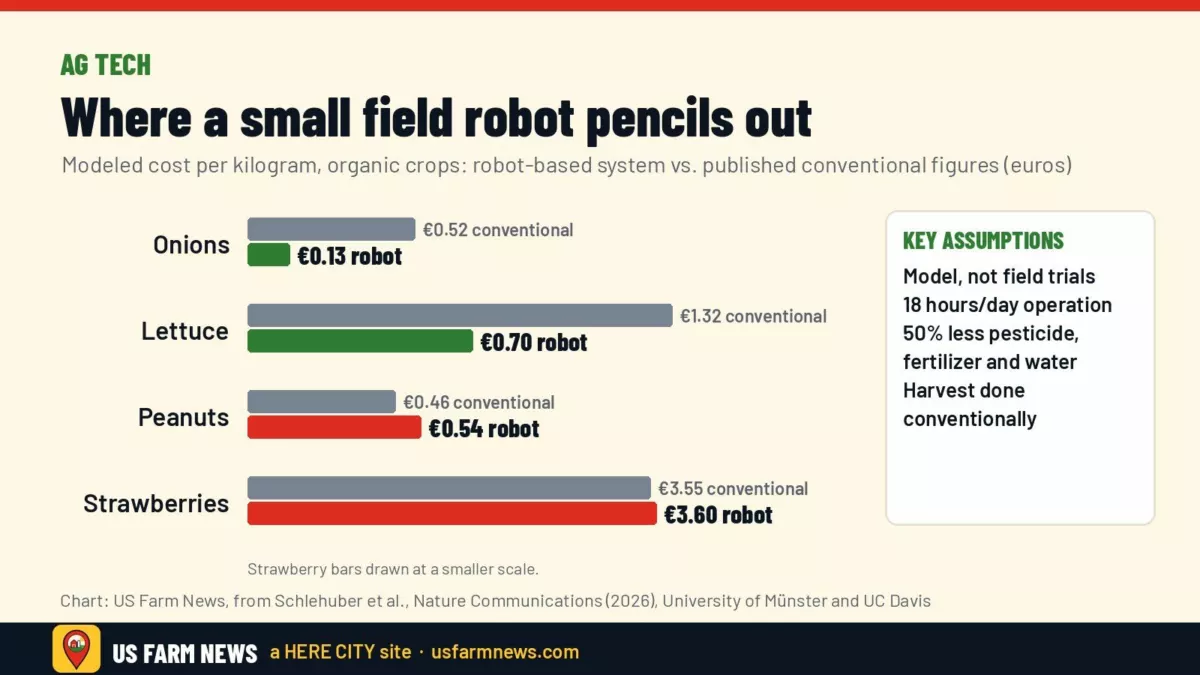
- A modeling study from the University of Münster and UC Davis estimated a small battery robot could cut organic onion production costs to €0.13 a kilogram from €0.52, about 75%. Organic strawberries came out slightly more expensive.
- The numbers come from a model, not field trials, and assume the robot runs 18 hours a day and cuts pesticide, fertilizer and water use by half.
- Separately, a $1 million, four-year USDA grant will let Michigan State and Oregon State test laser weeding in carrots, lettuce, onions and spinach.
- Both projects point the same way: weeding robots pay best where hand weeding is most expensive. They still have to prove it on real farms.
Two research projects in the news this month tackle a question many vegetable growers are asking: when does a weeding robot or laser weeder actually pay for itself?
One is an economic model published in Nature Communications by researchers at UC Davis and Germany’s University of Münster. The other is a new U.S. Department of Agriculture grant that will put precision laser weeders to work in Michigan and Oregon vegetable fields. Together they give growers an early sense of where the math is promising and where the open questions are.
What the robot model found
The research team modeled a battery-powered robot weighing about 200 kilograms (roughly 440 pounds) that handles soil preparation, seeding, weed control, irrigation and fertilizing. Harvest was left to conventional methods, and those costs were added back from published studies. The team ran eight scenarios: strawberries, onions, lettuce and peanuts, each grown organically and conventionally.
Total cost per kilogram at the farm gate, compared with published figures for conventional production, according to the paper:
- Organic onions: €0.13 with the robot vs. €0.52 conventionally.
- Organic lettuce: €0.70 vs. €1.32, a saving of about 47%, Future Farming calculated.
- Organic peanuts: €0.54 vs. €0.46, so the robot cost more.
- Organic strawberries: €3.60 vs. €3.55, slightly more with the robot.
Across all scenarios, modeled costs ranged from 76% below to 17% above the published reference values, the University of Münster said.
Why the inputs matter more than the robot
The biggest takeaway for a farm budget is where the money goes. Seed and transplants, water, fertilizer, herbicide, electricity and labor made up 72% to 90% of modeled costs, the university said. The robot’s purchase price was a smaller share. In other words, savings come mostly from applying less, more precisely, not from the machine being cheap.
“A robot does not automatically make agriculture more sustainable,” Stephan von Delft of the University of Münster said in the university’s release. He said the benefits in the model come when precise use saves resources.
Strawberries show the limit. In the crop’s peak month, soil prep and irrigation, the two biggest time demands, stack up together, which shrinks the area one robot can cover in a year, the paper said.
The fine print
Future Farming, a trade publication, stressed that the savings are theoretical. Key assumptions in the model:
- The robot works 18 hours a day with working widths of 0.2 to 0.7 meters (about 8 to 28 inches).
- Precision application cuts pesticide, fertilizer and irrigation water by 50% compared with conventional practice.
- Breakdowns, downtime, charging logistics and outside AI or software costs are not fully counted, the authors acknowledged.
The authors also suggested that, because one robot covers a limited area each year, the earliest fits may be smaller farms or several farms sharing a machine.
Laser weeders get a real-world test
On the field side, Michigan State University researchers won a four-year, $1 million award from the Organic Transitions Program at USDA’s National Institute of Food and Agriculture to study laser weeding for vegetable growers moving to organic production. Oregon State University is a partner, and growers in both states will take part, Michigan Farm News reported.
These machines rely on cameras and machine vision to find individual weeds and then hit each one with a laser beam. Project leader Joshua Miranda, an MSU Extension specialist, said the technology is still expensive and too slow for most farms, and growers lack data on the crop stages, weed sizes and timing that give the best results, according to Michigan Farm News.
The four-year project will:
- Test crop safety, weed control and accuracy in carrots, lettuce, onions and spinach.
- Build organic weed programs that pair lasers with other in-row and between-row methods.
- Compare costs with standard organic weed control to find where buying a laser weeder makes economic sense.
- Produce fact sheets, decision tools, videos and on-farm field days.
“Vegetables, especially onions, have serious weed issues in Michigan,” said Greg Bird, who leads both the Michigan Vegetable Council and the Michigan Onion Committee, in the Michigan Farm News report.
What it means before you buy or trial a weeder
- Start with your hand-weeding bill. Both projects suggest the payoff is largest in organic onions and lettuce, where hand labor is heavy.
- Ask about acres per season, not acres per hour. The strawberry result shows that a crop calendar can limit how much ground one machine covers.
- Price the whole system. Include software subscriptions, service, downtime and charging, which the model did not fully capture.
- Watch for the MSU and OSU field data. Measured results on working farms will be a better guide than any model.
Related: North Dakota’s $500,000 AI farm trials and robotic pollination for fruit crops.
Get the Daily Ag Business Briefing
Markets, policy and farm business in one free email each weekday.