A HERE CITY site

H-2A Wage Rates Face a Dec. 30 Court Deadline: What Employers Should Do Now About Possible Back Pay
A court gave DOL until Dec. 30 to replace the H-2A wage formula, and back pay from Sept. 2 is possible. What rates apply now and five steps to take.
Key takeaways
- A federal court ordered the Labor Department to issue a new H-2A wage methodology by Dec. 30, 2026. The current rule is vacated on that date.
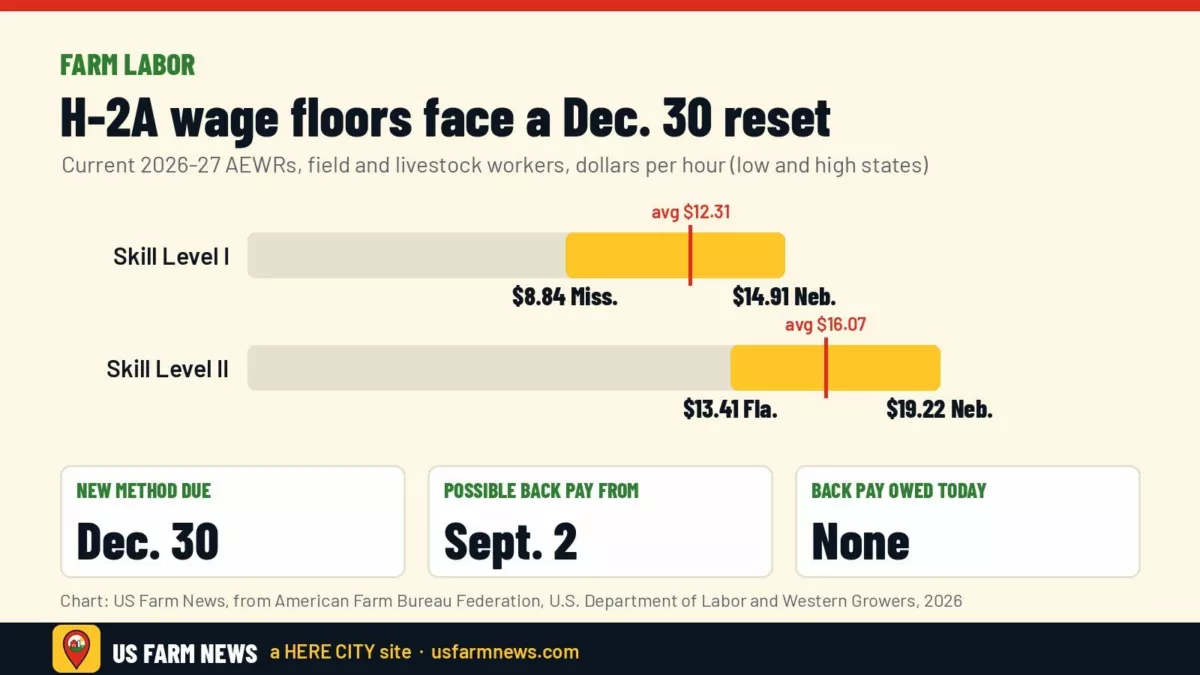
- Until new rates are published, the current Adverse Effect Wage Rates (AEWRs) still apply. For field and livestock workers they range from $8.84 to $14.91 an hour at Skill Level I and $13.41 to $19.22 at Skill Level II.
- DOL says no one owes back pay now. But employers may later have to pay the difference for work done from Sept. 2, 2026 on, if the new rates come in higher.
- DOL told employers to keep current contact records for every H-2A worker and U.S. worker in corresponding employment.
Farms and ranches that rely on H-2A guestworkers are heading into 2027 without knowing what their minimum wage bill will be. A federal judge has given the U.S. Department of Labor until Dec. 30 to replace the formula it uses to set H-2A wage floors. Employers could also face a back-pay bill for work done this fall.
Here is what has happened, what is still unknown and what employers can do now to avoid surprises.
This is general information, not legal, tax, or financial advice. Talk to your attorney, H-2A agent or accountant about your own situation.
How we got here
- August 2025: A federal court in Louisiana vacated DOL’s 2023 AEWR rule, and USDA’s National Agricultural Statistics Service then canceled the Farm Labor Survey that older rates were based on, according to a Congressional Research Service report summarized by Legis1.
- October 2025: DOL issued an emergency interim final rule. It set two state-level wage tiers based on the Occupational Employment and Wage Statistics survey and allowed a housing adjustment.
- Aug. 26, 2026: In a case brought by United Farm Workers against the Labor Department, a federal judge in California’s Eastern District found the rule arbitrary and capricious and procedurally defective. The judge did not vacate it at first and told DOL to write a new method, Western Growers said.
- Sept. 2, 2026: DOL issued a court-ordered notice warning that some employers may owe wage adjustments later.
- Oct. 2, 2026: The court ordered a new interim rule by Dec. 30, with the current rule vacated on that date. Western Growers said the court found DOL had not justified the four to six months it asked for. The parties must also file status reports every three weeks.
According to Texas Farm Bureau, Judge Kirk Sherriff found that the wage percentiles chosen for both tiers were unreasonable. He also found the housing adjustment amounted to charging workers for housing through lower pay, even though employers must provide housing at no cost.
What you must pay right now
The 2026-27 rates published this summer stay in force until DOL issues new ones, DOL said. For field and livestock worker jobs, which cover most certified H-2A positions, the American Farm Bureau Federation reported:
- Skill Level I (entry-level work): Mississippi is lowest at $8.84 an hour and Nebraska highest at $14.91. The simple average across states and territories is $12.31.
- Skill Level II (experienced or supervisory-type work): Florida is lowest at $13.41 and Nebraska highest at $19.22, for an average of $16.07.
- Texas: $10.40 at Skill Level I and $14.37 at Skill Level II, Texas Farm Bureau said.
- Kansas had the largest Skill Level I increase, 21.3%, to $13.86, AFBF said.
The AEWR is a floor, not the only test. Employers owe whichever of five wage rates is highest, AFBF noted: the AEWR, the prevailing wage, a collective bargaining wage, or a state or local minimum wage.
The back-pay question
This is the part that can hit a budget. Under the court’s order, DOL’s Sept. 2 notice says employers who used H-2A labor under the current rates may later have to pay eligible H-2A workers, and U.S. workers doing the same jobs, the difference. That applies only if the workers were paid less than the new rates turn out to be.
- The possible back-pay period runs from Sept. 2, 2026, to the date DOL issues new AEWRs under a new method, the notice said.
- It covers employers with active certifications on Sept. 2, pending applications, and applications filed after that date until a new method is published.
- DOL said it disagrees that back pay can lawfully be required and will keep fighting it in court. “To be clear, no employer is under an obligation at this time to pay any back wages,” the department wrote.
Nobody knows yet whether the new rates will be higher or lower than today’s, so the exposure could be zero. But it is a real contingency for 2026 and 2027 cash flow.
Five things to do before Dec. 30
- Update worker records now. DOL reminded employers to keep, for every H-2A worker and every U.S. worker in corresponding employment, the worker’s name, permanent home address, Social Security number if issued, and where available the I-94 arrival/departure record number, a permanent email address and phone number. Those details are hard to collect once a crew has gone home.
- Keep clean hours and pay records by worker since Sept. 2. If an adjustment is ever owed, it would be figured from hours worked times the gap between the new rate and what you paid.
- Run a range in your 2027 budget. AFBF’s analysis urged growers to expect AEWR swings from year to year and to plan labor costs over several years with that in mind.
- Talk to your H-2A agent or attorney about pending 2027 applications. DOL said it will announce transition procedures when the new method is set.
- Watch for the new rule. It is due by Dec. 30. Western Growers said it will keep members posted as the new method takes shape.
Could Congress change it?
A bill from House Agriculture Committee Chairman G.T. Thompson, the Securing Agriculture’s Workforce Act, would limit yearly AEWR increases to 3.25% and decreases to 1.5%, AFBF said. It would need to pass both chambers. Congress has only a few weeks left in the lame-duck session, as we reported in our lame-duck farm bill preview.
Related: USDA benefits for veteran farmers and more farm management guides.
Frequently asked questions
Do I owe H-2A back pay right now?
No. DOL says there is no back-pay obligation today. Employers may have to pay adjustments later if the new AEWRs are higher than what workers were paid from Sept. 2, 2026, on.
Which H-2A wage rates apply until Dec. 30?
The current 2026-27 AEWRs stay in effect until DOL publishes new rates under a new method. Employers must still pay the highest applicable wage, including state or local minimum wages.
When is the new H-2A wage rule due?
A federal judge set a Dec. 30, 2026, deadline for DOL’s replacement interim rule. The current rule is vacated that day.
Get the Daily Ag Business Briefing
Markets, policy and farm business in one free email each weekday.