A HERE CITY site

States Ask USDA to Allow Bird Flu Vaccines for Dairy Herds as Cases Top 1,200 Farms
State ag departments and veterinarians asked USDA on Nov. 5 for voluntary dairy HPAI vaccination as cases top 1,200 farms in 20 states. What it means.
Key takeaways
- State agriculture departments and state veterinarians asked USDA on Nov. 5 to green-light voluntary emergency vaccination of dairy herds against H5N1 bird flu under a national framework.
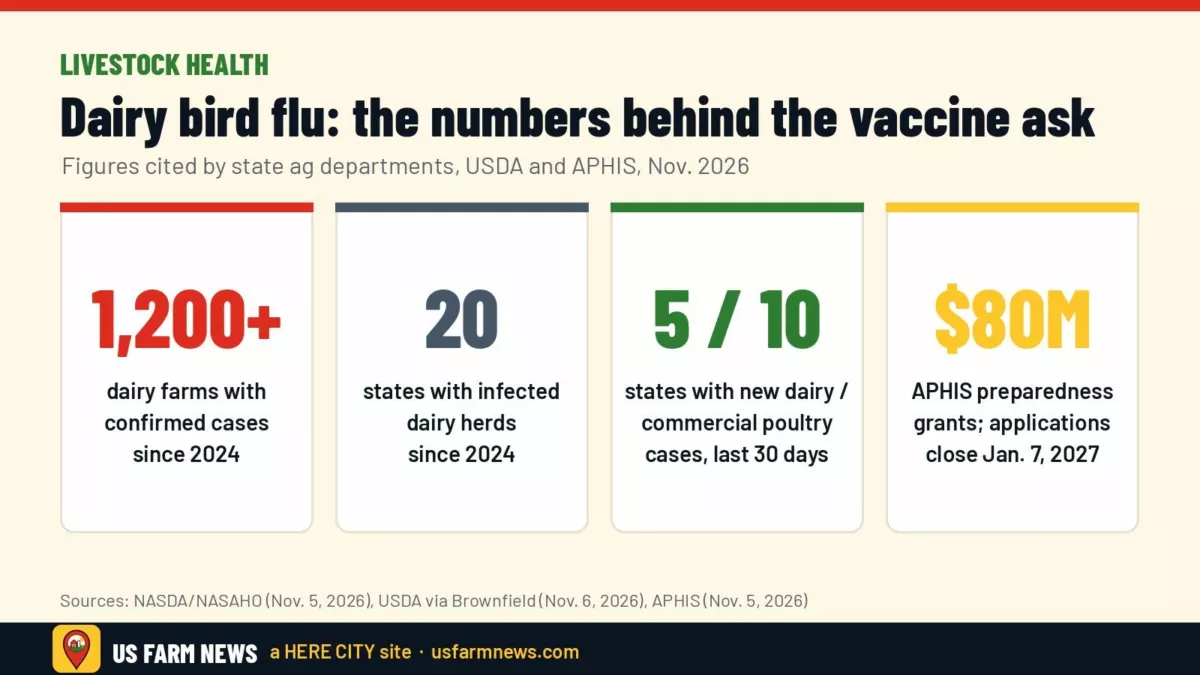
- The groups count more than 1,200 dairy farms in 20 states with confirmed cases since 2024, plus poultry losses in at least 17 states tied to nearby infected herds.
- Over the past 30 days the virus turned up in dairy herds in five states and commercial flocks in 10 states, Brownfield reported, citing USDA.
- APHIS opened $80 million in animal-disease preparedness grants on Nov. 5; applications close Jan. 7, 2027.
The organizations that run animal health programs in every state want USDA to let dairy herds be vaccinated against highly pathogenic avian influenza (HPAI), as a fresh wave of detections in cattle spreads from the Pacific Northwest to Indiana and Colorado.
Leaders of the National Association of State Departments of Agriculture (NASDA) and the state veterinarians’ group NASAHO sat down with USDA on Nov. 5 and delivered a letter urging the department to set up a national framework for emergency vaccination of dairy herds that states could opt into, according to the groups’ announcement as published by the Oklahoma Farm Report. Under the request, state animal health officials could choose to use vaccines alongside the testing, biosecurity and movement controls already in place.
Why it matters to dairy and poultry budgets
For dairy farms, an infected herd means quarantine, lost milk and movement limits. For poultry growers, the stakes extend to whole flocks. The state groups said the virus has jumped from infected dairies to commercial poultry in at least 17 states, and they warned that continued spread threatens export access, supply chains and the financial survival of dairy and poultry operations.
NASDA chief executive Ted McKinney said bulk milk surveillance and testing cattle before they move have been “critical in early detection,” but argued the control plan “must go beyond biosecurity and movement controls and include veterinary countermeasures.”
NASAHO president Dr. Alex Hamberg said state leaders “need every available tool” to protect their farm economies.
What the outbreak looks like this fall
- More than 1,200 dairy farms in 20 states have had confirmed cases since the virus first spilled over from wild birds to cattle in 2024, NASDA and NASAHO said.
- In the last 30 days, USDA confirmations covered dairy herds in five states (Indiana and Kansas among them) and commercial poultry in 10 states, Brownfield reported on Nov. 6.
- In Washington, a cluster that began in October topped 40 cow detections, mostly in Yakima County, Agri-Pulse reported. USDA genome sequencing indicated Pacific Northwest herd detections likely arrived through cattle moved from Idaho to Washington, according to Brownfield.
- Colorado confirmed its first dairy detection since 2024 in a Weld County herd found through mandatory bulk milk tank testing; the dairy was quarantined, Agri-Pulse said.
- A Washington resident with underlying health conditions died after being directly exposed to infected cows, the Yakima Health District reported. Agri-Pulse said it is the third HPAI death since the virus emerged as a U.S. public health issue in 2024.
The Centers for Disease Control and Prevention still rates the risk to the general public as low, while people with job-related exposure to infected birds or mammals face higher risk, according to Agri-Pulse. The state groups stressed the commercial milk supply remains safe.
Where USDA stands on a cattle vaccine
USDA’s own HPAI livestock page says the department continues to back “the rapid development and timely approval” of an H5N1 vaccine for dairy cows and that several candidates are in field trials. The agency also calls biosecurity the best defense, noting the virus can travel on equipment, people and other items moving between farms, including between dairies and poultry sites.
The state groups were careful to say vaccines should not replace surveillance, biosecurity, movement management, animal ID and traceability. Their ask is for a voluntary option each state could decide whether to use.
Poultry interests are pushing in the same direction. Nancy Barr, executive director of the Michigan Allied Poultry Industry and a former state veterinarian, told Brownfield that producers worry an El Niño winter could stretch out the outbreak risk and that the industry still wants a vaccination program for flocks.
New preparedness money on the table
Separately, APHIS announced on Nov. 5 that annual funding for its three Farm Bill animal health programs rose from $30 million to $233 million starting in fiscal 2026. As part of that, it opened two competitive grant rounds worth up to $80 million:
- $40 million for state preparedness projects, open to state agriculture departments, state animal health officials and regional response groups.
- $40 million for industry preparedness projects, open to livestock producer organizations and veterinary organizations.
Both windows close Jan. 7, 2027, and selected projects begin in spring 2027, APHIS said. The agency also plans more than $153 million in fiscal 2027 purchases for its vaccine and countermeasures bank, mainly foot-and-mouth disease vaccine antigen concentrate and diagnostic kits.
What dairy and poultry producers can do now
- Tighten traffic control. University of Wisconsin-Madison extension poultry specialist Ron Kean told Brownfield the main goal is keeping the virus out of barns, since wild birds carry it.
- Ask about cost-share. APHIS says USDA helps pay herd owners to plan and put stronger biosecurity in place. Your state veterinarian’s office or the local APHIS veterinarian in charge can explain how to enroll.
- Consider the Dairy Herd Status Program. The voluntary program lets herds monitor with weekly bulk milk samples before interstate moves instead of testing each animal; APHIS lists 100 herds in 18 states enrolled.
- Protect workers. Officials recommend personal protective equipment for anyone handling livestock, poultry or wild birds, Brownfield reported.
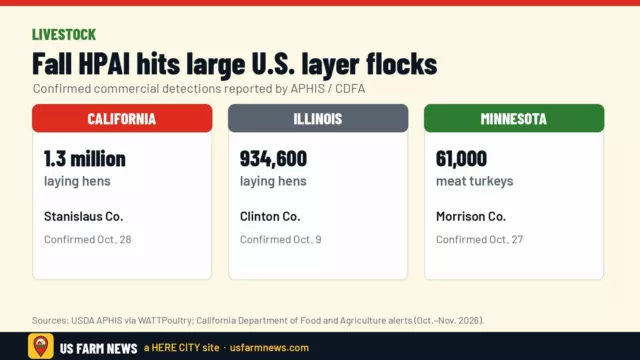
For earlier coverage of this fall’s poultry losses, see our report on the 1.3 million-bird California layer outbreak, and follow ongoing herd health news in our livestock section.
Frequently asked questions
Is there an approved HPAI vaccine for dairy cows?
Not yet. USDA says several dairy cow vaccine candidates are in field trials, and state groups asked on Nov. 5 for a voluntary emergency framework so states could use one.
Would vaccination be required?
No. NASDA and NASAHO asked for a voluntary framework that state animal health officials could choose to use alongside existing testing and biosecurity.
When are the APHIS preparedness grants due?
Both $40 million funding opportunities opened Nov. 5, 2026, and close Jan. 7, 2027. Producer and veterinary organizations can apply for the industry round.
Get the Daily Ag Business Briefing
Markets, policy and farm business in one free email each weekday.