A HERE CITY site

Bird flu hits 1.3 million California laying hens as backyard detections keep spreading
APHIS confirmed HPAI in a Stanislaus County layer flock of 1.3 million birds. CDFA now counts seven fall detections across four counties.
Key takeaways
- APHIS confirmed highly pathogenic avian influenza in a 1.3 million-bird commercial laying flock in Stanislaus County, California, on Oct. 28.
- CDFA says that since Oct. 5, California has logged seven HPAI detections (six backyard, one commercial) across Sacramento, Solano, Stanislaus and San Benito counties.
- Only Stanislaus County is under a movement hold, CDFA says.
- USDA continues to offer free biosecurity assessments and up to 75% cost-share for high-risk fixes identified in those reviews.
California’s commercial egg sector is back in the HPAI spotlight as backyard detections keep appearing along the Central Valley and coast. USDA’s Animal and Plant Health Inspection Service confirmed highly pathogenic avian influenza in a Stanislaus County laying flock of 1.3 million birds on Oct. 28, WATTPoultry reported, and state alerts since then show the virus is still finding backyard premises.
What has been confirmed
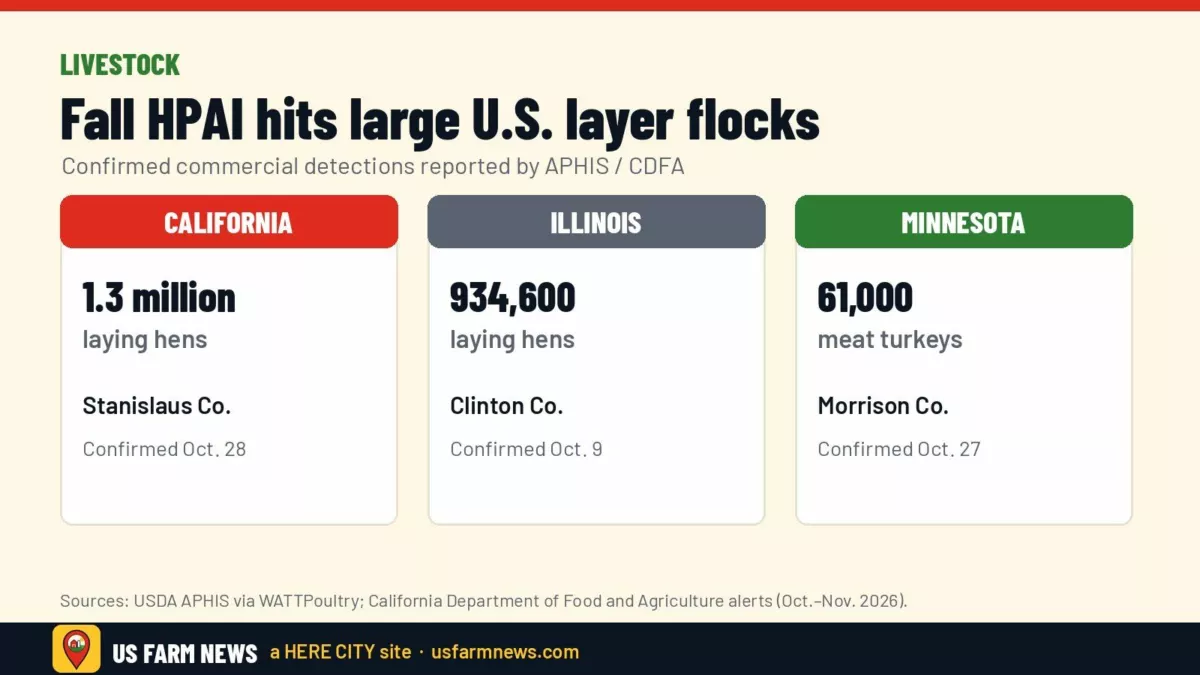
WATTPoultry, citing APHIS, said the Stanislaus County case was the first commercial poultry detection in California this fall and the second large U.S. layer hit in three weeks. On Oct. 9, APHIS confirmed HPAI in a Clinton County, Illinois, flock of 934,600 hens. A Morrison County, Minnesota, commercial meat-turkey flock of 61,000 birds was confirmed Oct. 27; Minnesota has had 21 commercial poultry flocks affected in 2026, according to the same report.
The California Department of Food and Agriculture’s Nov. 4 alert said NVSL confirmed HPAI in a San Benito County backyard flock on Nov. 3. CDFA’s running tally since Oct. 5 is seven detections — six backyard and one commercial — in Sacramento, Solano, Stanislaus and San Benito counties. Only Stanislaus County is under a movement hold, the department says.
A Nov. 5 alert from the University of California Davis Poultry Health Inspection program summarized the same cluster: a commercial egg layer operation in Stanislaus County on Oct. 28, plus backyard flocks in Sacramento and San Benito counties confirmed Oct. 29, Nov. 2 and Nov. 3. The program urged all poultry owners to tighten biosecurity as detections moved from the San Joaquin Valley to the Sacramento Valley and central coast.
Why backyard cases still matter to commercial farms
Backyard detections do not trigger the same international trade rules as commercial outbreaks under World Organisation for Animal Health guidance, WATTPoultry noted. They do signal virus in the local environment. CDFA says infected wild birds can introduce HPAI through direct contact or by contaminating shared spaces, and that wild-bird detections are already widespread in California.
For commercial barns, the practical risk is movement, shared service crews, feed deliveries and equipment that can carry virus between premises. That is why CDFA is stressing enhanced biosecurity even in counties without movement holds.
What USDA says producers can do now
On its HPAI poultry page, USDA highlights no-cost biosecurity reviews that commercial farms can request before an outbreak, plus audits once a farm is inside a control area or already hit. The department also advertises cost-share of up to 75% to fix the highest-risk biosecurity gaps identified in those assessments.
USDA says producers should report sick or dying birds quickly to a state veterinarian or to USDA at 1-866-536-7593. California owners can reach CDFA’s bird-health hotline at 866-922-BIRD (2473).
Indemnity for depopulated flocks remains part of the federal response, USDA says, and the department continues work on repopulation speed, vaccine and therapeutics research, and other tools. Those longer-term programs do not replace day-to-day biosecurity while fall wild-bird migration keeps virus pressure high.
Bottom line for egg and turkey operations
- Assume wild-bird risk is elevated wherever waterfowl are moving, not only where a map shows a red county.
- Audit people, vehicles and shared equipment before the next load of birds or feed rolls in.
- Use the free assessment offer if you have not had a recent third-party biosecurity review.
Related reading: our earlier ag lender survey on farm credit stress, and livestock updates in the Livestock section. For market context after large layer losses, see the Nov. 5 briefing.
Frequently asked questions
How many birds were in the Stanislaus County flock?
APHIS reported 1.3 million laying hens, according to WATTPoultry.
Are there movement restrictions in California?
Only Stanislaus County is under a movement hold, CDFA says.
Where should California poultry owners report sick birds?
CDFA asks California poultry owners to call 866-922-BIRD (2473).
Get the Daily Ag Business Briefing
Markets, policy and farm business in one free email each weekday.