A HERE CITY site

Screwworm reaches Arizona: First case confirmed in a Cochise County ranch dog, 74 U.S. cases so far
USDA confirmed New World screwworm in a Cochise County, Ariz., dog, the state's first case. A 20-km infested zone is set as Nogales eyes a Nov. 30 reopening.
Key takeaways
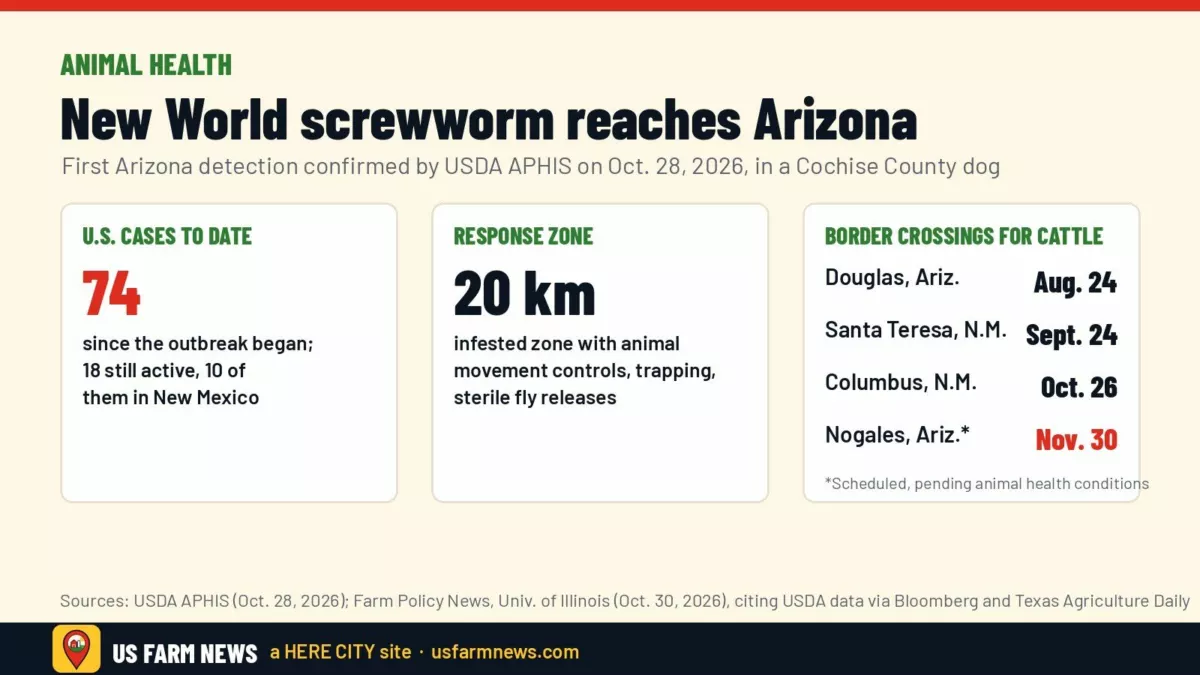
- USDA’s Animal and Plant Health Inspection Service confirmed New World screwworm in a dog in Cochise County, Arizona on Oct. 28, the state’s first detection.
- Officials are setting up a 20-kilometer infested zone with animal movement controls, plus extra trapping, surveillance and sterile fly releases.
- The U.S. count has reached 74 cases since the outbreak began, with 18 still active, according to USDA figures reported by Bloomberg.
- The next border crossing slated to reopen to Mexican cattle is Nogales, Arizona, on Nov. 30, if animal health conditions allow.
New World screwworm has turned up in Arizona. Federal officials confirmed the flesh-eating parasite in a ranch dog in Cochise County, on the Mexican border, which makes Arizona the third U.S. state with a case. For cow-calf operators and feeder cattle buyers across the Southwest, the finding brings movement controls, more inspections and fresh questions about how fast cattle imports from Mexico can keep reopening.
What officials confirmed
APHIS announced the detection on Wednesday, Oct. 28, after samples from the dog were tested at its National Veterinary Services Laboratories in Ames, Iowa. The agency said it is running a joint response with the Arizona Department of Agriculture (AZDA).
The case surfaced two days earlier. According to the Arizona Game and Fish Department, a local veterinarian examined the dog on the evening of Oct. 26 and found a back wound heavily infested with maggots, and lab testing then confirmed the species. The dog is receiving veterinary care. Arizona’s Family (KTVK/KPHO) reported that the animal lived on a ranch, had no movement history, and that other livestock on the property will be evaluated.
State Veterinarian Ryan Wolker stressed during a virtual news conference that the pest, while serious, “is very treatable.” It is also the first time the pest has been found in a U.S. dog, officials said. Earlier detections in Texas and New Mexico involved cattle or sheep.
The response playbook
APHIS said it and state officials are following the agency’s NWS Response Playbook. In practice, that means:
- a 20-km infested zone drawn around the detection, with controls on animal movement inside it;
- more surveillance of live animals and more fly trapping;
- releases of sterile flies to suppress the population; and
- direct outreach to local producers, veterinarians and communities.
AZDA has pushed for a sterile fly dispersal facility in Douglas, Arizona, and plans for it are still moving forward, the station reported. The University of Arizona received a $3.74 million USDA grant earlier this year to prepare the state for the fly.
Why it matters for cattle producers
Screwworm larvae feed on living tissue. Left untreated, they cause severe wounds and real economic losses, APHIS said, and the pest can infest livestock, pets, wildlife and, less often, people. Arizona officials say no human infestation has been acquired in the U.S., and the risk to people remains very low.
The national picture has worsened this fall. Farm Policy News, the University of Illinois policy digest, summarized Bloomberg reporting that USDA has logged 74 U.S. cases since the outbreak began, that 18 remain active, and that 10 of the active cases are in New Mexico. That made October the second-busiest month since the first U.S. animal case in June.
The Arizona case also lands in the middle of the effort to restart cattle imports from Mexico. According to the same digest, which cited Texas Agriculture Daily:
- Douglas, Arizona, reopened to cattle on Aug. 24;
- Santa Teresa, New Mexico, followed on Sept. 24;
- Columbus, New Mexico, became the third crossing to reopen on Oct. 26; and
- Nogales, Arizona, is next, set for Nov. 30 if animal health conditions are favorable and inspection arrangements are complete.
Not everyone is comfortable with that pace. R-CALF USA is “deeply concerned” that USDA reopened the border before all of its screwworm mitigations were running, chief executive Bill Bullard said, according to Bloomberg.
The longer-term fix is more sterile flies. The Army Corps of Engineers said its USDA sterile insect production plant at Moore Air Base in Edinburg, Texas, a $610 million project, is still on track to begin initial operations in April 2027, Farm Policy News reported.
What to do now
APHIS is asking animal owners in the area to check animals every day for:
- wounds that drain or keep getting bigger;
- maggots or egg masses in a wound;
- animals that seem uncomfortable or irritable; and
- lesions around the ears, nose, genitals or navel.
Report anything suspicious right away to a veterinarian, a state animal health official or USDA. In Arizona, AZDA takes livestock and pet reports at [email protected]. For wildlife, Game and Fish asks people to note a GPS location, take photos if possible, avoid handling or moving the animal, and call 623-236-7201. USDA posts a list of confirmed U.S. detections on its dashboard at screwworm.gov, updated daily at 6 p.m. ET.
For more animal health coverage, see our livestock section and our report on bird flu in an Iowa commercial turkey flock.
What to watch
- Whether surveillance inside the Cochise County zone turns up more cases in livestock or wildlife.
- USDA’s decision on the Nogales crossing ahead of its planned Nov. 30 reopening.
- Progress on the Douglas dispersal facility and the Edinburg sterile fly plant.
Frequently asked questions
Where was screwworm found in Arizona?
In a dog on a ranch in Cochise County, which borders Mexico. APHIS confirmed it on Oct. 28, 2026, and it is the first detection in Arizona.
What should livestock owners look for?
APHIS asks owners to look over animals every day for wounds that drain or grow, fly eggs or maggots in a wound, signs an animal is uncomfortable, and sores near the ears, nose, genitals or navel.
Who do I call about a suspected case in Arizona?
Contact a veterinarian, AZDA at [email protected], or USDA. For wildlife, call Arizona Game and Fish at 623-236-7201.
Get the Daily Ag Business Briefing
Markets, policy and farm business in one free email each weekday.