A HERE CITY site

Army Delays Iowa Lead Azide Blast to Nov. 23: A Checklist for Livestock Owners Near Middletown
The Army moved its Iowa lead azide detonation to Monday. Iowa officials urge baseline soil and forage tests, sheltering animals and feed, and a claims record.
Key takeaways
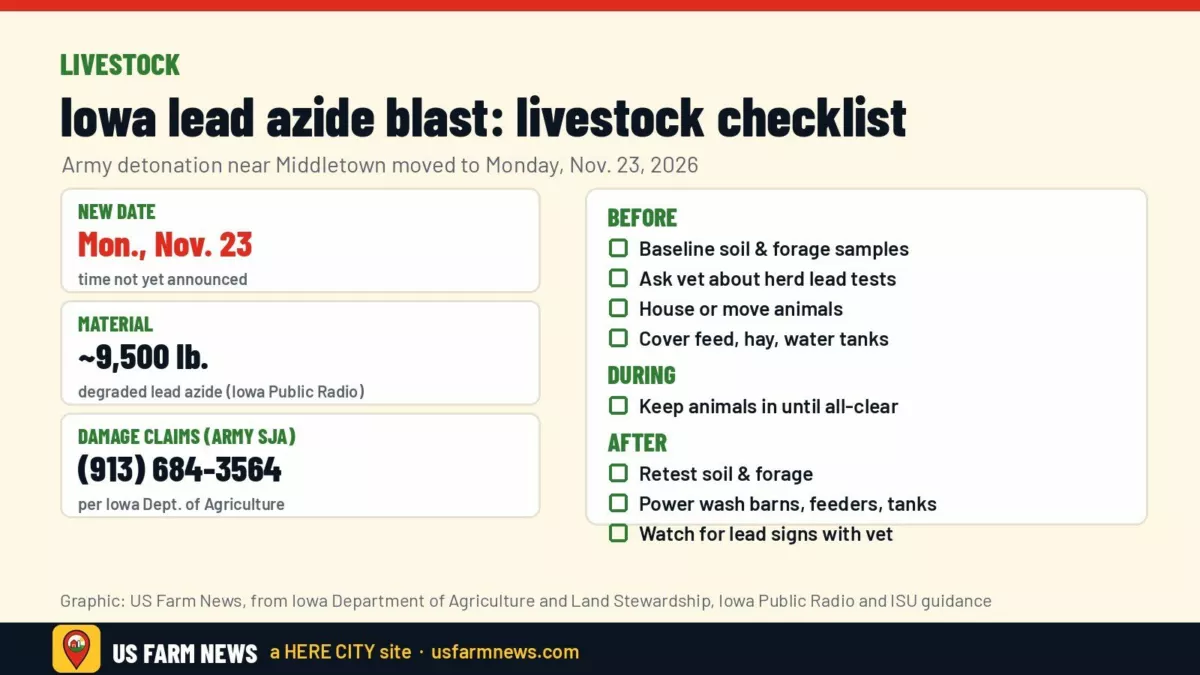
- The Army pushed back its plan to blow up about 9,500 pounds of deteriorating lead azide stored at the Middletown, Iowa, munitions plant from Friday to Monday, Nov. 23, with no time yet announced.
- The Iowa Department of Agriculture and Land Stewardship (IDALS) is urging nearby livestock owners to get baseline soil and forage samples before the blast and to keep animals indoors or elsewhere until the Army gives the all-clear.
- Feed, hay, bedding and portable water tanks should be moved under a roof or tarped; ISU’s pork center warns hog barns still need enough air exchange.
- Producers who think animals or property were harmed can file a claim with the Army’s Office of the Staff Judge Advocate at (913) 684-3564, according to IDALS.
Livestock producers in southeast Iowa have a few extra days to get ready. Acting Army Secretary Adam Telle on Thursday evening pushed the Army’s controlled blast at the Iowa Army Ammunition Plant back three days, from noon Friday to Monday, Nov. 23, Iowa Public Radio and CBS2 Iowa reported. State agriculture officials used the delay to issue a step-by-step checklist for farms in the potential fallout area.
Why it matters for cattle, hog and sheep operations
Lead is a well-known poison for livestock, but this exposure route is unusual. Patrick Wall, an ISU Extension beef specialist, told CBS2 Iowa that cattle normally get into lead one or two animals at a time, from an old battery or a burn pile. “This is different. It’s airborne,” he said, adding that nobody yet knows how far the particles will travel or which farms will be in their path.
That uncertainty is the business risk. A herd problem would mean vet bills, lost performance and possibly condemned feed, and the best protection for a later claim is evidence gathered before Monday. IDALS lists baseline sampling as the first item on its checklist.
What’s being detonated, and why the delay
Iowa Public Radio put the material at about 9,500 pounds of unstable lead azide, which the Army discovered was degrading in storage bunkers at the plant in March. In a social media post, Telle said he had ordered Army Materiel Command to wait until the latest possible moment before a forecast drop in temperatures, because colder weather could make the material even less stable. The Army has said that moving the explosive could set it off and that destroying it in place is the lowest-risk option, a plan developed with the EPA, which granted the Army an emergency permit on Nov. 13.
The delay followed calls from Iowa officials in both parties. Gov. Kim Reynolds said she asked Telle for the postponement in a Thursday conversation, adding, “I’m grateful for his decision to do so.” Sen. Chuck Grassley said the Army was delaying the operation “to further educate the public.” Separately, two environmental groups, the Iowa Environmental Council and the state Sierra Club chapter, have challenged the EPA permit at the 8th U.S. Circuit Court of Appeals through the law firm Earthjustice and asked for an emergency hold, Iowa Public Radio reported.
The weather models behind earlier plume maps were built for Friday’s conditions. Linn County Emergency Management said new modeling will be needed to know which areas Monday’s operation could reach, CBS2 Iowa reported, so producers outside the original zone should keep checking local updates through the weekend.
The IDALS checklist for livestock owners
Before the detonation
- Ask the Army for baseline samples. Request soil and forage sampling on your farm ahead of time; if the Army can’t do it, IDALS suggests pulling samples yourself.
- Call your veterinarian about whether to run baseline lead tests on the herd.
- House or relocate animals in a barn, machine shed or other shelter if you can. Close doors and windows only where it won’t hurt the animals.
- Protect feed and water. Bring feed, hay bales and portable tanks inside, or cover them with tarps. Move trailers, medical and grooming supplies and other equipment under a roof too.
During the detonation
- Keep livestock inside or at the alternate site until the Army gives the “all clear” and the plume has passed. IDALS notes, citing the Army, that dust can take several hours to settle.
After the detonation
- Request follow-up soil and forage tests to see whether lead levels rose, or test on your own.
- Power wash barn exteriors, fences, feeders, tanks, trailers and equipment once the dust settles, and wash your hands afterward.
- Watch the herd with your vet. IDALS lists sudden death, blindness, unusual head movements, more vocalizing, weakness, seizures and lost appetite as possible signs of acute lead poisoning. Chronic exposure can show up as weight loss, poor performance, anemia, vision problems and reproductive trouble.
Extra steps for grazing cattle and hogs
The Iowa Beef Center at ISU has gone further for cattle, according to BEEF magazine. It suggests taking cattle off pasture in the impact zone and away from ponds for a few days, since standing water is the bigger worry, and draining and rinsing any uncovered tanks after the blast. It also recommends feeding cattle under a roof while lead is in the air, with ventilation fans shut off. Hay or feed that can’t be covered can be cleared of dust with a leaf blower before feeding, using a mask or other protective gear. The center warned that the risk lasts beyond the first few days, since stored feed, pasture and water can stay contaminated longer.
Baseline soil numbers matter because, as Wall told CBS2 Iowa, without a starting point there’s no way to measure an increase.
Hogs are a different case. The Iowa Pork Industry Center says confinement pigs face much less direct risk, and the main job is airflow, not shutting it off. Its fact sheet warns that sealing a barn too tightly can build up gases and humidity, so producers should keep pit fans running and maintain air exchange; curtain-sided barns may raise curtains during the plume window. Outdoor herds should have feed, water and bedding covered or moved inside, and troughs washed after the all-clear. The center also suggests rescheduling feed deliveries and livestock hauling around the expected deposition window and keeping workers indoors.
How to document damage and file a claim
IDALS says anyone who believes livestock health or property was damaged by the detonation can seek compensation from the Army; claims are handled by its Staff Judge Advocate office at Fort Leavenworth, Kan., at (913) 684-3564. Dated sample results, vet records, photos of covered or exposed feed and a log of where animals were kept will make any claim easier to support.
For more on managing herd risk this fall, see our livestock section and our look at hog margins at a contract low.
What to watch
- This weekend: updated Army plume modeling and county emergency notices for Monday’s conditions.
- Monday, Nov. 23: rescheduled detonation; the Army has not set a time.
- Pending: the 8th Circuit’s response to the emergency motion challenging the EPA permit.
Frequently asked questions
When is the Iowa Army Ammunition Plant detonation now scheduled?
Monday, Nov. 23, 2026. The Army moved it from Friday, Nov. 20, and has not announced a time.
Should I test my soil and forage before the blast?
Yes, IDALS recommends asking the Army for baseline soil and forage samples and collecting your own if the Army can’t. Baseline numbers let you show whether lead levels rose afterward.
How do I file a claim if my livestock are harmed?
IDALS says claims go to the U.S. Army’s Office of the Staff Judge Advocate at Fort Leavenworth, reachable at (913) 684-3564.
Get the Daily Ag Business Briefing
Markets, policy and farm business in one free email each weekday.