A HERE CITY site

Nebraska Shuts 2 Unlicensed Elevators: How to Check Your Grain Buyer’s License Before You Haul
Nebraska closed two unlicensed Home City Grain elevators and took title to the grain. How to verify a buyer's license and protect stored or unpriced grain.
Key takeaways
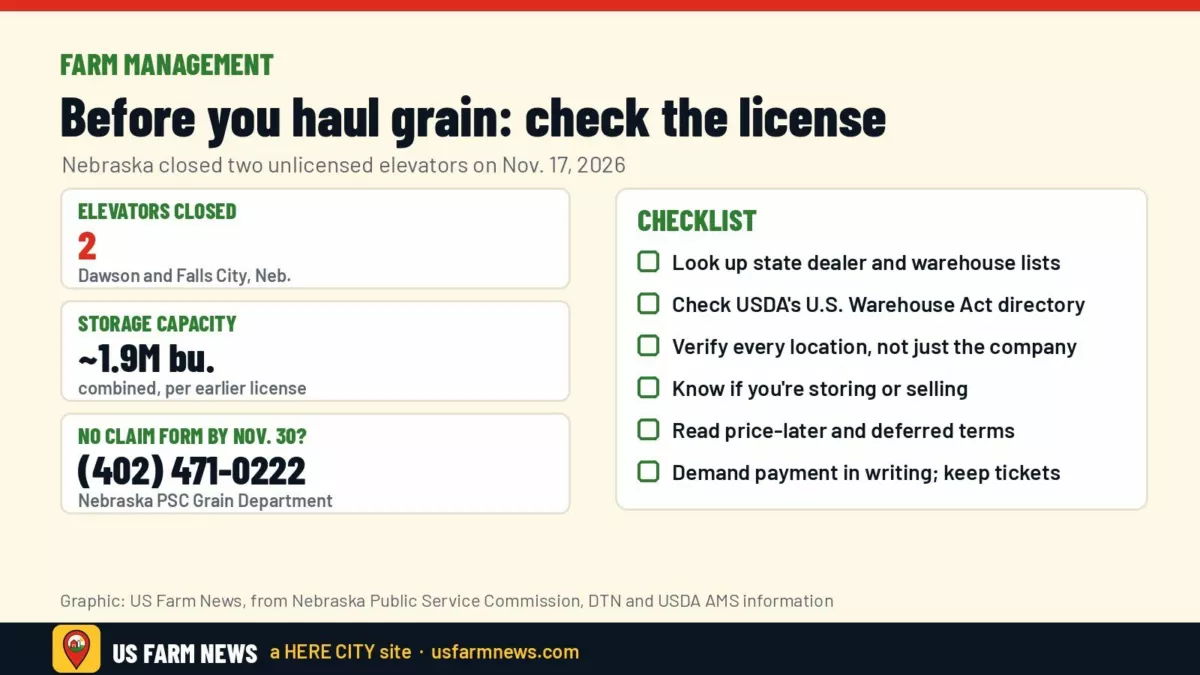
- Nebraska’s Public Service Commission on Nov. 17 closed Home City Grain’s elevators in Dawson and Falls City, saying the company stored grain without a required state or federal warehouse license.
- The commission took title to the grain and is mailing claim forms; if a Nebraska producer’s form hasn’t arrived by Nov. 30, the number to call is (402) 471-0222, the commission’s Grain Department.
- Before you store or sell, check the buyer against your state’s licensed dealer and warehouse lists and USDA’s U.S. Warehouse Act directory.
- Price-later and deferred-pricing contracts can carry less protection than a completed cash sale, so read the terms.
Nebraska regulators shut down two southeast Nebraska grain elevators this week, and the case is a timely reminder for any farmer who hauls grain to someone else’s bins: find out whether the buyer or warehouse is licensed before the first truck leaves the yard.
What happened in Nebraska
The Nebraska Public Service Commission (PSC) said on Nov. 18 that it had ordered Home City Grain Inc. to close its facilities in Dawson and Falls City the day before, after finding the company was acting as a grain warehouse in Nebraska without a license from the commission or from USDA. State law requires one of those licenses to take in grain for storage.
Under the order, the commission took title to the grain held at both sites, citing state statute, and said Nebraska farmers who hauled grain to the two sites would get claim forms by certified mail this week. Anyone still without a form on Nov. 30 can reach the commission’s Grain Department at (402) 471-0222, and forms can also be sent by email on request, the commission said. It also asked that questions not go to individual commissioners while the case is pending.
Home City Grain is based in Home, Kan., and runs locations there that fall outside the Nebraska commission’s reach and are not covered by the order. Kansas producers with grain at those sites were told to contact the Kansas Department of Agriculture.
The two elevators, formerly run by Salem Grain Co., have about 1.9 million bushels of combined storage capacity, based on an earlier license under the previous owner, DTN reported. DTN also said the PSC had opened a complaint against the company in December 2024 and dismissed it in January 2025, and that it had contacted the company’s owner for comment.
Why a license matters to your bottom line
A license is what puts a regulator, inspections and a financial backstop between you and a buyer that runs into trouble. In Nebraska, every licensed warehouse is inspected at least once a year, according to the PSC. Grain dealers must post security, such as a surety bond, letter of credit or certificate of deposit, scaled to their Nebraska business, with a statutory range of $35,000 to $1 million, which can cover valid producer claims. Applicants for both licenses also go through a criminal background check.
Rules differ by state, so the steps below are a general checklist rather than a summary of any single state’s law.
How to protect yourself: a checklist
1. Verify the license before delivery
- State lists. Nebraska posts current lists of licensed grain dealers and grain warehouses on the PSC Grain Department page (psc.nebraska.gov/grain). Other states run their own programs; for Kansas locations, the PSC pointed producers to the Kansas Department of Agriculture.
- Federal list. USDA’s Agricultural Marketing Service licenses warehouses under the U.S. Warehouse Act, a voluntary program, and offers a dashboard of federally licensed warehouses and facilities with Commodity Credit Corporation storage agreements. In Nebraska, the PSC said in September, federally licensed warehouses now need a state license too.
- Check every location. A company can be licensed in one state and not another, as the Nebraska case shows.
2. Know whether you’re storing or selling
Storage and sales are covered differently. Nebraska’s Supreme Court has held that a warehouse bond and a dealer bond can’t be combined because each covers a different activity, according to annotations to the state’s Grain Dealer Act. Keep warehouse receipts for stored grain and settlement sheets for sold grain, and make sure you know which one you’re holding.
3. Be careful with price-later and deferred-payment contracts
Nebraska’s updated Grain Dealer Act requires licensed dealers to pay within 10 business days after a written demand for payment that comes with proof of delivery, the PSC said in its 2026 harvest reminders. Deferred-pricing, price-later and similar contracts are an exception, since payment isn’t due until a later date.
That has consequences if something goes wrong. Under the statute, a seller holding that kind of contract generally can’t claim against the dealer’s security unless the payment had already come due before the commission started an administrative action. In plain terms, grain you’ve delivered but not priced or been paid for can sit in a weaker position.
4. Get paid, and keep paper
- Ask for payment in writing once a cash sale is complete, and keep scale tickets, receipts and contracts together.
- If payment is late, contact your state grain regulator quickly. Claim rights often depend on timing.
5. Compare the cost of storing at home
If you’re weighing commercial storage against your own bins, our grain storage cost-per-bushel guide walks through the math. For more practical guides, see our farm management section.
Frequently asked questions
What should Nebraska farmers with grain at Home City Grain do?
Watch for a claim form by certified mail. If nothing has arrived by Nov. 30, phone the commission’s Grain Department at (402) 471-0222; you can also request the form by email. Kansas producers should contact the Kansas Department of Agriculture.
How can I check whether a grain elevator is licensed?
Look up your state’s licensed grain dealer and warehouse lists, such as those on the Nebraska PSC Grain Department page, and check USDA’s U.S. Warehouse Act licensed warehouse dashboard.
Are price-later contracts protected by a grain dealer’s bond?
Not always. In Nebraska, sellers with deferred-pricing or price-later contracts generally can’t claim against the dealer’s security unless payment was already due before the commission took administrative action.
This article is general information, not legal, tax, or financial advice. Contact your state grain regulator or an attorney about your situation.
Get the Daily Ag Business Briefing
Markets, policy and farm business in one free email each weekday.