A HERE CITY site

Corn Groups Push for Ethanol in Ship Fuel, a Market NCGA Puts at 680 Million Bushels
Corn and ethanol groups want a fair IMO carbon score for U.S. ethanol. NCGA says today's methanol-ready ships could use 680 million bushels of corn a year.
Key takeaways
- National corn and ethanol organizations, joined by 21 state corn groups, asked the Trump administration to press the International Maritime Organization (IMO) to give U.S. corn ethanol a carbon rating that reflects farm conservation work.
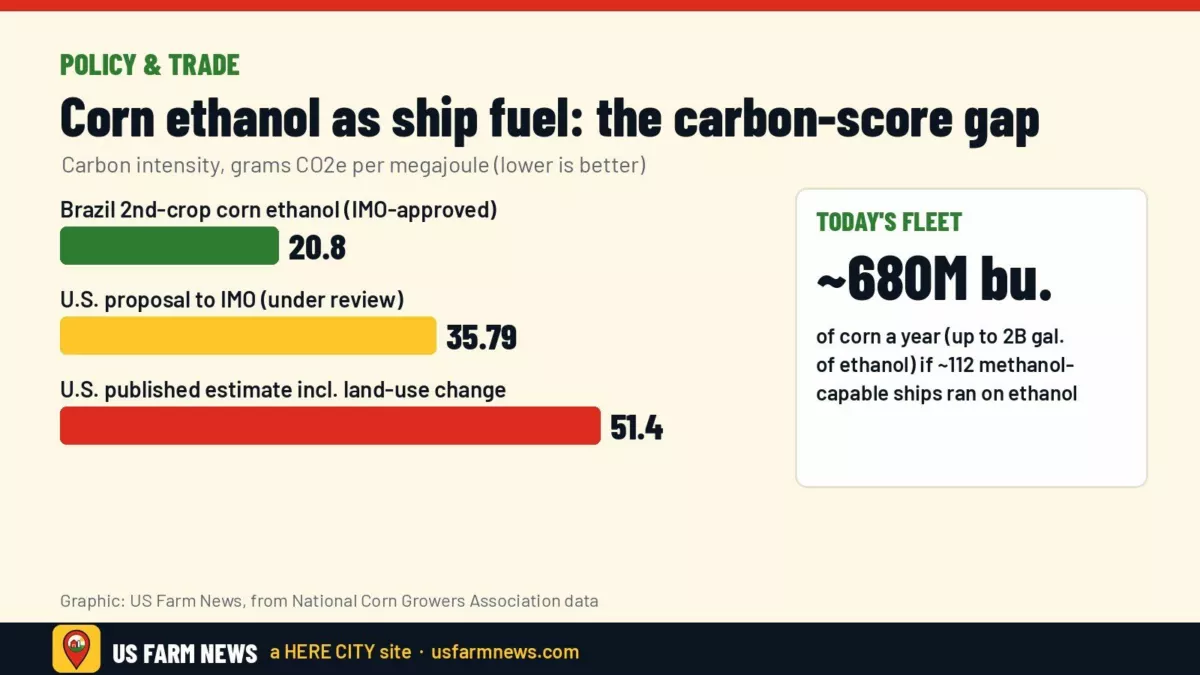
- NCGA estimates ships already able to burn methanol could use up to 2 billion gallons of ethanol a year, about 680 million bushels of corn.
- Brazil’s second-crop corn ethanol already has an IMO-approved score of 20.8 g/MJ; the U.S. proposal of 35.79 g/MJ is still under review, NCGA said.
- A score that credits farm conservation practices could decide whether U.S. ethanol can compete on cost.
Corn growers are making a pitch for a new market that would sit at the bottom of a cargo ship’s fuel tank. Growth Energy, the Renewable Fuels Association, the National Corn Growers Association (NCGA) and 21 state corn grower organizations sent a letter this week to the secretaries of state, agriculture and energy. It urges them to make U.S. corn ethanol a priority as the U.N.’s International Maritime Organization sets standards for low-carbon shipping fuels.
The size of the prize is what has farm groups paying attention. NCGA President Matt Frostic, a Michigan farmer, told Brownfield that marine fuel could give corn growers a new long-term source of demand at a time when they keep producing bigger crops and need more “grind” for them.
Why shipping, and why now
Shipping lines have been ordering vessels that can run on methanol, and those engines can burn ethanol with little or no modification, according to NCGA. The group counts about 112 methanol-capable ships in service, about 325 on order and roughly 700 more designed to be converted later.
- Today’s fleet: up to 2 billion gallons of ethanol a year if fully fueled with ethanol, or about 680 million bushels of corn, NCGA estimated.
- Longer term: as new ships come online, that could grow to 7.7 billion gallons, according to the NCGA estimate reported by Brownfield.
- Supply: NCGA said existing U.S. plants have roughly 2 billion gallons of unused capacity. The group pointed to USDA’s forecast that about 1.85 billion bushels of corn will be left over at the end of the 2026/27 marketing year.
For perspective, 680 million bushels would be more than a third of that projected carryout. The groups’ letter also points out that every gallon of ethanol comes with distillers grains for livestock feed.
The fuel has already been used at a U.S. port. On Sept. 28 in Houston, a Maersk container ship took on 100% U.S. corn ethanol from a barge in what NCGA described as the first ship-to-ship ethanol fueling of an ocean-going vessel at a U.S. port. POET made the ethanol, Kirby Corp. moved it by barge and the port coordinated the transfer.
The sticking point: a carbon score
The IMO is building a system that would make lower-emission fuels more financially attractive, so buyers will weigh both a fuel’s price and its carbon-intensity score. A fuel without a recognized score could have trouble competing however cheap it is, NCGA warned.
That’s where Brazil has a head start. IMO has approved a score of 20.8 grams of CO2-equivalent per megajoule for Brazil’s second-crop corn ethanol. The score the U.S. proposed in September, 35.79 g/MJ, is still under review, according to NCGA. A widely cited published estimate that includes land-use change puts U.S. ethanol at 51.4 g/MJ.
NCGA’s analysis says U.S. ethanol was cheaper per gallon than Brazil’s on the dates it compared, and that the lower U.S. price can offset some of Brazil’s scoring advantage. Its numbers show that using the U.S.-proposed score, U.S. ethanol would cost slightly less per metric ton of carbon dioxide cut at October prices. Without an approved score, the market may reward Brazil’s lower number instead. The group also said U.S. ethanol rose from about $1.99 to $2.21 a gallon between June and October, which made it costlier relative to conventional ship fuel.
The coalition wants the score to recognize conservation practices that farmers are already using. In the letter, the groups wrote that any replacement for the IMO’s Net-Zero Framework “should not exclude U.S. agricultural feedstocks.” They also asked the administration to keep USDA experts involved in the U.S. delegation and to support port infrastructure for ethanol fueling.
What it means for your farm
Nothing here changes corn prices this week. But if IMO recognizes a fair U.S. score, ethanol could gain a new outlet for corn that, by NCGA’s math, starts at hundreds of millions of bushels a year, and it would reward the same low-carbon farming practices that already matter for the 45Z clean fuel credit. If you’re tracking practice-based premiums, see our guide to 45Z and low-carbon corn and our report on the fight over 2027 Renewable Fuel Standard waivers.
What to watch
- IMO meetings: more sessions on the Net-Zero Framework are coming up in the next few weeks, according to Brownfield.
- U.S. score review: whether IMO accepts the 35.79 g/MJ U.S. proposal or a different number.
- Port investment: whether more U.S. ports follow Houston with ethanol fueling.
Get the Daily Ag Business Briefing
Markets, policy and farm business in one free email each weekday.