A HERE CITY site

Farm Payments Could Fall 49% in 2027: How to Build a Cash-Flow Plan That Doesn’t Count on Aid
FAPRI projects federal farm payments falling from $42.3 billion to $21.5 billion in 2027. Here's how to build a 2027 cash-flow plan for smaller checks.
Key takeaways
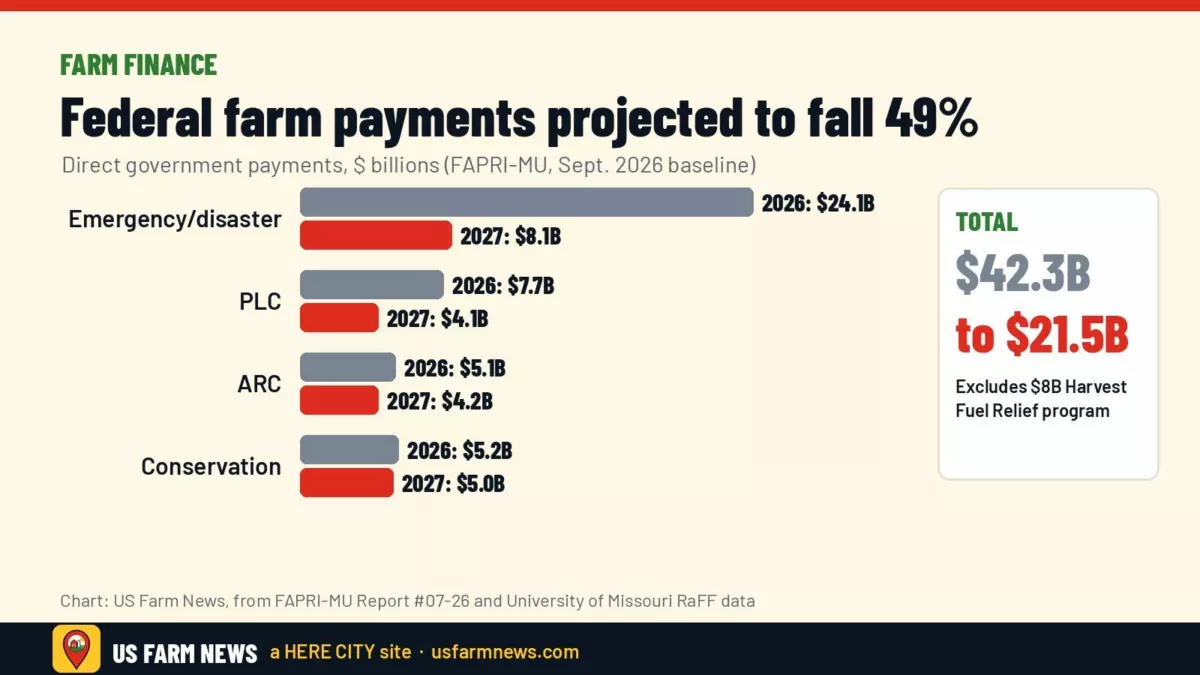
- University of Missouri economists project direct government payments to farms sliding to $21.5 billion in 2027 from $42.3 billion this year, a drop of about 49%.
- Most of the cut is emergency and ad hoc aid, which FAPRI projects shrinking to $8.1 billion next year versus $24.1 billion in 2026; ARC and PLC payments also shrink.
- Even if USDA’s $8 billion Harvest Fuel Relief program is added, 2027 payments would still be about 32% lower, RAFF director Alejandro Plastina told Farm Progress.
- Below: a step-by-step way to build a 2027 cash-flow plan that doesn’t count on this year’s aid repeating.
If your 2026 cash flow balanced because of a government check, plan for 2027 as if that check will be a lot smaller. That is the message from the University of Missouri’s farm policy economists, whose latest outlook shows federal payments to farms dropping by roughly half next year.
The Food and Agricultural Policy Research Institute at the University of Missouri (FAPRI-MU) projects total direct government payments of $21.47 billion in calendar 2027, down from $42.33 billion in 2026. Alejandro Plastina, who directs the university’s Rural and Farm Finance Policy Analysis Center (RaFF), told Farm Progress this week that he “would build cash-flow plans around lower assistance payments.”
This article is general information, not legal, tax, or financial advice. Talk with your lender, accountant or farm financial adviser about your own operation.
Where the drop comes from
FAPRI’s September baseline update assumes Congress approves no new ad hoc assistance after 2026, beyond what USDA can fund through Commodity Credit Corporation transfers. Under that assumption, the biggest change is in emergency and disaster money. The farm policy center’s table breaks the 2027 payment total down this way:
- Emergency and disaster payments: $24.14 billion in 2026, falling to $8.08 billion in 2027
- Price Loss Coverage (PLC): $7.65 billion, falling to $4.14 billion
- Agriculture Risk Coverage (ARC): $5.09 billion, falling to $4.17 billion
- Conservation programs: $5.25 billion, slipping to $4.96 billion
Combined ARC and PLC payments shrink as crop prices improve, FAPRI said, although the drop is softened by the expansion of up to 30 million base acres in the 2025 law known as the One Big Beautiful Bill Act.
There is some good news in the same outlook. FAPRI expects crop receipts to climb to $261.9 billion in 2027 from $254.5 billion, and livestock receipts to rise to $294.1 billion from $290.4 billion. But cash expenses are projected to inch higher again, to $465.0 billion from $461.5 billion, after a big jump in 2026 driven by fuel and fertilizer. Net farm income slips only modestly, to $153.3 billion from $155.3 billion, in FAPRI’s projection, but net cash income falls further, to $163.1 billion from $172.9 billion.
The national totals don’t include USDA’s $8 billion Harvest Fuel Relief program, announced Oct. 19, because payment rates weren’t available when the outlook was prepared, RaFF noted. Plastina told Farm Progress that adding the full $8 billion would still leave 2027 payments about 32% below 2026. (See our earlier report on how Harvest Fuel Relief payments are expected to work.)
Why the state picture can look different
RaFF’s fall outlook for Missouri shows how much a state result can move. Net farm income there is projected to rise to $5.13 billion in 2026 from $4.61 billion in 2025, then fall to $4.85 billion in 2027. Plastina told Farm Progress that falling government payments are the main reason for the 2027 decline. In a hypothetical case where Missouri received about $320 million from the fuel relief program, based on its roughly 4% share of an earlier aid program, he estimated state net farm income would rise 0.6% next year instead of falling 5.5%. He stressed that figure is not a confirmed allocation.
Your farm’s mix matters just as much. A crop farm that collected large ad hoc and PLC checks in 2026 will likely feel the change more than a cattle operation, given the record cattle prices FAPRI describes.
How to build a 2027 cash-flow plan for smaller payments
Oklahoma State University Extension’s guide to developing a cash flow plan lays out the basic method: project the amount and timing of every dollar coming in and going out, usually month by month, then find the months where you’ll need to borrow and the months you can pay down debt. Here is how to apply that to next year.
1. Start from what actually happened in 2026
Pull this year’s real numbers from your records, tax forms or bank statements. The OSU guide suggests filling in last year’s actual totals first, as a reasonableness check on next year’s estimates. Mark each 2026 government payment on its own line: ARC or PLC, ad hoc aid, disaster money and conservation contracts.
2. Budget government payments conservatively
Don’t copy 2026 aid into 2027. Include only payments you can reasonably expect, such as ARC/PLC estimates for your base acres and signed conservation contracts. Treat any further ad hoc help as upside, not as a line you’re counting on to pay bills. If you haven’t made your 2027 program choice yet, our ARC/PLC sign-up checklist can help.
3. Put sales in the months you’ll actually sell
Enter crop and livestock sales when the cash arrives, not when the crop is grown. The OSU guide notes that only cash transactions belong in the plan. If you’re storing 2026 bushels into next year, put them in the months you plan to deliver.
4. Enter expenses when you pay them
Fertilizer, fuel, seed, cash rent, labor and repairs go in the months the checks clear. Prepaid inputs bought this December belong in 2026, not 2027.
5. Add debt payments, capital purchases and family living
Use your loan schedules for principal and interest due dates, add any planned machinery or building purchases, and include family living withdrawals and taxes. The OSU guide recommends talking with your lender about how new term loans would be structured.
6. Find the gaps and test the plan
Running a monthly total shows when your cash balance dips below your minimum and how much line of credit you’ll need. If the plan can’t cover operating costs, debt payments, taxes and family living without a growing operating loan balance at year’s end, OSU says that signals a liquidity problem. Its suggested fixes include changing the production plan, trimming family living, delaying a machinery purchase or refinancing debt. Run the plan again with lower prices or yields to see how much cushion you have.
7. Take it to your lender early
Lenders use cash-flow plans to set operating lines. Pair it with a current balance sheet; our year-end balance sheet guide covers what bankers look for.
What to watch
- Harvest Fuel Relief: USDA payment rates and timing, which would change the 2027 outlook.
- Farm bill: any lame-duck bill or year-end package that adds aid or changes program payments.
- Dec. 10: USDA’s next WASDE, which feeds price expectations for ARC and PLC.
Frequently asked questions
How much are farm payments expected to drop in 2027?
FAPRI-MU projects direct government payments falling from $42.33 billion in 2026 to $21.47 billion in 2027, about 49%, mostly because it assumes no new ad hoc aid.
Does the projection include Harvest Fuel Relief?
No. RaFF said payment details weren’t available. Plastina told Farm Progress that adding the full $8 billion would still leave 2027 payments about 32% lower than 2026.
What should I change in my 2027 cash-flow plan?
Budget only the payments you can reasonably expect, time sales and expenses by when cash actually moves, and test the plan at lower prices before you meet your lender.
Get the Daily Ag Business Briefing
Markets, policy and farm business in one free email each weekday.